
Island Nations Underwater: Climate Change and the Existential Threat to Kiribati and Tuvalu
An island is a terrestrial geographical feature that is entirely surrounded by water. Three types of islands can be identified: (1) Continental islands are land features that are part of a continental shelf. These islands tend to be larger in size, with Borneo and Sicily as two prominent examples. (2) Volcanic islands are land features formed through volcanic activity and are generally not connected to continental shelves. The Hawaiian Islands and Saint Helena are two examples of this type of island. (3) Coral islands are relatively small clusters of islands located in tropical regions of the world’s oceans. They form as coral polyps, and their skeletons replace the original volcanic island that slowly vanished due to erosion. These small islands are most vulnerable to rising sea levels.
On many small islands around the world, rising seas are everyday news, and global warming is on everyone’s lips. Sea-level rise provoked by global warming could imperil more than 3,000 small isolated islands, grouped into twenty-four political entities in the Pacific Ocean, with a population of about five million people in 800 distinct cultures. Many coral atolls also contain permanent areas of freshwater (lagoons), which are vulnerable to salinization as sea levels rise.
In no other place is global warming more urgent an issue, in a practical sense, than in equatorial Kiribati (pronounced “Kirabas”), a chain of coral atolls in the Pacific, near the Marshall Islands. Kiribati is a republic, a member of the United Nations, and home to about 79,000 people. Its land area, at any point, is no more than 2 meters above sea level.
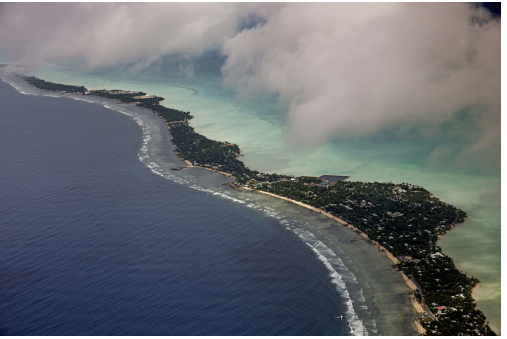
Tarawa atoll, Kiribati. The capital of Kiribati is Tarawa atoll, which lies in the center of the Gilbert chain. Seen from the air, Tarawa appears as a narrow strip of land in the middle of the ocean. The people of Kiribati are under pressure to relocate due to sea-level rise caused by global warming (Jonas Gratzer/LightRocket via Getty Images).
Additionally, the living corals that have raised the islands above sea level are threatened with demise by warmer ocean waters. Ierimea Tabai, who became president of Kiribati after its independence from Britain in 1979, has said that “[i]f the greenhouse effect raises sea levels by one meter, it will eventually do away with Kiribati. In fifty or sixty years, my country will not be here” (Webb 1998).
Kiribati’s thirty-three islands, comprising 277 square miles, are scattered across 5.2 million square kilometers (2 million square miles) of ocean, including three groups of islands: seventeen Gilbert Islands, eight Line Islands, and eight Phoenix Islands. Kiribati includes Kiritimati (formerly Christmas Island), the world’s largest coral atoll (150 square miles). The islands of Kiribati, located roughly halfway between California and Australia, more than doubles in surface area at low tide.
The Alliance of Small Island States (AOSIS), including the Philippines, Jamaica, the Marshall Islands, the Bahamas, Samoa, and others, has offered a strident voice at climate talks favoring swift, worldwide reductions in greenhouse gas emissions. Their self-interest is evident: with warming already “forced,” but not yet fully worked into the world’s temperature equilibrium, many small island states will lose substantial territory and economic base within the next few decades. For every other country on Earth, competing economic interests drive climate negotiations. For the small island nations, the driving force is survival.
“For us, it’s a matter of death and life, whereas in terms of the citizens of the industrialized countries, [global warming] will affect their lifestyles basically, but not to the extent they will be disappearing,” said Bikenibeu Paeniu, Tuvalu’s prime minister (Webb 1998).
During 1997, the area was devastated by El Nino, which brought heavy rainfall, a halfmeter rise in sea level, and extensive flooding. About 40 percent of the atolls’ coral were killed by overheated water, and nearly all of Kiritimati Island’s roughly fourteen million birds died or deserted the island. During February 2009, President Anote Tong of Kiribati sought international aid to move the island nation’s 100,000 people to a new homeland. He asked for an international fund that would buy land for the migration and supplement their own funds. Many Kiribatians may migrate to New Zealand.
Many of these islands face two compounding problems: the sea is rising while the land itself is slowly sinking, as 65-million-year-old coral atolls reach the end of their life spans. The atolls were formed as formerly volcanic peaks sank below the ocean’s surface, leaving rings of coral. For five years, the government of Tuvalu has noticed many such troubling changes on its nine inhabited islands and concluded that, as one of the smallest and lowest-lying countries in the world, it is destined to become among the first nations to be sunk by a combination of global warming-provoked sea-level rise and slow erosion. The evidence before their own eyes, including forecasts for a rise in sea level of as much as 88 centimeters during the twenty-first century by international scientists, has, according to Barkham’s report, convinced most of Tuvalu’s 10,500 inhabitants that rising seas and more frequent violent storms are certain to make life unlivable on the islands, if not for them, then for their children.
Tuvalu: Soon a Digital Rather than an Island Nation? Tuvalu, a collection of less than ten islands in the South Pacific, became independent from Great Britain in 1978. Its roughly 11,000 inhabitants congregate on 26 square kilometers (or about 10 square miles). Climate change and rising sea levels have doomed the future of this nation, which has the highest elevation of 4.6 meters (or 15 feet). The increasing tides erode Tuvalu’s coastlines and greatly infiltrate the potable water lens that sustains life on the islands.
To avoid the physical erasure of the land, the nation’s parliament amended its constitution in October of 2022 to maintain sovereignty and maritime zones even if all of Tuvalu disappears under the waves. In addition, Tuvalu is now well on its way to becoming the first digital nation by creating a clone of itself on the internet through the Future Now Project. The Tuvaluan government also struck a deal with Australia to protect its citizens from the ravenous tides. The Australian government vowed to allow 280 Tuvaluans to reach their shore each year, requiring more than a generation to relocate all the inhabitants. However, this deal came at a price. To prevent China’s increasing encroachment on the Pacific, Australia ensured that Tuvalu remained one of the last international supporters of Taiwan. Rainer F. Buschmann
More than 1,000 Marshall Islands on twenty-five coral atolls in the South Pacific by 2015 were eroding into a gradually rising ocean that regularly flooded many towns during high-tide cycles, inundating crops with salty water. Only the occasional bluff is more than 6 feet in elevation, even at low tide. Changing trade winds have raised sea levels a foot in thirty years (more during tidal cycles), with more expected. Damage was clearly evident in daily life.
As Coral Davenport wrote in The New York Times in 2015:
Linber Anej waded out in low tide to haul concrete chunks and metal scraps to shore and rebuild the makeshift sea wall in front of his home. The temporary barrier is no match for the rising seas that regularly flood the shacks and muddy streets with saltwater and raw sewage, but every day except Sunday, Mr. Anej joins a group of men and boys to haul the flotsam back into place.
Davenport continued:
In neighborhoods like Mr. Anej’s, after the sewage-filled tides wash into homes, fever and dysentery soon follow. On other islands, the wash of saltwater has penetrated and salinated underground freshwater supply. On Majuro [the islands’ capital], flooding tides damaged hundreds of homes in 2013. The elementary school closed for nearly two weeks to shelter families. That same year, the airport temporarily closed after tides flooded the runway.
Cemeteries near the ocean are being washed away.
FURTHER READING: Barkham, Patrick. 2002. “Going Down: Tuvalu, a Nation of Nine Islands—Specks in the South Pacific—Is in Danger of Vanishing, a Victim of Global Warming. As their Homeland is Battered by Ferocious Cyclones and Slowly Submerges under the Encroaching Sea, What will become of the Islanders?” London Guardian, February 16, p. 24.
Davenport, Coral. 2015. “The Marshall Islands Are Disappearing; Rising Seas Are Claiming a Vulnerable Nation.” The New York Times, December 2. http://www.nytimes.com/interactive /2015/12/02/world/The-Marshall-Islands-Are-Disappearing.html. Accessed March 14, 2018.
Kristof, Nicholas. 1997. “For Pacific Islanders, Global Warming Is No Idle Threat.” The New York Times, December 1, K9.
Webb, Jason. 1998. “Small Islands Say Global Warming Hurting them Now.” http://bonanza.lter .uaf.edu/~davev/nrm304/glbxnews.htm. Accessed December 20, 2002.
Date added: 2026-02-14; views: 352;