
Assessing and Mitigating Threats to Soil Biodiversity: A Scientific Analysis
Growing scientific concern surrounds the potential decline of soil biodiversity, despite a paucity of long-term data specifically documenting this trend. It is an established fact that planetary biodiversity is diminishing at rates orders of magnitude above background extinction levels due to anthropogenic activities. However, the status of the immense diversity of soil organisms remains largely obscured. Given the accelerated extinction rates observed in macrofauna like mammals and amphibians, it is a logical and pressing assumption that similar losses are occurring within soil ecosystems. The relatively nascent disciplines of soil ecology and soil biology contribute to this data gap, as comprehensive historical records for soil biota are limited.
Emerging evidence, however, points to significant declines. In several European nations, fungi populations show alarming decreases. For instance, The Netherlands documented a 65% reduction in mushroom species over two decades. Similarly, Switzerland's Federal Environment Office has published a "Red List" identifying 937 fungal species at risk of national extinction. Furthermore, invasive species are a demonstrated driver of soil biodiversity loss. In North American hardwood forests, the invasive garlic mustard plant severely reduces populations of beneficial arbuscular mycorrhizal fungi (AMF). In the United Kingdom, the New Zealand flatworm (Arthurdendyus triangulatus) poses a major threat to native earthworm communities. These specific threats are explored in greater detail in Section 5.1.2.
A foundational step for conservation is achieving sufficient knowledge of soil biodiversity's current state, distribution, and the pressures it faces. The DPSIR framework (Driving Forces-Pressures-State-Impacts-Responses), illustrated in Figure 5.1, provides a robust model for this evaluation. This framework systematically analyzes environmental problems: socio-economic Driving Forces propel human activities that create environmental Pressures. These pressures alter the State of the environment, leading to Impacts, which in turn elicit societal Responses. Originally conceptualized for global biodiversity assessment, this framework is applied here specifically to soil biodiversity.
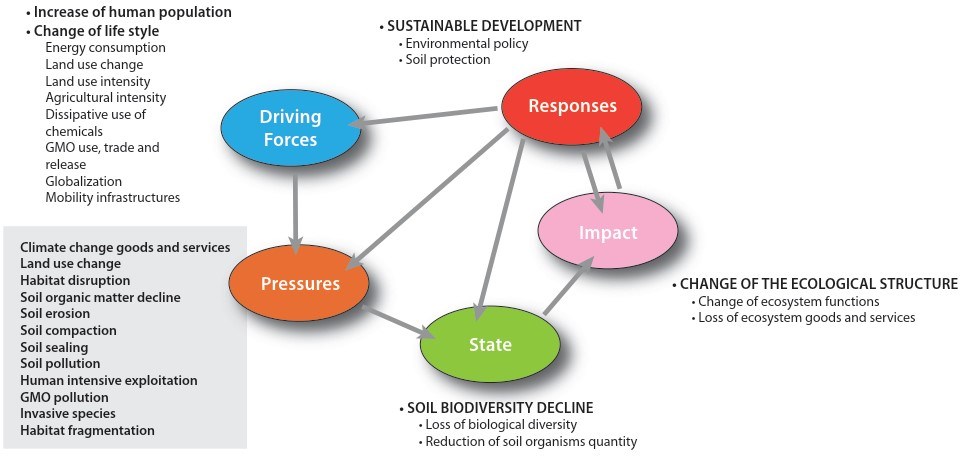
Fig. 5.1: Driver Pressure State Impact Responses framework applied to soil biodiversity
For Europe, primary anthropogenic pressures have been categorized across three hierarchical levels of biodiversity. At the ecosystem level, key pressures include land use change, overexploitation, and alterations to climatic, hydrological, and geochemical regimes. At the species level, main threats arise from changing environmental and geochemical conditions, competition with invasive species, and exposure to ecotoxins. At the most fundamental genetic level, pressures stem from environmental changes, ecotoxins, and "genetic pollution" from engineered or exotic genes.
Some pressures significant for above-ground biodiversity are less critical for soil organisms at typical spatial scales. Habitat fragmentation, while theoretically detrimental, often operates at scales irrelevant to soil biota with their small sizes and limited migration. Experimental evidence exists for effects at the centimeter scale, but this is disconnected from real-world fragmentation dimensions. Crucially, any process causing soil degradation or physical soil loss inherently threatens its biological diversity. Figure 5.1, based on the DPSIR approach, synthesizes these main pressures and their driving forces.
To quantify these threats, an expert evaluation was conducted. A soil biodiversity expert working group convened at the European Commission's Joint Research Centre (JRC). Using a structured questionnaire, twenty experts assigned a severity weighting (1-10) to each identified threat. Individual scores were summed and calculated as a percentage of the maximum possible score (200) to mitigate subjective bias from individual backgrounds. The results are presented in Figure 5.2. This survey addressed a core difficulty in soil biodiversity assessment: the subjectivity and lack of extensive empirical data in this emerging research field.
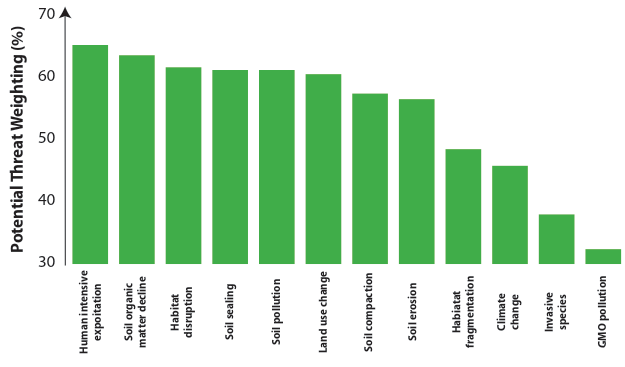
Fig. 5.2: The potential threat weighting given to a selection of possible threats to soil biodiversity by the Expert Working Group at the JRC on 2nd March 2009.
Fundamental knowledge gaps persist for most soil species regarding their precise ecological functions, resilience to pressure, biotic interactions, and spatial distribution within the soil matrix. Quantifying current baselines is challenging but vital for assessing future impacts. Complicating evaluation further is the concept of functional redundancy, where ecosystem processes may persist despite reduced species diversity, masking the true impact of a threat (see Section 4.1). This makes quantifying the effect of any single pressure on overall soil system functionality exceptionally difficult.
The culmination of this expert analysis was the creation of a Soil Biodiversity Potential Threats map. This visual tool, described in its caption on page 62 (Section 5.2), synthesizes expert judgment to highlight geographic areas of greatest concern. It represents a critical step in translating scientific understanding into a format usable for targeted policy and conservation responses, guiding efforts to preserve the essential yet vulnerable biodiversity beneath our feet.
Date added: 2025-12-15; views: 681;