
The Economic Commodity of Soil Biodiversity: Insurance, Productivity, and Valuation Challenges
From an economic standpoint, biodiversity is valued for its association with useful traits and services. Economists increasingly view biodiversity as a commodity due to specific, valuable qualities it provides. These include its role as insurance for future services, its enhancement of ecosystem productivity, its direct provision of welfare-enhancing services, and its function as a source of knowledge. This framework allows for a structured analysis of its contribution to economic systems and human well-being, moving beyond abstract ecological concepts to tangible benefits.
A primary economic quality is insurance in respect to future services. Genetic diversity acts as a safeguard, where genes from non-commercial species may provide resistance to diseases affecting major crops. More broadly, functional diversity within ecosystems, including soil, enhances ecosystem resilience and resistance to shocks. This resilience minimizes risks of catastrophic welfare losses from exogenous or anthropogenic disturbances, representing a significant insurance value. Quantifying this is challenging, requiring the link between biodiversity levels, critical thresholds of service provision, and the concept of "resilience stock." The economic value of resilience can be estimated as the shadow price of a change in this stock, calculated from the expected loss avoided by a reduced probability of a systemic flip to an undesirable state.
Secondly, biodiversity leads to enhanced ecosystem productivity. Empirical studies consistently link greater plant functional diversity to higher primary productivity. This principle extends belowground, where soil biota drive services like nutrient cycling and pathogen repression that directly enhance agricultural yield. The economic gains from these productivity boosts are substantial, though precisely quantifying the contribution of soil biodiversity levels remains a key research challenge. The genetic material within diverse systems has already been instrumental in plant breeding and yield increases over recent decades.
Thirdly, biodiversity is responsible for enhanced ecosystem services with diffuse welfare benefits. For instance, soil microbial activity contributes to pollution attenuation, reducing water contamination and associated public health costs. While economically beneficial, these services operate at landscape or regional scales, making it difficult to isolate and value the specific marginal contribution of soil biodiversity. The benefits are public goods, accruing beyond individual land managers, which complicates market-based valuation and investment in conservation.
The fourth quality is knowledge, referring to biodiversity's role as a genetic library for biotechnology and pharmaceuticals. While the aggregate value of drugs and crops derived from genetic resources is enormous (e.g., billions annually), this does not guide conservation funding well, as it violates the marginality principle. Valuing a marginal species for bioprospecting involves calculating the probability it yields a unique, marketable product not substitutable by other species. Given vast species redundancies, this marginal value is often calculated to be extremely low—less than 0.1 cents per species. The potential supply of genetic leads likely exceeds industry demand, further depressing the market price.
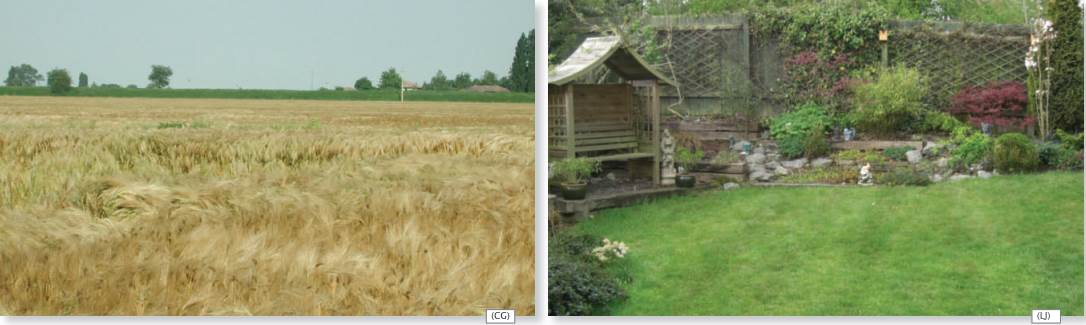


Fig 4.25: As this section has made clear, while clearly of vital importance, the valuing of soil biodiversity and its associated ecosystem services is as complicated and difficult as the many and varied uses to which soil is put. Whether it be growing crops (top left), the aesthetic value of urban gardens (not to mention the value of urban gardens in conservation of both above and below ground species; top right), use for sport and recreation (middle), or as a platform on which to build houses, roads and other infrastructure vital to the efficient functioning of our towns and villages (bottom)
Therefore, the economic argument for conserving soil biodiversity cannot rely primarily on its pharmaceutical value. Instead, it must be based on its indispensable role in sustaining ecosystem services of near-infinite value to society, such as food and timber production. The economic value of these wider, well-documented services—which are underpinned by soil biota—is often sufficient to justify conservation investments. This integrative perspective is championed by initiatives like "The Economics of Ecosystems and Biodiversity" (TEEB), a major UNEP-led study. As noted in Fig. 4.25, protecting soil and its biodiversity makes economic sense when considering these foundational ecosystem services. TEEB aims to integrate ecological and economic knowledge, recommend valuation methods, analyze costs of biodiversity loss, and develop policy toolkits to foster sustainable development and conservation. Its findings and reports are accessible via http://www.teebweb.org.
Date added: 2025-12-15; views: 439;