
Biostratigraphy, Unconformities, and Sequence Stratigraphy in Earth History
Biostratigraphy is the branch of stratigraphy that uses fossil assemblages and index fossils to correlate and assign relative ages to strata. Index fossils are employed to identify and define geological periods or faunal stages. Ideal index fossils are short‑lived, have broad geographic distribution, and are easy to identify. Most good index fossils are floating or swimming organisms that live independently of the bottom environment; many have floating larval stages dispersed by currents, or seeds and spores blown by the wind, and they evolve rapidly.
In contrast, some organisms are restricted to certain sedimentary facies and can indicate the paleoenvironment but not necessarily the age of the strata. A fossil zone is an interval of strata characterized by a distinctive index fossil or fossil assemblage. These index fossils and fossil zones have the same age on a global scale, allowing geologists to correlate strata from continent to continent and reconstruct the state of the globe at any interval in Earth’s history.
The distribution and changes in the fossil record are controlled both by the evolution and extinction of index fossils and by changing environmental conditions (facies) that may cause organisms to migrate to new habitats. Environmental changes are usually short‑term compared with extinctions, and the two effects are easily distinguished. Fossil zones do not necessarily correspond to formation boundaries.
Unconformities and Gaps in the Historical Geological Record. Unconformities are regional surfaces that extend over large distances and represent periods of time missing from the geological record at a given location. To interpret unconformities and understand their meaning for regional and global history, it is essential to determine how much time is missing and whether the missing stratum was once present and later eroded or was never deposited. Unconformities are classified into three major types.
Angular unconformities separate deformed and tilted rocks below from a new sequence of flat‑lying rocks above (which can later be deformed). Regional angular unconformity surfaces indicate a major deformation event, typically an orogenic (mountain‑building) episode, that occurred between the deposition of the lower and upper rock sequences. The age of the unconformity is generally the approximate age of that mountain‑building event.
Disconformities represent periods of nondeposition or erosion but have no angle between the lower and upper rock sequences. Disconformities are often harder to recognize than angular unconformities, and prior knowledge of the stratigraphic sequence, biostratigraphic zones, or geochronologic data is typically required to establish their existence. Nonconformities are boundaries where sedimentary strata are laid down upon underlying igneous or metamorphic strata, usually during a marine transgression. Long time gaps—often hundreds of millions or even billions of years—may be present along nonconformity surfaces.
Unconformity‑Bound Sequences. Understanding of stratigraphy underwent a major change in the 1950s when American geologist Laurence L. Sloss (1913‑1996) proposed the concept of sequence stratigraphy. Sloss and many colleagues recognized numerous large, laterally extensive rock units that they named sequences, which are bounded by unconformities of global significance. Some of these unconformities are so significant that they are found in almost all shallow‑water deposits of that particular age worldwide.
Studies revealed that these unconformities always occur where sea level has dropped from high to low, and the overlying sequence is always transgressive. Sloss and coworkers used index fossils to show that these unconformities have the same age on all continents and are clearly related to changes in sea level. Sea level has been as much as 1,200 feet (350 m) higher than present and as much as 650 feet (200 m) lower than present. By correlating different unconformity‑bound sequences across continents, Sloss and his team produced curves showing the relative height of the sea for the past 600 million years of Earth history.
The simple, slow rise and fall of sea level through geologic time produces unconformity‑bound sequences. When sea level is high, sediments accumulate on the continental shelf; when sea level falls, the shelf is exposed and eroded, and sediments move off the shelf, generating an unconformity. When sea level rises again, the new sequence is transgressive and is deposited unconformably over the eroded shelf.
The history of the Earth and its life‑forms has been reconstructed largely from the stratigraphic record, correlating events such as sea‑level changes across continents using index fossils, fossil zones, geochronology, the magnetic polarity timescale, geochemical timescales, and plate reconstructions based on paleomagnetism, paleoclimate, and paleoenvironmental data. From this evidence, geologists have pieced together a robust history of the planet, though much remains to be learned and debated by future generations.
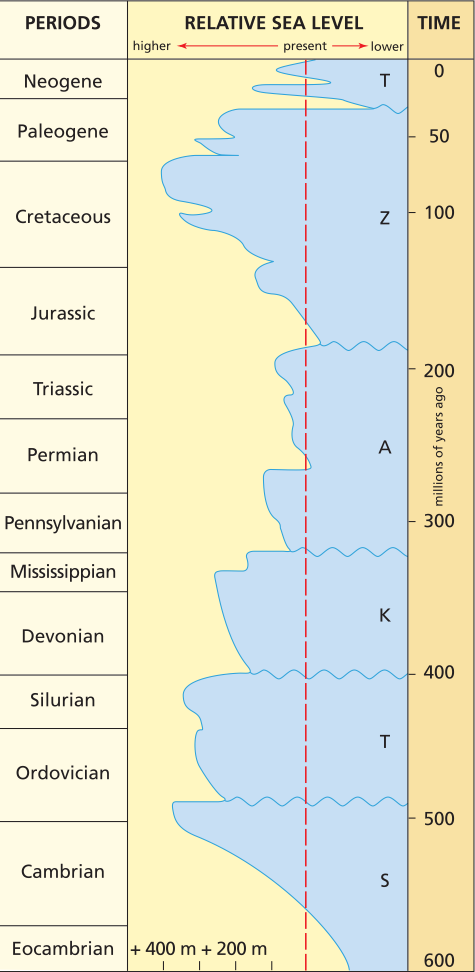
Sea-level curve showing the global average sea-level height through Phanerozoic geologic time, along with the six main unconformity bounded sequences deposited during transgressive and sea level high–stands. These sequences include the Sauk (S), Tippicanoe (T), Kaskasia (K), Absaroka (A), Zuni (Z), and Tejas (T) sequences
Biogeography and Paleogeography. Biogeography is the study of the geographic distribution of plants and animals, whereas paleogeography examines the past distribution of plants, animals, landmasses, mountains, basins, and climate belts. The distribution of organisms can be explained by one of two general theories. The dispersal theory states that a specific group of organisms originated at an initial center spot and radiated outward, with specific lineages evolving as they migrated. An alternative model, vicariance biogeography, proposes that initially primitive groups were widely distributed and were later broken up by processes such as rifting and divergent plate tectonics, leading to evolution in isolated groups. Both models have been shown to explain species distribution in different cases.
In the following sections, the principles of historical geology and stratigraphy are applied to discuss a brief history of the planet Earth and its life, focusing mostly on North America and events that affected that continent, with examples from around the world as appropriate.
Precambrian Geologic History. The oldest rock record on Earth belongs to the Precambrian, which includes all rocks formed before 543 million years ago and represents about 80 percent of Earth’s history. The Precambrian is divided differently in various parts of the world. The youngest period of the Precambrian is the Ediacaran (also known as the Vendian, and in China as the Sinian), ranging from 650 to 543 million years ago; it is named after the Ediacaran Hills in Australia, where fossils from this age are exceptionally well preserved.
The Ediacaran was preceded by the Proterozoic, from 2,500 million to 650 million years ago, subdivided into the Paleoproterozoic (2.5–1.6 Ga, or billion years ago), the Mesoproterozoic (1.6–1.0 Ga), and the Neoproterozoic (1.0 Ga–543 Ma)—equivalent in some usages to the early, middle, and late Proterozoic. The Proterozoic was preceded by the Archean, from 2.5 billion years ago to the age of the oldest known rocks (currently 4.2 Ga). The Archean was preceded by the Hadean, the time from which no preserved geological record exists.
Date added: 2026-04-26; views: 355;