
Groundwater: Aquifers, Movement, and Sustainable Resource Management
Groundwater encompasses all water contained within spaces in bedrock, soil, and regolith. The volume of groundwater is 35 times greater than the volume of freshwater in lakes and streams, yet overall this water accounts for less than 1 percent of the planet’s total water supply. Much of the world’s population obtains freshwater from the groundwater system, either by pumping water from beneath the surface or by pulling buckets from wells dug into the ground. Any body of rock or unconsolidated sediment that can hold and transmit water is known as an aquifer, whereas units that restrict water flow are termed aquitards.
Groundwater originates from rainfall and surface flow, seeping into the ground and slowly migrating downhill toward the sea. Water exists everywhere beneath the ground surface, with most occurring within 2,500 feet (750 m) of the surface. The total volume of groundwater is estimated to be equivalent to a layer 180 feet (55 m) thick spread evenly over the Earth’s land surface. The distribution of water in the ground can be divided into the unsaturated zone and the saturated zone. The top of the water table is defined as the upper surface of the saturated zone; below this surface, all openings are completely filled with water.
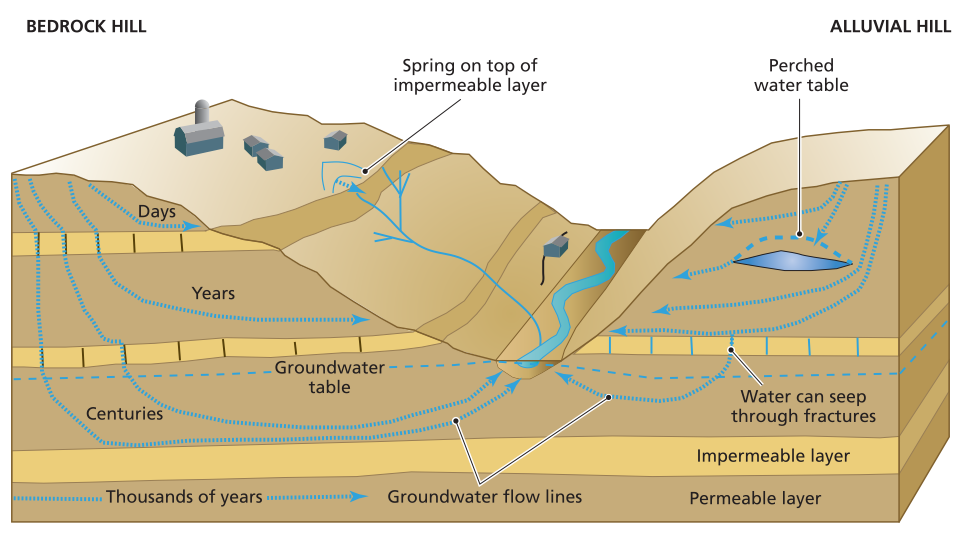
Schematic diagram of the groundwater system. Water enters the system on hillslopes and emanates lower on hills as springs and in effluent streams
Increasingly, groundwater is being used for purposes beyond drinking or watering plants and animals. Water possesses a high specific heat capacity, meaning it requires considerable time and heat energy to warm up or cool down. Additionally, the insulating effects of surrounding soil and bedrock cause groundwater to remain at a relatively constant temperature year-round, typically in the low 50s Fahrenheit (10–12°C). Based on these properties, engineers are beginning to use groundwater to help heat and cool buildings. During hot weather, water is pumped through radiators to cool buildings; in cool weather, water is heated, and because it stores thermal energy more efficiently than air, significant energy savings result.
Freshwater ranks among the most critical resources in the world. Wars have been fought over freshwater, and water rights remain politically charged issues in arid regions such as the American West and the Middle East. Given that we live on a planet with a finite amount of freshwater and a rapidly growing global population, freshwater will likely become an increasingly important topic for generations to come. Much of the world’s groundwater is at rising risk of contamination from industrial and human pollutants, so efforts must be undertaken to adequately protect this scarce resource.
The United States and other nations have recognized that groundwater is vital for national survival, and they are only recently beginning to appreciate that much of the world’s groundwater resources have become contaminated by both natural and human-induced processes. Approximately 40 percent of drinking water in the United States comes from groundwater reservoirs. About 80 billion gallons of groundwater are pumped from these reservoirs every day in the United States.
Movement of Groundwater. Most groundwater does not remain stationary; it is constantly in motion, although typical rates are only one or two inches (2–5 cm) per day. The rate of movement is controlled by the amount of open space in the bedrock or regolith and by how well those spaces are interconnected. The groundwater system also includes immobile subsurface water, such as water locked in soil moisture, permafrost, and geothermal or oil-formation water.
Porosity is the percentage of a body’s total volume that consists of open spaces. Sand and gravel typically have about 20 percent open spaces, whereas clay has about 50 percent. The sizes and shapes of grains determine porosity, which is also influenced by compaction, cementation, and deformation.
In contrast, permeability is a body’s capacity to transmit fluids or allow fluids to move through its open pore spaces. Permeability is not directly related to porosity; for instance, all pore spaces in a body could be isolated from each other (high porosity), trapping water and preventing movement (low permeability). Molecular attraction—the force that makes thin films of water adhere to objects rather than being pulled downward by gravity—also affects permeability. When pore spaces are very small, as in a clay layer, molecular attraction is strong enough to stop water flow. When pores are large, water in the center of the pores is free to move.
After rainfall, much water stays near the surface because clay in near-surface soil horizons retains significant water due to molecular attraction. This forms a layer of soil moisture in many regions, capable of sustaining seasonal plant growth. Some near-surface water evaporates or is used by plants; other water runs directly off into streams. The remaining water seeps into the saturated zone, recharging the water table. Once in the saturated zone, it moves slowly by percolation from higher to lower areas under gravity’s influence. These lowest areas are typically lakes or streams, and many streams form where the water table intersects the land surface.
Within the water table, individual water particles follow varying paths. Transit time from the surface to a stream may range from days to thousands of years along a single hillside. Water can flow upward due to high pressure at depth and low pressure in streams.
The Groundwater System. Groundwater is best understood as a system of many interacting components: some act as conduits and reservoirs, while others serve as entry and exit points. Recharge areas are where water enters the groundwater system, and discharge areas are where water leaves it. In humid climates, recharge areas encompass nearly the entire land surface (except streams and floodplains); in desert climates, recharge areas consist mostly of mountains and alluvial fans, with discharge areas consisting mainly of streams and lakes.
The level of the water table changes with varying precipitation amounts. In humid regions, the water table reflects topographic variation, whereas during dry periods or in dry locations, it tends to flatten to the level of streams and lakes. Water flows fastest when the slope is greatest, so groundwater flows more rapidly during wet periods. The fastest observed groundwater flow rate in the United States is 800 feet per year (250 m/yr).
Aquifers include any body of permeable rock or regolith saturated with water through which groundwater moves. Gravel and sandstone make good aquifers, as do fractured rock bodies. Clay is so impermeable that it forms poor aquifers and typically creates aquicludes that stop water movement.
Springs are places where groundwater flows out at the ground surface. Springs can form where the ground surface intersects the water table or at a vertical or horizontal change in permeability—for example, where water in gravels on a hillslope overlies a clay unit, causing water to flow out along the gravel‑clay boundary.
Water wells fill with water simply because they intersect the water table. However, rocks below the surface are not always homogeneous, which can produce a complex type of water table known as a perched water table. Perched water tables result from impermeable bodies in the subsurface that create bodies of water at elevations higher than the main water table.
Date added: 2026-04-26; views: 345;