
Economic Geology: Mineral Resources, Ore Deposits, and Global Commodities
Economic geology represents the scientific discipline dedicated to investigating Earth materials that possess economic or industrial utility. This specialized field encompasses multiple subdisciplines, including the systematic study of ore deposits containing metals, nonmetallic resources such as hydrocarbons and petroleum, precious gemstones, and industrial materials utilized in construction and advanced technology sectors. A comprehensive analysis of economic resources integrates various geological specialties—field geology, geophysics, geochemistry, and structural geology—while extending into interdisciplinary domains including investment banking, stock and futures market analysis, and economic and government planning frameworks. The extraction and development of economic resources additionally necessitate the involvement of environmental scientists and planning professionals who ensure that resource development proceeds with minimal detrimental impact on surrounding ecosystems.
Mineral Resources, Occurrences, and Ore Reserves. Geologic processes naturally concentrate numerous minerals within the Earth's crust, some of which possess economic value offering potential benefits to human society. When a rare, potentially valuable mineral becomes concentrated at a specific location but in quantities insufficient for economic extraction or mining viability, it is classified as a mineral occurrence. Upon reaching a critical concentration threshold that renders it mineable under current or reasonably anticipated future economic scenarios, the accumulation is designated as a mineral resource. Ore reserves represent concentrations of minerals that are both economically viable and technically feasible to extract using existing mining technologies and market conditions.
Different categories of mineral resources encompass metallic ores, nonmetallic ores, gemstones, hydrocarbons, and construction materials. Detailed descriptions of metallic ore deposits are presented herein, with references to nonmetallic ores and associated resources cited in the discussions listed at the conclusion of this entry.
Formation and Concentration of Metallic Ore Deposits. Most metallic ores originate through one of several principal genetic processes, including concentration by hydrothermal fluids, crystallization from igneous magma, metamorphic processes that mobilize fluids and chemical components within rocks, weathering mechanisms, sedimentary sorting by water in streams, and other surficial processes that selectively remove certain elements while concentrating others. These diverse geological mechanisms operate across various temporal and spatial scales to generate economically significant mineral accumulations.
Many metallic mineral ores occur as compounds of the sulfide ion (S²⁻) with metal cations, forming a broad class of minerals characterized by metallic luster and relatively soft physical properties. These sulfide minerals constitute many of the world's largest and most economically significant ore deposits. Pyrite (FeS₂) ranks among the most common sulfide minerals, occurring as a minor component in numerous rock types and as an accessory mineral in many ore deposits. Pyrrhotite (Fe₇S₈–FeS) represents a less common iron sulfide mineral with variable iron content. Most economically significant ore deposits form through hydrothermal fluid activity, where hot, chemically reactive solutions transport and precipitate metals. Lead (Pb) and zinc (Zn) commonly occur in sulfide compounds such as galena (PbS) and sphalerite (ZnS), while copper deposits are dominated by sulfide minerals including chalcopyrite (CuFeS₂) and bornite (Cu₅FeS₄).
Iron Ore. Iron constitutes one of the most economically important metalliferous ores utilized globally in construction, the automobile industry, and numerous other commodity applications. Most iron ore occurs within Precambrian banded iron formations (BIFs) , exemplified by deposits in Australia's Hamersley Basin, which feature finely layered sequences of sedimentary rocks containing thin iron oxide mineral layers interbedded with chert or other silica-rich strata. These banded iron formations predominantly date to the Archean or Proterozoic eons, with genetic models suggesting they required specialized environmental conditions including an oxygen-poor atmosphere and submarine volcanic settings capable of transporting dissolved iron to seafloor depositional environments. Subsequent weathering processes altered many of these deposits, converting primary magnetite through oxidation to hematite—an iron oxide form more readily mined and processed by the steel industry.
Lead-Zinc-Silver Ores. Numerous lead and zinc deposits exhibit association with silver and occur in submarine settings formed in conjunction with volcanic activity, generating a deposit type known as SEDEX (sedimentary exhalative) deposits. These accumulations typically occur along the margins of extensive volcanic flows or on the peripheries of subvolcanic plutons, with notable examples located within Canada's Superior craton and additional occurrences documented throughout Australia. An alternative, distinctly different lead-zinc deposit type occurs as metalliferous layers that have replaced primary carbonate strata; the world's largest example of this category is found in the central United States within Missouri's Mississippi Valley lead-zinc deposit belt.
Gold. Gold occurs in a diverse array of deposit types, ranging from concentrations within quartz veins in igneous-metamorphic rocks controlled by plate tectonic settings, to metamorphic environments, to extensive areas termed alluvial deposits where streams have eroded primary gold sources and deposited the metal in locations of decreased current velocity. Most lode gold deposits are found within quartz veins associated with intrusions, granites, shear zones, and deformed turbidite sequences. Basalt constitutes a common component of many gold provinces, with evidence indicating that metamorphic fluids migrate through basaltic rocks, leaching gold and associated elements before depositing them under optimal chemical and temperature conditions within suitable host rocks.
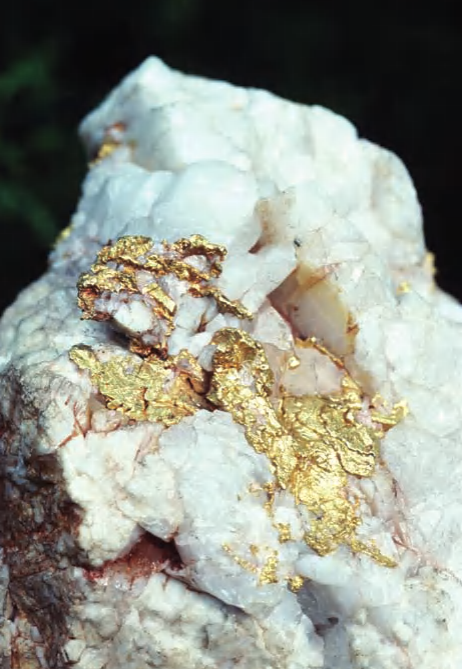
Photo of gold-quartz vein
Placer gold originates from erosion of lode gold sources and subsequent transportation by streams and rivers, or reworking by beach processes prior to final deposition. The world's largest placer gold accumulation occurs in the Archean Witwatersrand Basin of South Africa, though numerous additional placer gold provinces are recognized globally. Among the most active placer districts, where lode-gold sources were identified substantially after placer layers, are the gold districts of Alaska.
Historical Note on Placer Gold Deposits of Alaska. The placer gold deposits of Alaska and the Yukon Territories attracted tens of thousands of frontiersmen to the wild and hazardous northern territories during the late 1800s and early 1900s. Life proved extremely harsh, rewards were few, and dangers abundant, yet some prospectors successfully discovered gold and contributed to the settlement of the northern frontier.
Gold typically occurs as a native metal and is found in either lode deposits or placer deposits. Lode gold encompasses primary deposits within hard bedrock or in vein systems within the bedrock. In contrast, placer deposits represent secondary concentrations formed in stream gravels and soils. Gold's chemical unreactive nature allows it to persist through weathering and transportation processes, concentrating in soils and as heavy minerals in stream gravel deposits known as placers. Placer gold constituted the sought-after treasure during the great gold rushes of the Fairbanks gold district and Canada's Yukon Territories, where numerous placer and lode deposits continue to be discovered and mined.
Placer gold mining in Alaska commenced following George Washington Carmack and his Native American brothers-in-law Skookum Jim and Tagish Charlie's discovery of rich placer gold deposits on a Klondike River tributary in the Yukon Territory during 1896. Tens of thousands of aspiring gold miners rushed to the Klondike in 1897–1898, with many more traversing the treacherous Chilkoot and White Passes in 1898, only to discover that all streams and rivers in the area had already been claimed. Many of these entrepreneurs continued northward into Alaska's wilderness in their quest for gold. Alaska, purchased from Russia only in 1867, offered a new frontier for the United States. Gold had been reported from the Russian River on the Kenai Peninsula in 1834, and in 1886 the first major gold discovery in interior Alaska was reported from the Fortymile River. Additional gold deposits were known from Birch Creek, within what is now the Circle mining district.
Miners departing the Klondike district continued down the Yukon River to the coast on the Seward Peninsula, discovering gold on the beaches at Nome and initiating a new gold rush to the coastal region. The Nome beaches were quickly staked and claimed, and thousands of explorers and potential gold miners settled between the Yukon and Nome beaches, searching for precious metal in central Alaska's soils and gravels. In 1902, Italian gold prospector Felix Pedro discovered gold along a tributary to the Tanana River at the site of present-day Fairbanks. This discovery initiated the next Alaska gold rush and led to many years of gold exploitation along rivers, as well as the establishment of what has become one of Alaska's largest cities, founded upon gold concentration in the regolith.
Early placer mining techniques were highly labor-intensive, with miners excavating gravel from streams, transporting it in wheelbarrows, and washing it in sluices and gold pans in search of the metal. Later, near the turn of the century, new techniques emerged wherein miners built fires to melt permafrost, tunneling 20 to 30 feet (6–10 m) into gravel and excavating large piles subsequently sluiced for gold. Subsequent techniques employed powerful fire hose-like hydraulic nozzles to thaw and loosen large gravel quantities for sluicing, followed by steam-powered shovels and bucketline dredges in the 1930s that rapidly accelerated mining production. Not until the 1980s did environmental concerns halt these mining methods, by which time the entire environment had been stripped bare, with barren gravels subsequently replaced in stream channels. Currently, exploration for gold in soils and regolith must be conducted under strict guidelines established by the U.S. Environmental Protection Agency.
Platinum Group Elements. Certain rare metals designated as platinum group elements (PGEs) form economically significant concentrations within specific ultramafic igneous rocks and occur in several morphological forms. Chromite may occur as layers, typically within continental intrusions or as small pods in ultramafic rock associations. Chromite and platinum group elements typically associate with sulfide minerals, forming when sufficient sulfur exists in the magma to crystallize these phases while the rock remains in liquid state. In many instances, the metal phases result from magma contamination by melted country rock, particularly within continental layered intrusions. Notable examples of large economic chromite deposits are found in South Africa's Bushveld Complex and North America's Muskox and Stillwater Complexes.
Nickel. Nickel deposits typically occur as concentrations in lateritic soils or in association with sulfide minerals within ultramafic magmatic rocks. Nickel frequently occurs alongside platinum group elements and exhibits geochemical affinities that cause its association with sulfide minerals such as pyrite, chalcopyrite, and pyrrhotite in ultramafic rocks including komatiites.
Additional nickel deposits are found in tropical regions where lateritic weathering leaches away numerous elements, leaving residual materials such as insoluble nickel. These deposits, designated nickel laterite deposits, occur in parts of Africa including Madagascar and in the Caribbean region. In most instances, the host rock is ultramafic, though in some examples tropical weathering is sufficiently intense that nickel and associated metals become concentrated from other host rock types. Gold may also become concentrated within some lateritic weathering profiles.
Copper Deposits. Most economic copper deposits are found in association with volcanic-plutonic arc sequences within porphyry copper deposits, though additional economic copper resources occur in sedimentary deposits. In porphyry copper deposits, copper is carried by the sulfide mineral chalcopyrite, which becomes enriched and transported upward by granitic magmas and associated hydrothermal fluids related to plutons. Copper is also frequently found in association with nickel, gold, lead, and zinc deposits. Copper can additionally form in deep oceanic settings when brine fluids from deeply buried sediments discharge, depositing copper, lead, and zinc directly onto the seafloor.
Uranium. Uranium ores generally originate from granitic sources, where radioactive minerals such as monazites are leached from granites, transported by acidic solutions, and subsequently deposited where fluids encounter neutralizing conditions such as those found in carbon-bearing sediments and, in some instances, along unconformity surfaces. Additional uranium ores occur directly within granitic host rocks, exemplified by Australia's Olympic Dam deposit, which contains approximately 35 percent of the world's known economically recoverable uranium resources.
FURTHER READING: Evans, A. M. Ore Geology and Industrial Minerals: An Introduction. Oxford: Blackwell Science, 1993.
Groves, D. I. "The Crustal Continuum Model for Late-Archaean Lode-Gold Deposits of the Yilgran Block, Western Australia." Mineralium Deposita 28 (1993): 366–374.
Jensen, Mead LeRoy, and Alan Bateman. Economic Mineral Deposits. New York: John Wiley & Sons, 1979.
Date added: 2026-04-26; views: 265;