
Understanding the Electromagnetic Spectrum: Wavelengths, Frequencies, and Applications
The electromagnetic spectrum encompasses the complete range of all possible electromagnetic radiation frequencies, extending from the shortest gamma rays with wavelengths smaller than an atom to the longest radio waves spanning thousands of kilometers. The spectrum of an object refers to the characteristic distribution of radiation emitted or absorbed by that object across these wavelengths. Electromagnetic wavelengths vary dramatically, from gamma rays at approximately 10⁻¹⁴ meters—a fraction of an atomic diameter—to radio waves reaching 10⁴ meters or more. The spectrum is theoretically open-ended, with the largest possible wavelengths approaching the scale of the universe itself, while the smallest approach the size of a proton, measuring approximately 1.6 × 10⁻³⁵ meters.
Electromagnetic energy is characterized by a specific wavelength λ, which corresponds to a particular frequency *f* and photon energy E. The relationships between these quantities are expressed through three fundamental equations:
λ = c / f
E = hc / λ
E = hf
In these equations, c represents the speed of light in a vacuum (299,792,458 meters per second), and h denotes Planck’s constant, equal to 6.62606896 × 10⁻³⁴ joule-seconds. These relationships demonstrate that high-frequency electromagnetic waves possess short wavelengths and high energy, whereas low-frequency waves exhibit long wavelengths and low energy.
The wavelength of electromagnetic radiation is conventionally expressed as its value in a vacuum. When radiation traverses any medium—including air or water—its wavelength decreases, a critical consideration because the behavior of electromagnetic radiation depends fundamentally on its wavelength. Higher-frequency radiation corresponds to shorter wavelengths, while lower-frequency radiation corresponds to longer wavelengths. Electromagnetic radiation exhibits wave-particle duality, possessing properties of both waves and particles as described by quantum mechanics. When interacting with small particles such as molecules or individual atoms, quantum effects become dominant, and radiation behavior is best understood in terms of the energy contained within each quantum. In terms of energy levels, electromagnetic radiation can be divided into octaves, analogous to the classification of sound waves. The table “Characteristics of Electromagnetic Radiation” provides a comparative analysis of different wave and particle energy levels across the electromagnetic spectrum.
Types of Electromagnetic Radiation. The electromagnetic spectrum is conventionally divided into distinct regions based on wavelength, with the most widely accepted classification scheme comprising radio waves, microwaves, terahertz radiation, infrared radiation, visible light, ultraviolet light, X-rays, and gamma rays.
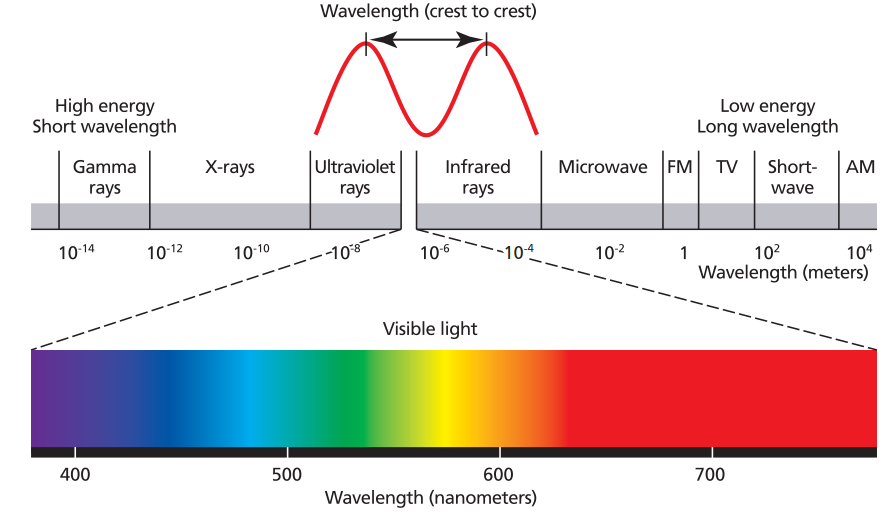
The electromagnetic spectrum
Radio waves exhibit wavelengths ranging from one millimeter to hundreds of meters, corresponding to frequencies between approximately 3 Hz and 300 GHz. These waves serve as the foundation for data transmission in television broadcasting, mobile telecommunications, wireless Internet connectivity, and numerous other applications. The complex technology involved in encoding data onto radio waves relies on modulating the amplitude, frequency, and phase relationships of waves within specific frequency bands.
Microwave radiation spans wavelengths from one millimeter to one meter, with frequencies between 0.3 GHz and 300 GHz. This category includes super-high-frequency (SHF) and extremely-high-frequency (EHF) bands. Microwaves are absorbed by molecules possessing dipolar covalent bonds, a property exploited in microwave ovens to achieve rapid and uniform heating of materials.
Terahertz radiation occupies the wavelength region between the far infrared and microwaves, with frequencies ranging from 300 GHz to 3 terahertz. This radiation band has applications in imaging technologies, communications systems, and electronic warfare for disabling electronic equipment.
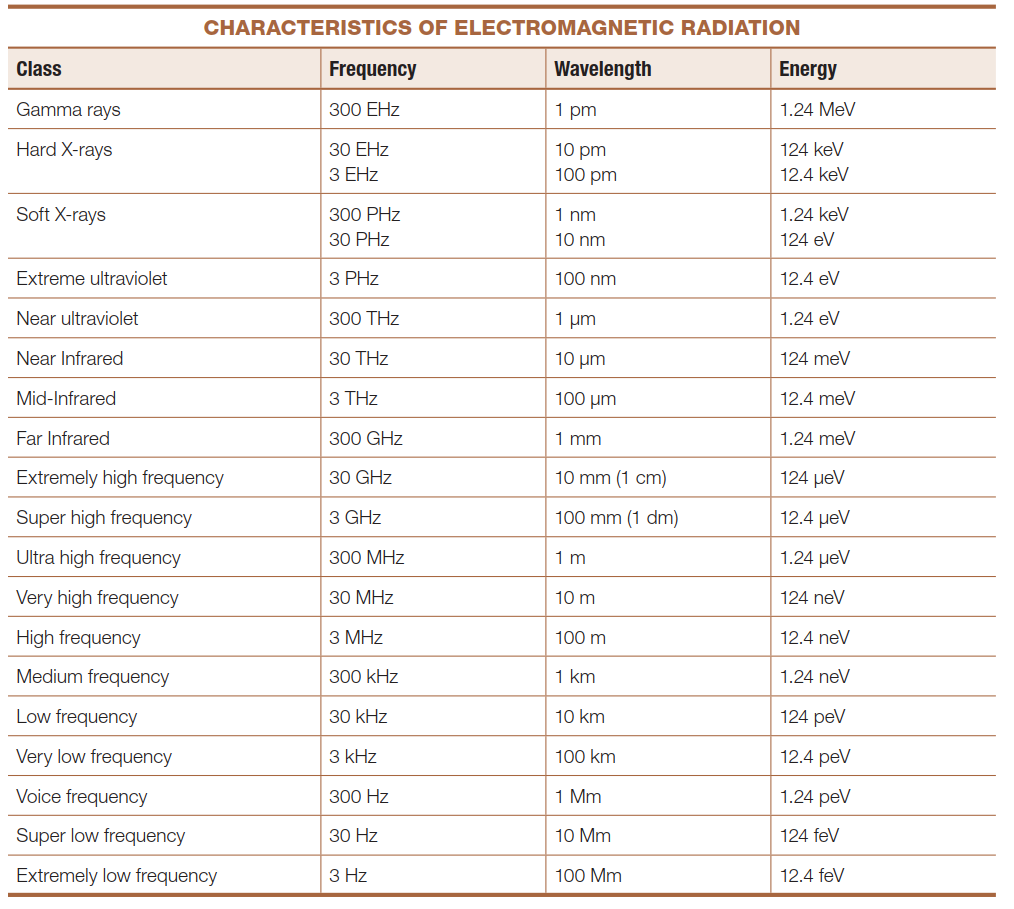
Infrared radiation encompasses wavelengths situated between visible light and terahertz radiation, with frequencies from 300 GHz (1 mm) to 400 THz (750 nm). Far-infrared radiation (300 GHz to 30 THz) is absorbed through rotational transitions in gas molecules, molecular motions in liquids, and phonons (quantized lattice vibrations) in solid phases. Most far-infrared radiation entering Earth’s atmosphere is absorbed, except within specific wavelength ranges known as atmospheric windows, where partial transmission occurs. Mid-infrared radiation spans frequencies from 30 to 120 THz and includes thermal emission from black bodies—theoretical objects that absorb all incident radiation at all wavelengths when cold. Near-infrared radiation, with frequencies from 120 to 400 THz, exhibits properties similar to visible light.
Visible light occupies the higher-frequency portion of the spectrum (400–790 THz) with wavelengths between 400 and 700 nanometers, detectable by the human eye. This range constitutes the majority of radiation emitted by the Sun and stars. When objects reflect or emit light within the visible spectrum, the human eye and brain collaborate to process these wavelengths into coherent optical images. The precise mechanisms by which the brain perceives and reconstructs visual information from these wavelengths remain incompletely understood and represent an active area of research across molecular biology, neuroscience, psychology, and biophysics.
Ultraviolet radiation features wavelengths shorter than visible light but longer than X-rays, spanning approximately 400 to 10 nm with corresponding energies between 3 and 124 electron volts. The Sun serves as a primary source of ultraviolet radiation, which constitutes a highly energetic ionizing radiation capable of inducing chemical reactions, causing fluorescence in certain substances, and producing sunburn on human skin. Although ultraviolet radiation from the Sun is harmful to most living organisms, the atmospheric ozone layer absorbs the majority of this radiation, preventing significant biological damage on Earth’s surface.
X-rays exhibit wavelengths from 10 to 0.01 nanometers, with frequencies ranging from 30 petahertz to 30 exahertz (30 × 10¹⁵ Hz to 30 × 10¹⁸ Hz) and energies between 120 eV and 120 keV. X-rays possess the ability to penetrate certain materials—such as soft tissue—while being absorbed by others like bone, enabling their use in diagnostic radiography and crystallography for producing detailed internal images. In astrophysical contexts, X-rays are emitted by neutron stars, certain nebulae, and the accretion disks surrounding black holes.
Gamma rays represent the most energetic form of electromagnetic radiation, with no defined lower wavelength limit. These photons exhibit frequencies exceeding 10¹⁹ Hz, energies above 100 keV, and wavelengths shorter than 10 picometers. Gamma rays are intensely energetic and highly ionizing, rendering them capable of causing severe damage to human tissue and posing significant health hazards.
Further Reading: Chaisson, Eric, and Steve McMillan. Astronomy Today. 6th ed. Upper Saddle River, N.J.: Addison-Wesley, 2007.
Comins, Neil F. Discovering the Universe. 8th ed. New York: W. H. Freeman, 2008.
National Aeronautic and Space Administration, Goddard Space Flight Center. “Imagine the Universe! Electromagnetic Spectrum.” Available online. URL: http://imagine.gsfc.nasa.gov/docs/science/know_l1/emspectrum.html. Updated August 22, 2008.
Snow, Theodore P. Essentials of the Dynamic Universe: An Introduction to Astronomy. 4th ed. St. Paul, Minn.: West, 1991.
El Niño-Southern Oscillation (ENSO): Mechanisms, Global Climate Impacts, and Desertification Dynamics
The El Niño-Southern Oscillation (ENSO) represents one of the most significant and well-documented variations in global atmospheric circulation patterns. Large-scale oceanic and atmospheric systems undergo recurrent shifts that exert considerable influence over vast geographical regions, particularly impacting arid and semiarid zones governed by Hadley Cell dynamics. These fluctuations in global circulation are historically linked to severe environmental disasters, including the Dust Bowl era of the 1930s in the midwestern United States. Furthermore, analogous global climate oscillations have been implicated in prolonged drought conditions, widespread famine, and the progressive desertification observed across the Sahel region, as well as the catastrophic famines that afflicted Ethiopia and Sudan during the 1970s and 1980s.
As a secondary but immensely powerful air circulation phenomenon, ENSO exerts a profound influence on the development of drought conditions and the subsequent desertification of ecologically stressed landscapes. The Hadley cells undergo seasonal meridional migration, shifting northward and southward in response to the summer and winter solstices, thereby relocating the zones of maximum atmospheric heating. Several zonal oceanic-atmospheric feedback systems modulate the global climate; however, the Austral-Asian system stands out as the most influential. During a typical Northern Hemisphere summer, the locus of intense heating shifts from equatorial regions toward the Indian subcontinent, coinciding with the activation of the Indian monsoon. This thermal forcing draws moist air onto the subcontinent, where it ascends and diverges aloft toward Africa and the central Pacific Ocean. Conversely, during the Northern Hemisphere winter, this intense heating center migrates to the archipelagos of Indonesia and Australia, fostering the development of a powerful low-pressure system over this predominantly maritime region. Surface air converges into this low-pressure zone, rises through the troposphere, and subsequently flows outward toward the eastern Pacific, establishing a closed circulation loop.
In both seasonal scenarios, a persistent high-pressure system develops off the coast of Peru, driven by the presence of cold, upwelled water that cools the overlying air, inducing atmospheric subsidence or downwelling. The resulting pressure gradient generates easterly trade winds that traverse the Pacific Ocean from the Peruvian coast toward the western Pacific heating center. This persistent wind stress accumulates warm surface water in the Coral Sea and along the northeastern coast of Australia, creating a warm water pool. Simultaneously, this process depresses sea level off the coast of Peru, facilitating the upwelling of cold, nutrient-rich water from the ocean depths. This configuration constitutes a stable positive feedback mechanism, wherein intensified cold-water upwelling off Peru reinforces atmospheric downwelling, while the accumulation of warm water over Indonesia and Australia enhances atmospheric upwelling, thereby perpetuating the strength of the global circulation system.
This stable and interconnected oceanic-atmospheric equilibrium undergoes a quasi-periodic breakdown every two to seven years, a phenomenon attributed to inherent chaotic behavior within the coupled climate system. During these destabilization events, the Indonesian-Australian heating center shifts eastward, and the constraining influence of the westward-blowing trade winds diminishes, allowing the accumulated warm water mass in the western Pacific to collapse. This elevated warm water pool then propagates eastward across the equatorial Pacific as a massive Kelvin wave, typically manifesting off the coast of Peru by late December. ENSO events are formally recognized when this oceanic warming is exceptionally pronounced, with sea surface temperatures rising by approximately 40–43°F (22–24°C) above average and remaining anomalously high for several consecutive months. This phase is also characterized by a reversal of the atmospheric circulation, known as the Southern Oscillation, wherein the dry, subsiding air typical of the eastern Pacific relocates to the Australasian region, while warm, rising air and convective activity shift to the eastern Pacific and western South America.
The arrival of El Niño conditions carries severe consequences for Peru, as the influx of warm water suppresses the normal upwelling of cold, nutrient-rich waters. This thermocline deepening forces the marine ecosystem into crisis; fish populations either migrate to more favorable feeding grounds or face mass mortality. Consequently, the fishing industry experiences a catastrophic collapse, alongside the fertilizer industry, which depends on guano harvested from seabird populations that prey on the anchovies decimated during these events. The region’s typical arid climate is abruptly transformed as cold, dry air is replaced by warm, moist air, subjecting the normally desert-like coastal regions of Peru to torrential rainfall. This deluge triggers widespread flooding, devastating landslides, loss of life, and extensive infrastructural damage. Additionally, shoreline erosion intensifies during El Niño due to the influx of the warm water mass, which elevates local sea levels by 4 to 25 inches (10–60 cm), causing significant coastal degradation.
The termination of an ENSO event often precipitates a transition to abnormally intensified conditions, effectively reactivating the “normal” circulation pattern with greater vigor. Following an El Niño, the return of cold upwelling water off the coast of Peru can be so robust that it extends northward, inundating a 1–2° latitudinal band around the equator in the central Pacific with sea surface temperatures as low as 68°F (20°C). This counterbalancing phase, characterized by anomalously cold ocean temperatures and enhanced trade winds, is known as La Niña (“the girl” in Spanish), representing the opposite extreme of the ENSO cycle.
The cyclical alternation among El Niño, La Niña, and neutral ocean-atmospheric states exerts a profound influence on global climate variability and the migration of climatic belts over interannual to decadal timescales. This oscillation is estimated to account for approximately one-third of all global rainfall variability. During ENSO events, atmospheric teleconnections can induce flooding in the western Andes and Southern California, while concurrently suppressing rainfall in other South American regions, including Venezuela, northeastern Brazil, and southern Peru. The altered climate dynamics can lead to severe droughts across Africa, Indonesia, India, and Australia; notably, ENSO has been implicated in the failure of the Indian monsoon in 1899, which resulted in widespread famine and millions of fatalities. More recently, the seven-year cycle of flooding along the Nile River has been correlated with ENSO activity, and the historical episodes of famine and desertification in the Sahel, Ethiopia, and Sudan are increasingly attributed to these large-scale shifts in global circulation patterns.
FURTHER READING: Ahrens, C. D. Meteorology Today: An Introduction to Weather, Climate, and the Environment, 6th ed. Pacific Grove, Calif.: Brooks/Cole, 2000.
Intergovernmental Panel on Climate Change homepage. Available online. URL: http://www.ipcc.ch/index.htm. Accessed January 30, 2008.
Intergovernmental Panel on Climate Change 2007. Climate Change 2007: The Physical Science Basis. Contributions of Working Group I to the Fourth Assessment Report of the Intergovernmental Panel on Climate Change, edited by S. Solomon, D. Qin, M. Manning, Z. Chen, M. Marquis, K. B. Averyt, M. Tignor, and H. L. Miller. Cambridge: Cambridge University Press, 2007.
National Oceanographic and Atmospheric Administration, Hazards Research. Available online. URL: http://ngdc. noaa.gov/seg/hazard/tsu.html Accessed January 30, 2008.
Date added: 2026-04-26; views: 243;