
Albert Einstein: Scientific Contributions and Legacy
Albert Einstein stands as one of the most influential physicists of the modern era. He achieved worldwide recognition primarily for his theory of relativity and for establishing the equivalence between mass and energy, expressed through the renowned equation E = mc², where E represents energy, *m* denotes mass, and *c* signifies the speed of light. In 1921, Einstein received the Nobel Prize in Physics “for his services to theoretical physics, and especially for his discovery of the photoelectric effect.” His most significant intellectual achievements include the special theory of relativity, which successfully reconciled mechanics with electromagnetism, and the general theory of relativity, which provided a comprehensive framework for understanding gravitation and nonuniform motion. Beyond these landmark theories, Einstein made pioneering contributions across cosmology, quantum theory, light and radiation, and unified field theory, authoring over 300 scientific papers and 150 non-scientific works throughout his career.
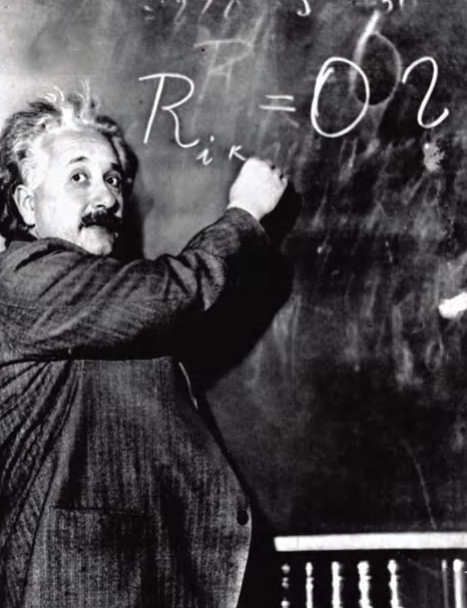
Albert Einstein, shown writing an equation for the density of the Milky Way Galaxy at Carnegie Institution, Mount Wilson Observatory headquarters, Pasadena, California, on January 14, 1931
Early Life and Family Background. Albert Einstein was born on March 14, 1879, in the Kingdom of Württemberg within the German Empire to Hermann Einstein and Pauline (Koch) Einstein, a Jewish family. His father worked as an engineer and salesman, and in 1880 the family relocated to Munich, where Hermann and his brother established an electrical manufacturing company. A defining moment in Einstein’s childhood occurred at age five when his father presented him with a compass; the young Einstein became convinced that some unseen force in space influenced the needle’s movement, an experience that profoundly shaped his intellectual curiosity. He developed a passion for building models and mechanical devices while demonstrating exceptional mathematical aptitude from an early age.
At ten years old, Einstein was introduced by Max Talmud, a medical student, to foundational texts in classical science, mathematics, and philosophy, including Euclid’s Elements, which Einstein affectionately called the “holy little geometry book.” By age twelve, he had mastered Euclidean geometry and progressed to infinitesimal calculus. During his early teens, Einstein grew disenchanted with the rigid curriculum of the electrical engineering program his father advocated at the Luitpold Gymnasium, seeking instead more creative intellectual pursuits. Following his father’s business failure in 1894, the family moved to Milan, Italy, and later to Pavia; at age fifteen, Einstein composed his first scientific paper, “The Investigation of the State of Aether in Magnetic Fields,” which he sent to his uncle, Casar Koch. Although his family left him in Munich to complete his education, Einstein grew homesick, withdrew from school, and traveled to Pavia to reunite with them.
After leaving Munich without completing secondary education, Einstein attempted but failed the entrance examination for the Swiss Federal Institute of Technology (ETH) in Zurich. His family subsequently arranged for him to finish his schooling in Aarau, Switzerland, where he boarded with Professor Jost Winteler. During this period, Einstein developed a romantic relationship with the Wintelers’ daughter, Marie, which lasted from 1895 to 1901. Upon completing his studies at seventeen, Einstein renounced his German citizenship to avoid military service and relocated to Zurich, where he successfully enrolled in the mathematics program at ETH. There he met Mileva Marić, a Serbian who was the only woman studying mathematics at the institution. Einstein graduated in 1900 with a degree in physics, published a significant paper on capillary forces, and obtained Swiss citizenship in 1901.
Einstein married Mileva Marić in 1903 following the birth of their mentally handicapped daughter in 1902, whose fate remains unknown—she likely died of scarlet fever in 1903 or was adopted by Helene Savić, a friend of the Marić family. The couple had two sons: Hans Albert Einstein, born in Bern, Switzerland, on May 14, 1904, and Eduard Einstein, born in Munich, Germany, on July 28, 1910. After living apart for five years, Einstein and Marić divorced on February 14, 1919. He subsequently married his cousin, Elsa, on June 2, 1919; together they raised Elsa’s daughters from a previous marriage but had no children of their own.
Early Career and the Annus Mirabilis. Following his graduation from ETH, Einstein was unable to secure a university teaching position and instead accepted employment in 1902 at the patent office in Bern, where he evaluated patent applications for electromagnetic devices. During this period, he established a discussion group with friends to explore topics in science and philosophy, fostering an environment of intellectual exchange. His patent office work proved intellectually formative, as many patents he reviewed concerned the synchronization of electrical and mechanical signals, prompting questions about the fundamental nature of light and the relationship between space and time.
While employed at the patent office, Einstein published four groundbreaking papers in Annalen der Physik, Germany’s premier physics journal, which later became known as the annus mirabilis (extraordinary year) papers due to their profound implications. His first paper addressed the particulate nature of light, explaining the photoelectric effect through the concept of light behaving as discrete quanta of energy. The second annus mirabilis paper examined Brownian motion, demonstrating that the random movement of small particles resulted from molecular action, thereby providing strong support for atomic theory. Einstein’s third paper introduced special relativity, establishing that the speed of light remains constant regardless of the observer’s motion. The final paper of this series derived the equivalence of mass and energy through the equation E = mc², demonstrating that mass could be converted into energy and foreshadowing the development of nuclear power. Although contemporary science regards these papers as monumental achievements, the physics community largely overlooked them at the time, with many dismissing them as nonsensical. At twenty-six, Einstein earned his Ph.D. from ETH under Alfred Kleiner, submitting his dissertation titled “A New Determination of Molecular Dimensions.”
Later Scientific Contributions and General Relativity. In 1908, Einstein secured his first academic position at the University of Bern with the title of privatdozent (a postdoctoral designation granted by European universities). His 1910 paper on critical opalescence elucidated how light scatters from atmospheric molecules, explaining the blue appearance of the sky. He continued advancing quantum theory through work on light quantization, publishing two papers—including “The Development of our Views on the Composition and Essence of Radiation”—that established the wave-particle duality of light, a foundational concept in quantum mechanics.
Einstein accepted an associate professorship at the University of Zurich in 1911 before swiftly moving to a full professorship at Charles University in Prague. From Prague, he published research on gravity’s effects on light, including the gravitational redshift phenomenon, which was later confirmed during a solar eclipse. Returning to ETH as a full professor in 1912, Einstein focused intensively on gravitational theory, culminating in the publication of his general theory of relativity in 1915. This theory fundamentally redefined gravitation as the distortion of space-time by matter, which subsequently influences the inertial motion of other matter.
When World War I erupted in 1914, Marić relocated to Zurich while Einstein moved to Berlin, where he joined the Prussian Academy of Sciences, became a professor at Humboldt University, and served as director of the Kaiser Wilhelm Institute for Physics from 1914 to 1932. He also accepted an extraordinary professorship at Leiden University, traveling regularly to the Netherlands to lecture between 1920 and 1930. In 1917, Einstein introduced the cosmological constant into his general relativity equations to account for the universe’s behavior, though he later abandoned this concept—decades later, observations in the 1990s suggested his initial intuition may have been correct. Throughout 1917, various astronomical groups tested his gravitational redshift predictions, with most initially claiming to have disproven his theories until 1919, when British astronomer Arthur Eddington confirmed the gravitational deflection of starlight by the Sun during a solar eclipse. This validation brought Einstein global recognition, with British Nobel laureate Paul Dirac subsequently describing Einstein’s theory as “the greatest scientific discovery ever made.”
Nobel Prize and Unified Field Theory. Albert Einstein received the 1921 Nobel Prize in Physics “for his service to theoretical physics, and especially for his discovery of the law of the photoelectric effect.” The award specifically recognized his paper “On a Heuristic Viewpoint Concerning the Production and Transformation of Light,” while his theory of relativity was noted as controversial. Earlier that year during a visit to New York, Einstein articulated his scientific philosophy, stating that scientific progress proceeds through examining physical reality and identifying underlying axioms that provide consistent, universal explanations without contradiction.
Following his Nobel Prize and the establishment of general relativity, Einstein devoted himself to developing a unified field theory that would integrate the fundamental laws governing electromagnetism and gravity into a single coherent framework. Despite sustained effort, he never succeeded in this endeavor—a challenge that remains unresolved in contemporary physics. Over time, Einstein became increasingly isolated within the scientific community, engaging in public debates with Danish physicist Niels Bohr regarding scientific determinism and the probabilistic nature of quantum phenomena. He notably disregarded major developments such as the discoveries of the strong and weak nuclear forces, though his pursuit of unification continues to influence modern physics through the ongoing search for a grand unifying theory.
Later Years, Exile, and Legacy. Following Adolf Hitler’s appointment as German chancellor in 1933, the Nazi regime immediately dismissed Jewish and politically suspect individuals from government positions, including university professorships. Einstein, who had been actively involved in discussions concerning science, religion, and the establishment of the State of Israel, had prudently left Germany in 1932 and taken residence in the United States. He spent time at the California Institute of Technology in Pasadena before joining the Institute for Advanced Study in Princeton, New Jersey. After his wife Elsa’s death in 1936, Einstein continued his work at the Institute while actively assisting European Jews in obtaining visas to escape Nazi persecution, helping establish the International Rescue Committee.
In Germany, physicists Philipp Lenard and Johannes Stark led a campaign to discredit Einstein’s work as “Jewish physics,” attempting to attribute his discoveries to Aryan physicists instead. After becoming a U.S. citizen, Einstein collaborated with Hungarian Jewish refugee physicist Leo Szilard to urge President Franklin Roosevelt to develop an atomic weapon before Germany could. By 1942, this initiative evolved into the Manhattan Project, which produced operational nuclear weapons by 1945. Following the bombings of Hiroshima and Nagasaki in August 1945, which resulted in approximately 220,000 deaths and concluded World War II, Einstein publicly stated that he had not directly worked on atomic bomb projects and expressed regret over his letter to Roosevelt initiating such research.
Einstein was admitted to Princeton Hospital on April 17, 1955, suffering from internal bleeding caused by a ruptured aortic aneurysm. He brought with him a speech he was preparing for the seventh anniversary of Israel’s founding but died the following morning at age seventy-six. Before cremation, the hospital pathologist removed Einstein’s brain without family permission—an act that led to his dismissal. The brain was subsequently preserved and sectioned, with samples distributed to researchers including Dr. Marian Diamond at the University of California, Berkeley, as well as investigators at Princeton University and McMaster University in Hamilton, Ontario, Canada.
Further Reading: Einstein, Albert. “Folgerungen aus den Capillaritatserscheinungen (Conclusions Drawn from the Phenomena of Capillarity).” Annalen der Physik 4 (1901): 513.
- “On a Heuristic Viewpoint Concerning the Production and Transformation of Light.” Annalen der Physik 17 (1905): 132-148.
- “A New Determination of Molecular Dimensions.” Ph.D. diss. Swiss Federal Institute of Technology (ETH), Zurich, 1905.
- “On the Motion—Required by the Molecular Kinetic Theory of Heat—of Small Particles Suspended in a Stationary Liquid.” Annalen der Physik 17 (1905): 549-560.
- “On the Electrodynamics of Moving Bodies.” Annalen der Physik 17 (1905): 891-921.
- “Does the Inertia of a Body Depend Upon Its Energy Content?” Annalen der Physik 18 (1905): 639-641.
- “Kosmologische Betrachtungen zur Allgemeinen Relativitätstheorie (Cosmological Considerations in the General Theory of Relativity).” Königlich Preussische Akademie der Wissenschaften (1917).
- “Fundamental Ideas and Problems of the Theory of Relativity.” *Nobel Lectures, Physics 1901-1921*. Amsterdam: Elsevier, July 11, 1923. Available online. URL: http://nobelprize.org/nobel_prizes/physics/laureates/1921/einstein-lecture.pdf. Accessed November 20, 2008.
- “Die Ursache der Mäanderbildung der Flussläufe und des sogenannten Baerschen Gesetzes.” Die Naturwissenschaften 14 (1926): 223-224.
- “On Science and Religion.” Nature 146 (1940): 605.
- “On the Generalized Theory of Gravitation.” Scientific American 182, no. 4 (1950): 13-17.
The Nobel Foundation. “The Nobel Prize in Physics 1921.” Available online. URL: http://nobelprize.org/physics/laureates/1921/. Accessed November 22, 2008.
Date added: 2026-04-26; views: 282;