
Environmental Geology: Hazardous Elements, Minerals, and Human Health Impacts
Environmental geology represents an applied interdisciplinary science focused on describing and understanding human interactions with natural geologic systems. This field encompasses earth system science, where different systems of the lithosphere, biosphere, hydrosphere, and atmosphere interact, with changes in one system directly influencing the others. Environmental geology includes studies of hydrological systems and how human water resource usage affects these systems, as well as investigations of natural resources such as petroleum and other hydrocarbons and how their utilization impacts the natural environment.
Many applications of environmental geology involve defining and mitigating the effects of exposure to natural hazards, including floods, earthquakes, volcanoes, tsunamis, landslides, and coastal hazards. In other contexts, the field is considered more restricted, referring to environmental issues arising from specific geologic materials such as radon, groundwater contaminants, asbestos, and lead. This discussion focuses on these later aspects of environmental geology, specifically examining the processes that concentrate hazardous elements in soils and how these elements enter homes and human bodies, ultimately harming individuals and entire populations.
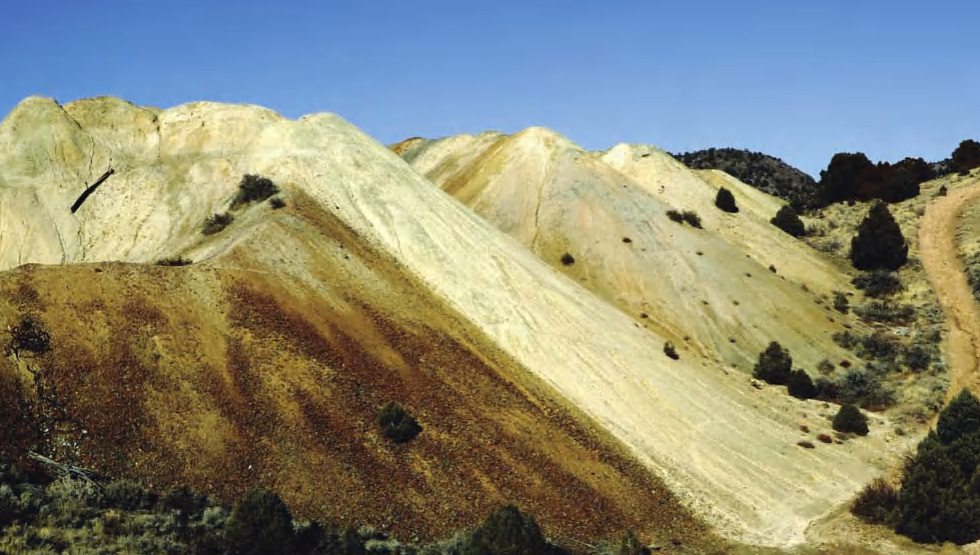
Tailings from the Comstock mine of the late 1800s
Hazardous Elements, Minerals, and Materials. Among the more than 100 naturally occurring elements, many are toxic to humans in high doses, with some occurring in high concentrations in soil. The same elements may be beneficial or even necessary in small, dilute doses while posing little or no threat in intermediate concentrations. Most elements demonstrate similar toxicity effects on humans, though not all are toxic in high doses. Understanding the effects of trace elements in the environment on human health constitutes the realm of medical geology, a rapidly growing interdisciplinary field.
Natural processes in soils across many locations concentrate potentially hazardous geologic materials. The health hazards posed by these elements depend significantly on how humans interact with their environment, which varies considerably among different cultures. Primitive cultures that live off the land are more susceptible to hazards associated with contaminated or poor water quality, toxic elements in plants harvested from contaminated soils, and insect- and animal-borne diseases linked to unsanitary environments. In contrast, more developed societies are more likely to be affected by air pollution, various types of water pollution, and indoor pollution such as radon exposure.
Some diseases reflect complex interactions among humans, insects or animals, climate, and the natural concentration of certain elements in the environment. For instance, schistosomiasis-bearing snails are abundant in parts of Africa and Asia where natural waters are rich in calcium derived from soils, but in similar climates in South America, the condition is rare. This difference exists because waters in South America are calcium-poor, whereas disease-bearing snails require calcium to build their shells.
All life-forms are composed of basic elements, including hydrogen, carbon, nitrogen, oxygen, phosphorus, sulfur, chlorine, sodium, magnesium, potassium, and calcium. Other elements play vital roles in controlling how tissues and organs function. Trace element metals present in very dilute quantities in human bodies include fluorine, chromium, manganese, iron, cobalt, copper, zinc, selenium, molybdenum, and iodine, all known to be important for life functions. Other elements accumulate in tissue with age, though their function and whether they are beneficial or detrimental remains undetermined; these age elements include nickel, arsenic, aluminum, and barium.
The distribution of elements in the natural environment is complex and may be altered by many different processes. Geologic processes such as volcanism may concentrate certain elements in some locations to ore grade or unhealthy levels. When igneous rocks undergo weathering, the concentrations of specific elements may increase or decrease in the soil horizon, depending on the element, climate, and other factors. Subsequently, biological processes may further concentrate elements. Together, leaching and accumulation during soil formation, biological concentration, and many other processes may concentrate or disperse elements harmful to humans.
Certain minerals become hazardous when exposed in the natural environment or extracted during mining operations. Specifically, selenium, asbestos, silica, coal dust, and lead can be harmful when inhaled or present in high concentrations in the environment.
Iodine. Iodine occurs naturally in the geologic environment and is released from rocks through weathering. It is readily soluble in water, so most iodine makes its way to the sea after being leached from bedrock or soil. A deficiency of iodine in the body can lead to several adverse health effects, including thyroid disease and goiter. There exists a strong correlation between the geography of thyroid disease occurrence and iodine deficiency in the environment. Much of the northern half of the conterminous United States has soils low in iodine, and this same region yields most of the thyroid disease cases in the country.
Selenium. Selenium ranks among the most toxic elements known in the environment. Like most elements, selenium is required in small concentrations for normal biological functions. Concentrations of 0.04 to 0.1 parts per million are healthy, but any larger concentration becomes toxic. Selenium is produced naturally by volcanic activity, typically ejected as small particles that fall out near volcanoes, causing higher concentrations near volcanic vents. Selenium in natural soils ranges from 0.1 parts per million to more than 12,000 parts in organic-rich soils.
Selenium exists in insoluble form in acidic soils and in soluble form in alkaline soils. Biological activity may also concentrate selenium, with some plants taking up soluble selenium and concentrating it in their structures. The efficiency of this process depends on the form in which selenium exists in the environment. Selenium is concentrated in human tissue to approximately 1,000 times the background level in freshwater and concentrated up to 2,000 times the natural background level in marine fish. The concentration of selenium in biological material has persisted through geological time; consequently, many coals and fossil fuels are also rich in selenium. Burning coal releases large amounts of selenium into the atmosphere, which then rains down on the landscape.
Asbestos. Asbestos was widely used as a flame retardant in buildings through the mid-1970s and was present in millions of buildings in the United States. It was also used in vinyl flooring, ceiling tiles, and roofing material. New construction no longer uses asbestos since scientists discovered it may cause certain diseases, including asbestosis (pneumoconiosis), a chronic lung disease. Asbestos particles lodge in the lungs, and lung tissue hardens around the particles, decreasing lung capacity. This decreased lung capacity causes the heart to work harder and can lead to heart failure and death. Virtually all deaths from asbestosis can be attributed to long-term exposure to asbestos dust in the workplace before environmental regulations governing asbestos were implemented.
A less common disease associated with asbestos is mesothelioma, a rare cancer of the lung and stomach linings. Asbestos has become one of the most devastating occupational hazards in U.S. history, costing billions of dollars for cleanup in schools, offices, homes, and other buildings. Approximately $3 billion annually is currently spent on asbestos removal in the United States, and many older buildings still contain substantial amounts of asbestos in their insulation, panels, and other building materials.
Asbestos is actually a group of six related minerals, all with similar physical and chemical properties. Asbestos includes minerals from the amphibole and serpentine groups that are long and needle-shaped, making it easy for them to lodge in the lungs. The Occupational Safety and Health Administration (OSHA) defined asbestos as having dimensions greater than 5 micrometers long, with a length-to-width ratio of at least 3:1. The amphibole group minerals included in this definition are grunerite (amosite), reibeckite (crocidolite), anthophyllite, tremolite, and actinolite, while the serpentine group mineral fitting the definition is chrysotile. Almost all asbestos used in the United States is chrysotile (white asbestos), with approximately 5 percent being crocidolite (blue asbestos) and amosite (brown asbestos). Considerable debate currently exists among geologists, policymakers, and health officials regarding the relative threats from different kinds of asbestos.
In 1972, OSHA and the U.S. government began regulating acceptable levels of asbestos fibers in the workplace. The Environmental Protection Agency (EPA) agreed and declared asbestos a Class A carcinogen. The EPA composed the Asbestos Hazard Emergency Response Act, signed by President Reagan in 1986. OSHA gradually lowered acceptable limits from a preregulated estimate of greater than 4,000 fibers per cubic inch to four particles per cubic inch in 1992. Responding to public fears about asbestosis, Congress passed a law requiring that any visibly deteriorating asbestos-bearing material must be removed and replaced with nonasbestos-bearing material. This regulation has caused billions of dollars to be spent on asbestos removal, which in many cases may have been unnecessary. Asbestos can be harmful only as an airborne particle, and only long-term exposure to high concentrations leads to disease. In some cases, removing asbestos caused indoor air to become more hazardous than before removal, as remediation can cause many small particles to become airborne and settle as dust throughout buildings.
Asbestos fibers in the environment have led to serious environmental disasters, as hazards were not appreciated during early mining operations before the late 1960s. One of the worst cases occurred in Wittenoom, Australia. Crocidolite was mined in Wittenoom for 23 years between 1943 and 1966, with mining largely unregulated. Asbestos dust filled the air of the mine and town, and the 20,000 residents of Wittenoom breathed the fibers daily in high concentrations. More than 10 percent (2,300 people) who lived in Wittenoom have since died of asbestosis, and the Australian government has condemned the town and is burying the asbestos in deep pits to eliminate the hazard.
In the United States, W. R. Grace and Company in Libby, Montana, afflicted hundreds of people with asbestos-related diseases through its mining operations. Vermiculite was mined at Libby from 1963 to 1990 and shipped to Minneapolis for insulation products, but the vermiculite was mixed with the tremolite variety of asbestos. In 1990, the EPA tested residents of Libby and found that 18 percent who had been there for at least six months had various stages of asbestosis, and 49 percent of W. R. Grace mine employees had asbestosis. The mine was closed, and Libby is now a Superfund site, where the EPA has determined toxic wastes were dumped and must be cleaned up. The problem was not limited to Libby; 24 workers at the processing plant in Minneapolis have since died from asbestosis, and one resident living near the factory also died.
Silica and Coal Dust. Other minerals can become hazardous when made into small airborne particles that lodge in the lungs. As with asbestos, both silica-mining and coal-mining operations release large amounts of dust particles into the air, known respectively as quartz dust and coal dust. Workers exposed to these dusts are at risk for diseases broadly similar to asbestosis.
Quartz dust is commonly produced during rock drilling and sandblasting operations. These practices generate airborne particles of various sizes, with the largest naturally filtered by hair and mucous membranes during inhalation. Some of the smallest particles can work their way deeply into the lungs and become lodged in the air sacs of the alveoli, where they cause great harm. When small particles become trapped in air sacs, the lungs react by producing fibrolitic nodules and scar tissue around the trapped particles, reducing lung capacity in a disease called silicosis. This disease is easily preventable by wearing a respiratory mask when exposed to silica fibers, though this practice remains uncommon.
Coal dust has presented a long-term health problem in the United States and elsewhere, with underground coal miners at high risk for developing disease. Mining operations inevitably release fine particles of coal into the air. These particles may lodge in the lungs, causing a myriad of diseases including chronic bronchitis and emphysema, collectively known as black lung disease. The longer a miner works underground, the greater the risk of developing black lung disease. Miners working underground for fewer than 10 years have approximately a 10 percent chance of developing these symptoms, whereas miners working underground for more than 40 years have a 60 percent chance of developing black lung disease.
Lead. Lead is a metalliferous element used primarily for pipes, solder, batteries, bullets, pigments, radioactivity shields, and wheel weights. Lead is a known environmental hazard, and ingestion of large amounts can lead to developmental problems in children, including retardation, brain damage, and birth defects. It may also lead to kidney failure, multiple sclerosis, and brain cancer. Some researchers speculate that the fall of the Roman Empire was partly caused by lead poisoning. Romans drank significant quantities of wine, and lead was concentrated at several different steps in the wine-making process. The upper class also drank from lead cups, and water was pumped into their homes through lead pipes. Lead poisoning likely contributed to brain damage, retardation, and the high incidence of birth defects among Romans. These ideas are supported by the high lead content measured in the remains of exhumed Roman citizens. Remarkably, lead content in ice cores from Greenland representing the Roman Empire period (500 B.C.E–300 C.E.) also preserves approximately four times the normal level of lead, reflecting increased mining and use of lead by Romans.
Lead is present in the natural environment in several different forms. Galena is the most common ore mineral, forming shiny cubes with a silvery lead color. Lead is not generally hazardous in its natural mineral form but becomes hazardous when mined and released from smelters as particulates, when leached from pipes or other fixtures, or when released into the air from automobile fumes. These processes can lead to high concentrations of native lead in soils, streams, and rivers. Lead may then be taken up by plants or aquatic organisms and enter the food chain, where it can cause great damage. Lead paint also presents a significant hazard in many U.S. homes, as lead was used as a paint additive until the 1970s. Paint in many older homes is peeling and ingested by infants, and paint along window frames becomes airborne dust when windows are opened and closed. Environmental regulations in many states now require removal of lead paint from homes upon property sale or leasing.
The largest lead smelter in the United States, in Herculaneum, Missouri, exemplifies the legacy of lead mining. Herculaneum is located approximately 30 miles south of St. Louis in the heart of the nation's largest lead deposit belt and has been the site of mining operations for generations. The town's smelter releases 34 tons of emissions per year (reduced from 800 tons per year a generation ago), including fine-grained lead dust. This dust rains down on the local community, and local street dirt has been tested and found to contain 30 percent lead. Signs on town streets warn children not to play in the streets, curbs, or sidewalks, and parents remain vigilant in attempting to keep dust off toys, shoes, and out of the food and water supply. Despite these efforts, the State of Missouri has replaced soil on 535 properties contaminated by lead. Many children and adults in the town are suffering effects of lead poisoning, with retardation, stunted growth, hearing loss, and clusters of brain cancer and multiple sclerosis in town. One-quarter of all children in the town tested positive for lead poisoning in 2001. Lead contamination had long been suspected in Herculaneum, but it was not until 2002 that the federal government intervened. In January 2002, the EPA initiated a large-scale relocation program, initially moving 100 families with young children or pregnant women to safer locations. Government officials have been attempting to shut down the Doe Run Lead Smelter and potentially relocate the 2,800 remaining families in Herculaneum.
Radon. Many U.S. homes accumulate radon, a poisonous gas and by-product of radioactive decay of the uranium decay series. A heavy gas, radon presents a serious indoor hazard in every part of the country. It tends to accumulate in poorly ventilated basements and well-insulated homes built on specific types of soil or bedrock rich in uranium minerals. Radon is known to cause lung cancer; since it is odorless and colorless, it can go unnoticed in homes for years. However, the radon hazard is easily mitigated, and homes can be made safe once the hazard is identified.
Uranium is a radioactive mineral that spontaneously decays to lighter daughter elements by losing high-energy particles at a predictable rate known as a half-life. The half-life specifically measures how long it takes for half of the original parent element to decay to the daughter element. Uranium decays to radium through a long series of steps with a cumulative half-life of 4.4 billion years. During these steps, intermediate daughter products are produced, and high-energy particles including alpha particles (consisting of two protons and two neutrons) are released, producing heat. The daughter mineral radium is itself radioactive and decays with a half-life of 1,620 years by losing an alpha particle, forming the heavy gas radon. Radon escapes from minerals and ground and makes its way to the atmosphere, where it disperses unless trapped in homes. If trapped, it can be inhaled and cause damage.
Radon is a radioactive gas that decays with a half-life of 3.8 days, producing daughter products of polonium, bismuth, and lead. If this decay occurs while the gas is in someone's lungs, the solid daughter products become lodged in the lungs, initiating radon damage. Most health risks from radon are associated with the daughter product polonium, which is easily lodged in lung tissue. Polonium is radioactive, and its decay and emission of high-energy particles in the lungs can damage lung tissue, eventually causing lung cancer.
The concentration of radon among geographic regions and in specific locations within those regions varies tremendously. There is also great variation in gas concentration at different levels in soil, homes, and atmosphere. This variation relates to the concentration and type of radioactive elements present at a location. Radioactivity is measured by the picocurie (pCi), approximately equal to the amount of radiation produced by the decay of two atoms per minute.
Soils have gases trapped between individual grains, with soil gases showing typical radon levels of 20 pCi per liter to 100,000 pCi per liter, with most U.S. soils falling in the range of 200–2,000 pCi/L. Radon can also be dissolved in groundwater, with typical levels between 100–2 million pCi/L. Outdoor air typically contains 0.1–20 pCi/L, and radon inside homes ranges from 1–3,000 pCi/L, with 0.2 pCi/L being typical.
Formation and Movement of Radon Gas. Many natural geologic variations lead to the complex distribution of hazardous radon. One of the main variables controlling radon concentration at any site is the initial concentration of the parent element uranium in underlying bedrock and soil. If underlying materials have high uranium concentrations, homes built in the area are more likely to have high radon concentrations. Most natural geologic materials contain small amounts of uranium, typically about 1–3 parts per million (ppm). Uranium concentration in soils derived from rock is typically about the same as in the original source rock. However, some rock and soil types have much higher initial uranium concentrations, ranging up to and above 100 ppm. Rocks with the highest uranium content include some granites, some volcanic rocks (especially rhyolites), phosphate-bearing sedimentary rocks, and their metamorphosed equivalents.
As uranium in soil gradually decays, it leaves its daughter product radium in concentrations proportional to the initial uranium concentration. Radium then decays by forcefully ejecting an alpha particle from its nucleus. This ejection represents an important step in radon formation, as every action has a reaction—in this case, the recoil of the nucleus of newly formed radon. Most radon remains trapped in minerals once formed. However, if radium decay occurs near the surface of a mineral and the recoil of the new radon nucleus is away from the grain center, the radon gas may escape mineral bondage. It then becomes free to move in intergranular space between minerals, soil, or cracks in bedrock, or become absorbed in groundwater between mineral grains. Less than half (10–50 percent) of radon produced by radium decay actually escapes the host mineral, with the rest trapped inside where it eventually decays, leaving solid daughter products behind as impurities.
Once radon is free in open or water-filled pore spaces of soil or bedrock, it may move rather quickly. The exact rate of movement is critical to whether radon enters homes, because radon does not stay around for long with a half-life of only 3.8 days. Rates at which radon moves through typical soil depend on how much pore space exists in the soil or rock, how connected these pore spaces are, and the exact geometry and size of openings. Radon moves quickly through very porous and permeable soils such as sand and gravel but moves very slowly through less permeable materials such as clay. Radon also moves very quickly through fractured material, whether bedrock, clay, or concrete.
Considering how radon movement rates are influenced by pore space geometry in soil or bedrock underlying a home, and how initial uranium concentration determines available radon, it becomes apparent that radon concentration varies greatly from place to place. Homes built on dry, permeable soils can accumulate radon quickly because it can migrate through soil rapidly. Conversely, homes built on impermeable soils and bedrock are unlikely to concentrate radon beyond natural background levels.
Radon becomes hazardous when it enters homes and becomes trapped in poorly ventilated or well-insulated areas. Radon moves up through soil toward areas with greater permeability. Home foundations are often built with porous and permeable gravel envelopes surrounding the foundation to allow water drainage. This also focuses radon movement and brings it close to the foundation, where radon may enter through small cracks in concrete, seams, spaces around pipes, sumps, other openings, and through moderately porous concrete. Most modern homes intake less than 1 percent of their air from soil. Some homes, particularly older homes with cracked or poorly sealed foundations, low air pressure, and other radon entry points, may intake as much as 20 percent of their internal air from soil. These homes tend to have the highest radon concentrations.
Radon can also enter homes and bodies through groundwater. Homes relying on well water may take in water with high concentrations of dissolved radon. This radon can then be ingested or released from water by agitation within the home. Radon is released from high-radon water by simple activities such as showers, washing dishes, or running faucets. Radon can also come from municipal water supplies, such as those from small towns relying on well fields that take groundwater and distribute it to homes without providing reservoirs for water to linger while radon decays to the atmosphere. Most larger cities rely on reservoirs and surface water supplies, where radon has had a chance to escape before being used by homeowners.
Radon Hazard Mapping. Greater understanding of radon hazard risk in an area can be obtained through mapping potential radon concentrations at many scales of observation. Radon concentrations can also be measured locally to determine what mitigation measures are necessary to reduce health risks from this poisonous gas.
The broadest sense of risk can be obtained by examining regional geologic maps and determining whether an area is located above potential high-uranium-content rocks such as granites, shales, and rhyolites. These maps are available through the U.S. Geological Survey and many state geological surveys. The U.S. Department of Energy has flown airplanes with radiation detectors across the country and produced maps showing measured surface radioactivity on a regional scale. These maps provide excellent indication of background uranium concentration in an area and thus relate to potential radon gas risk.
More detailed information is needed by local governments, businesses, and homeowners to assess whether radon remediation equipment is necessary. Geologists and environmental scientists can measure local soil radon gas levels using various techniques, typically involving placing a pipe into the ground and extracting soil air for measurement. Other devices may be buried in soil to more passively measure damage produced by alpha particle emission. Through such information, radon concentrations in certain soil types can be established. This information can be integrated with soil characteristic maps produced by the U.S. Department of Agriculture and state and county officials to create more regional maps of potential radon hazards and risks.
Most homeowners must resort to private measurements of radon concentrations in their homes using commercial devices that detect radon or measure alpha particle emission damage. Measurement of radon levels in homes has become a standard part of home sales transactions, resulting in increased data and awareness over the past decade. Remediation of radon problems in homes or businesses has become relatively simple. Engineers or contractors can be hired simply and inexpensively (typically less than $1,000 for an average home) to design and build ventilation systems that remove harmful radon gas, making air safe to breathe.
Summary. Soil formation involves the breakdown of solid rock and removal of dissolvable components, leaving residual material behind. This process concentrates certain elements, some of which can be harmful to human health. The most hazardous elements common in soils include selenium, arsenic, radon, and lead, while mines may expose workers to other harmful elements such as coal dust, silica dust, and asbestos fibers. Various health conditions and ailments worldwide, generally among poorer populations, are caused by exposure to or ingestion of hazardous elements in soil. Careful monitoring of these element concentrations in developed nations such as the United States has greatly reduced the health threat they pose.
Date added: 2026-04-26; views: 244;