
Erosion Processes: Weathering, Water, Wind, and Human Impact on Landscape Evolution
Erosion encompasses a suite of processes by which Earth materials are loosened, dissolved, abraded, or worn away and subsequently transported from one location to another. These processes integrate weathering, dissolution, corrosion, and transportation mechanisms. Weathering occurs in two principal categories: physical weathering and chemical weathering. Physical weathering involves the mechanical breakdown of bedrock through agents such as moving water, wind, freeze-thaw cycles, glacial action, crystallization pressures from ice and other minerals, and biological interactions including root penetration. Chemical weathering entails the chemical decomposition of bedrock within aqueous solutions. Erosion proceeds when weathering products are mobilized and transported from their source, typically by water, wind, or glacial ice.
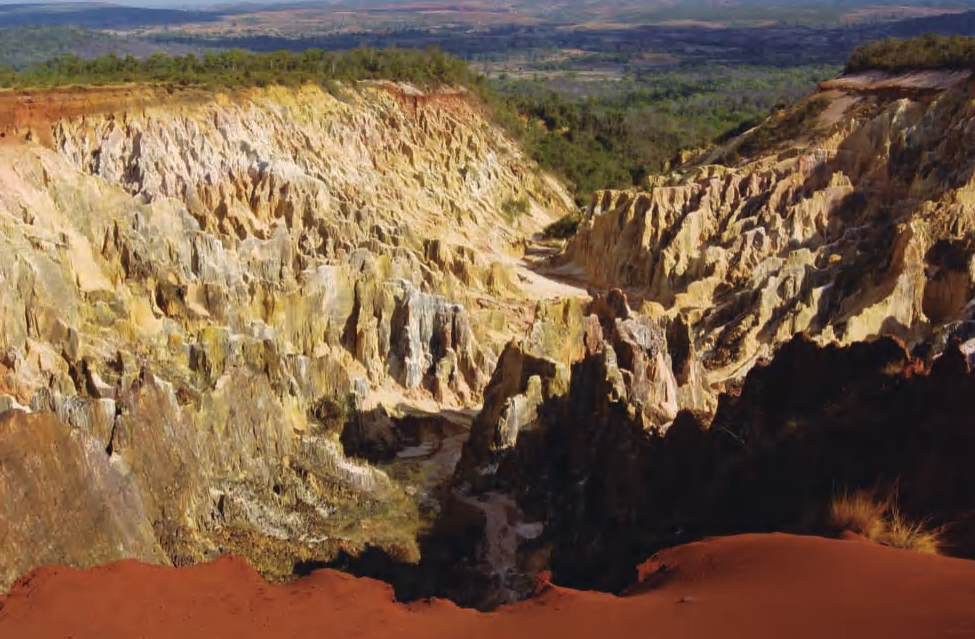
Lavaka from severe soil erosion in Ankarafantsika Nature Reserve, Madagascar
Water as an Erosional Agent. Water functions as an exceptionally effective erosional agent, operating across multiple scales from rainfall impact to organized streamflow. Erosion commences when raindrops strike a surface; the kinetic energy of impact dislodges rock and soil particles, initiating their movement. During heavy precipitation, runoff partitions into overland flow and streamflow. Overland flow represents the movement of runoff as broad sheets, typically traveling short distances before concentrating into discrete channels. Erosion by overland flow is termed sheet erosion. Streamflow constitutes the flow of surface water within well-defined channels. Vegetative cover exerts a strong influence on the erosive power of overland flow; plants with dense ground cover and extensive root systems provide substantially greater erosion protection than thin vegetation or row crops that leave exposed soil between plants. Ground cover conditions intermediate between true desert and savanna grassland exhibit the highest erosion susceptibility, whereas tropical rainforests offer optimal land cover for erosion protection through canopy interception of rainfall and interlocking root networks that stabilize soil.
Under normal flow regimes, streams achieve a state of dynamic equilibrium, eroding material from one bank while depositing sediment on the opposite bank. Small-magnitude floods may deposit layers of silt and mud across overbank areas and floodplains, contributing to vertical accretion of these landforms. During high-volume flood events, streams may become highly erosive, capable of removing entire floodplains that accumulated over centuries. The most severely erosive floods occur in confined channels with high discharge, such as mountain canyons downstream of tributary networks that have experienced intense rainfall events. Additional catastrophic erosive floods have resulted from dam failures and, in the geologic past, from the release of large volumes of water from ice-dammed lakes approximately 12,000 years ago. The erosive power of floodwaters intensifies dramatically upon reaching supercritical flow velocities, at which point flows can rapidly incise alluvium and even erode bedrock channels. Supercritical flow is typically short-lived, as channel enlargement induces self-regulation that returns flow to subcritical conditions.
Cavitation represents a significant erosive mechanism in high-velocity streams. This process occurs when flow velocities are sufficiently high that vapor pressure is exceeded, causing bubbles to form on rigid surfaces. These bubbles alternately form and collapse with tremendous pressure, creating an exceptionally effective erosive agent. Cavitation is observable on dam spillways during high-discharge events; however, it is distinct from the more common and substantially less erosive phenomenon of air entrapment by turbulence, which accounts for most bubbles observed in white-water streams.
Wind and Glacial Erosion. Wind operates as an important but comparatively less effective erosional agent than water, primarily in desert and dryland environments characterized by exposed, soil-poor regolith. Glaciers function as powerful erosional agents, having removed hundreds of feet (meters) of material from continental surfaces during Pleistocene glaciations. These moving ice masses carve deep valleys into mountain ranges and transport eroded sediments within, beneath, and in front of glaciers via meltwater stream systems. Warm-based glaciers, which possess layers of liquid water at their bases, exhibit significantly greater erosive effectiveness than cold-based glaciers, which lack basal liquid water and are known from regions such as Antarctica.
Mass Wasting and Anthropogenic Impacts. Mass wasting is classified as an erosional process under most definitions, though some treatments distinguish these rapid events separately. These processes involve the downslope transport of material and include landslides, debris flows, and rock slides. Mass wasting can substantially reduce regional elevation, typically occurring in cycles with recurrence intervals ranging from decades to tens of thousands of years.
Human activities are dramatically altering global landscapes and accelerating erosion rates. Deforestation has caused severe soil erosion in Madagascar, South America, the United States, and numerous other regions. Urbanization produces variable effects, reducing erosion in some areas while enhancing it elsewhere. River damming decreases local gradients, slowing erosion in upland areas while preventing sediment replenishment in downstream regions. Agriculture and levee construction have fundamentally altered floodplain sediment dynamics. Although precise quantification remains challenging, estimates indicate that human activities over the past two centuries have increased erosion rates by average factors ranging from five to one hundred times pre-anthropogenic levels.
Further Reading: Ritter, D. F., R. C. Kochel, and J. R. Miller. Process Geomorphology. 3rd ed. Boston: WCB-McGraw Hill, 1995.
Skinner, Brian J., and Stephen C. Porter. The Dynamic Earth: An Introduction to Physical Geology. 5th ed. New York: John Wiley & Sons, 2004.
Date added: 2026-04-26; views: 240;