
Earth: Structure, Composition, and Dynamic Systems of the Third Planet
Earth is the third planet from the Sun, situated between Venus and Mars at an average distance of 93 million miles (150 × 10⁶ km). With a mean radius of 3,960 miles (6,371 km) and a surface area spanning 2.04 × 10⁸ square miles (5.101 × 10⁸ km²), it maintains an average density of 5.5 grams per cubic centimeter. As one of the terrestrial planets—which include Mercury, Venus, and Mars—Earth is composed primarily of solid rock, with silicate minerals dominating the outer layers and a dense iron‑nickel alloy constituting the core.
Earth and the other planets formed through condensation from a solar nebula approximately 5 billion years ago. This process involved a swirling cloud of hot dust, gas, and protoplanets that collided and coalesced, eventually giving rise to the principal planets. The accretion phase occurred under high‑temperature conditions, facilitating widespread melting that allowed heavier metallic elements, particularly iron (Fe) and nickel (Ni), to sink toward the center while lighter rocky materials rose toward the surface. This differentiation produced several concentric shells of contrasting density and composition, establishing the fundamental large‑scale structure that characterizes Earth today.
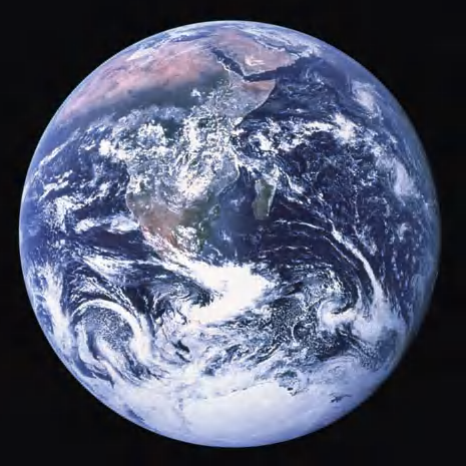
Earth seen by Apollo 17 crew: Africa and Madagascar at center of field of view (NASA)
The principal internal shells consist of the crust, a light outer layer ranging from 3 to 43 miles (5–70 km) in thickness. Beneath it lies the mantle, a solid rocky zone extending to a depth of 1,802 miles (2,900 km). The outer core is a molten metallic layer reaching 3,170 miles (5,100 km) depth, while the inner core represents a solid metallic sphere extending to 3,958 miles (6,370 km). Following the widespread acceptance of plate tectonics in the 1960s, geologists recognized that the outermost Earth is further subdivided into zones with distinct mechanical properties. The rigid outer shell was divided into numerous plates moving relative to one another, some of which carry continents in the process of continental drift. This outer rigid layer, termed the lithosphere, varies in thickness from 45 to 95 miles (75–150 km). The lithosphere effectively floats atop a denser, partially molten zone in the upper mantle known as the asthenosphere (or weak sphere), whose ductility permits the lateral movement of tectonic plates at the surface.
Earth’s surface is fundamentally divided into continents and ocean basins, with oceans covering approximately 60 percent and continents 40 percent. Mountains represent elevated portions of the continents, while shorelines mark the interface between land and sea. Continental shelves—broad to narrow areas underlain by continental crust and covered by shallow water—drop off to continental slopes, characterized by steep gradients leading to the deep ocean basin. At the continental rise, the gradient lessens, merging with the deep‑ocean abyssal plains. Ocean ridge systems are submarine mountain ranges where seafloor spreading generates new oceanic crust. Mountain belts occur in two principal forms. Orogenic belts are linear mountain chains, largely on continents, composed of highly deformed rocks that mark zones where lithospheric plates have collided or slid past one another. The mid‑ocean ridge system extends for 40,000 miles (65,000 km) and represents extensive outpouring of young lava on the ocean floor, serving as the primary site for the generation of new oceanic crust through plate tectonics. As newly formed crust moves away from ridge crests, upwelling magmatic material fills the resulting space. Oceanic basins also contain elongated, deep‑ocean trenches that descend several kilometers below the surrounding seafloor, locally reaching depths of seven miles (14 km). These trenches are locations where oceanic crust descends back into the mantle, completing the plate tectonic cycle.
Earth’s external layers include the hydrosphere, encompassing oceans, lakes, streams, and the atmosphere. The interface between air and water is geologically active, as erosion breaks down rocks into loose debris known as regolith. The hydrosphere functions as a dynamic mass of liquid in constant motion, comprising all water in oceans, lakes, streams, glaciers, and groundwater, with the vast majority residing in the oceans. The hydrologic cycle governs both short‑term and long‑term changes within the hydrosphere, driven by solar heat that induces evaporation and transpiration. This water vapor moves through the atmosphere, precipitates as rain or snow, and subsequently drains into streams, evaporates, or infiltrates as groundwater before eventually repeating the cycle.
The atmosphere consists of the gaseous mixture known as air, extending hundreds of kilometers above the surface and in perpetual motion due to uneven solar heating, with the equator receiving more heat per unit area than the poles. Heated air expands and rises, then spreads poleward, cools, sinks, and gradually returns toward equatorial regions. Earth’s rotation modifies this circulation pattern through the Coriolis effect, which deflects freely moving bodies to the right in the Northern Hemisphere and to the left in the Southern Hemisphere.
The biosphere encompasses all living matter on Earth, along with partially decomposed organic remains. Composed predominantly of carbon, hydrogen, and oxygen, these organic materials undergo decay and may become incorporated into the regolith, eventually being returned to the lithosphere, atmosphere, or hydrosphere through geological processes.
FURTHER READING: Skinner, Brian J., and Stephen C. Porter. The Dynamic Earth, an Introduction to Physical Geology. 5th ed. New York: John Wiley & Sons, 2004.
Date added: 2026-04-26; views: 229;