
Meteorite Classification and Composition: Decoding the Building Blocks of the Solar System
Our understanding of asteroids and meteorites has profoundly evolved. Historically, knowledge was limited to meteorites recovered on Earth. Modern planetary science, however, integrates these samples with direct data from space missions and remote sensing, allowing for a synthesized view of these primitive bodies. A key observation is that ice content in asteroids generally increases with orbital distance from the Sun. Meteorites are classified by composition, mineralogy, and degree of metamorphism from heating and pressure. Many originate from planetesimals that formed iron cores before being catastrophically destroyed, while others represent primordial solar nebula material never incorporated into larger bodies.
Meteorite classification aims to group specimens by common parent body, such as an asteroid or planet. This is achieved by analyzing mineralogical, physical, chemical, and isotopic properties. Their material is similar to Earth's, comprising silicate minerals, iron, and nickel. Distinctive features include chondrules—ancient melt droplets—and rare presolar grains like microscopic diamonds. Traditional taxonomy had three main groups: stony meteorites, iron meteorites, and stony-iron meteorites. Contemporary schemes simplify this into chondrites and nonchondrites, with the latter subdivided into primitive and differentiated types.
Identifying meteorites on Earth is challenging due to their similarity to terrestrial rocks. A key identifier is the fusion crust formed during atmospheric entry. Most classified specimens come from Antarctica, where rocky debris on ice sheets is almost certainly extraterrestrial. Approximately 85% of falls are chondrites, considered primitive solar material. Classifying nonchondrites often focuses on deducing the characteristics of their fragmented parent bodies.
Chondrites: Primordial Solar System Archives. Chondrites possess a chemical composition remarkably similar to the Sun, representing the average primordial material of the solar system. They contain chondrules, small round nodules of crystals and glass interpreted as condensed liquid droplets from the early solar nebula. Isotopic dating yields ages of about 4.568 billion years, confirming them as among the oldest solar system materials. Some contain Calcium-Aluminum Inclusions (CAIs), which formed at extreme temperatures exceeding 1,700°C and are considered the oldest known solids.
Chondrites are mixtures of chondrules, olivine, and pyroxene. While some show minimal alteration, others exhibit evidence of aqueous alteration or thermal metamorphism up to 1,000°C, indicating incorporation into larger parent bodies. Isotopic dating shows most cooled within 60 million years of solar system formation. Subsequent impacts in the asteroid belt shattered these bodies, creating brecciated chondrites formed under immense pressure.
The main chondrite classes are ordinary chondrites, carbonaceous chondrites, and enstatite chondrites. Carbonaceous chondrites are particularly significant as they contain complex organic material, including amino acids and hydrocarbons—prebiotic building blocks for life. Enstatite chondrites feature rapid-cooling signatures and impact breccias, suggesting origin from deep within a catastrophically disrupted body.
Achondrites: Samples of Differentiated Worlds. Achondrite meteorites resemble terrestrial igneous rocks, having crystallized from silicate magma on differentiated bodies. They lack chondrules, as melting erased primordial textures. Remarkably, some achondrites are lunar or Martian in origin, ejected by impacts. These include the SNC meteorites (shergottites, nakhlites, chassignites), whose young crystallization ages (150 million to 1.3 billion years) and chemical match confirmed their Martian origin. Cosmic-ray exposure ages suggest transit times to Earth of under 20 million years.
Other achondrites, like the howardites, eucrites, and diogenites (HED group), are linked to the asteroid 4 Vesta, representing its basaltic crust and deeper cumulate layers. Unusual groups like ureilites and brachinites record very early igneous activity, with some crystallizing just 5 million years after solar system formation, indicating rapid planetesimal growth and differentiation.
Iron Meteorites: Cores of Shattered Protoplanets. Iron meteorites, composed primarily of iron and nickel, are interpreted as fragments of the metallic cores of differentiated planetesimals. Their iconic Widmanstätten patterns are intergrowths of iron-nickel minerals whose crystal size reveals the parent body's cooling rate and size. Calculations suggest parent bodies ranged from under 80 km to over 300 km in diameter. While they formed early, their cosmic-ray exposure ages indicate the breakup of their parent bodies occurred relatively recently, between 200 million and 1 billion years ago. They are classified texturally into octahedrites, hexahedrites, and ataxites.
Stony-Iron Meteorites: The Core-Mantle Boundary. Stony-iron meteorites are hybrids of metal and silicate, thought to originate from the core-mantle boundaries of planetary bodies. The two main types are pallasites (olivine crystals in a metallic matrix) and mesosiderites (silicate rock with metallic inclusions). Mesosiderites are complex breccias, suggesting a violent formation history involving partial differentiation, catastrophic breakup, and gravitational reassembly of their parent body around 4.4 billion years ago.
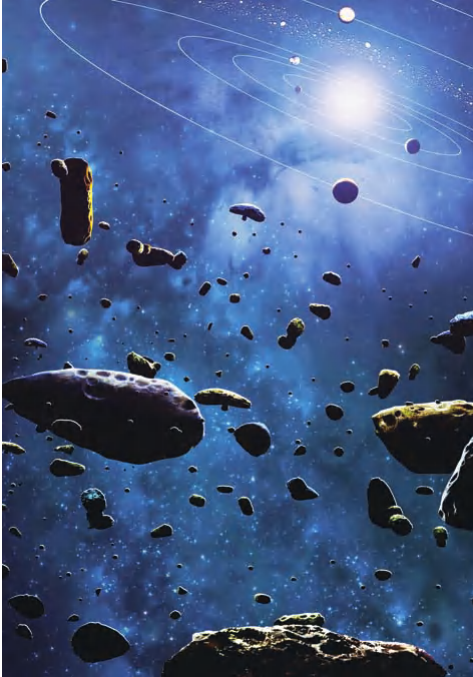
Computer artwork of main asteroid belt of the solar system (not to scale), between orbits of Mars and Jupiter (Mark Garlick/Photo Researchers, Inc.)
In summary, meteorite classification provides a systematic framework for tracing the origins of these cosmic samples. From pristine chondrites holding the recipe of the solar nebula to differentiated achondrites, irons, and stony-irons from shattered protoplanets, each group offers a unique window into the processes of planetary formation, differentiation, and destruction that have shaped our solar system over 4.5 billion years.
Date added: 2026-07-14; views: 111;