
Simple Diffusion: Definition, Mechanism, and Factors Affecting Molecular Movement
All molecules, whether in solids, liquids, or gases, exhibit continuous motion or vibration driven by thermal energy. This kinetic energy increases with temperature, causing molecules to move more rapidly. In solutions, these molecules undergo constant, random collisions—millions per second—which abruptly alter their direction of travel. Consequently, the path of any single molecule is unpredictable and entirely random, with no inherent directional preference.
This random thermal motion leads to the uniform distribution of molecules throughout an available space over time. If a solute is initially concentrated in one region of a solution (Figure 4.1a), its molecules will spread from the area of higher concentration to the area of lower concentration via this motion until a uniform concentration is achieved (Figure 4.1b). This passive movement driven solely by random molecular kinetic energy is defined as simple diffusion.
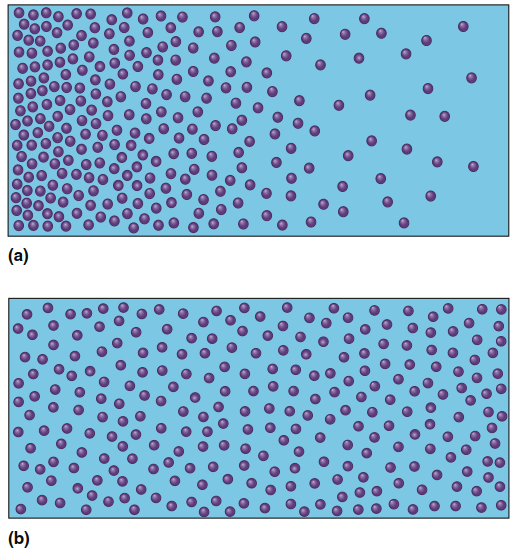
Figure 4.1. Simple diffusion. (a) Molecules initially concentrated in one region of a solution will, due to random thermal motion, undergo net diffusion from the region of higher concentration to the region of lower concentration. (b) With time, the molecules will become uniformly distributed throughout the solution
A critical understanding is that molecules do not move purposefully toward a goal. Their movement is stochastic. However, the statistical probability favors net movement from high-concentration regions to low-concentration regions simply because more molecules are present to move away from the higher concentration area. At diffusion equilibrium, molecular motion continues randomly but with equal flux in all directions, resulting in no net concentration change.
Simple diffusion is a fundamental process in biological systems. It governs the exchange of gases like oxygen and carbon dioxide, the movement of nutrients and wastes across capillary walls, and the passive transit of many substances through plasma membranes and organelle membranes. As a key passive transport mechanism, it is essential for maintaining cellular homeostasis. Herein, "diffusion" will refer to simple diffusion unless specified otherwise, distinct from the carrier-mediated facilitated diffusion discussed later.
Magnitude and Direction of Diffusion. The dynamics of diffusion can be modeled between two compartments separated by a permeable barrier. Consider glucose initially at 20 mmol/L in compartment 1, with compartment 2 containing none (Figure 4.2). The random movement of glucose molecules creates a one-way flux from compartment 1 to compartment 2. This flux is directly proportional to the concentration in the source compartment; doubling the molecule count doubles the flux, as twice as many molecules are available to move in any direction.
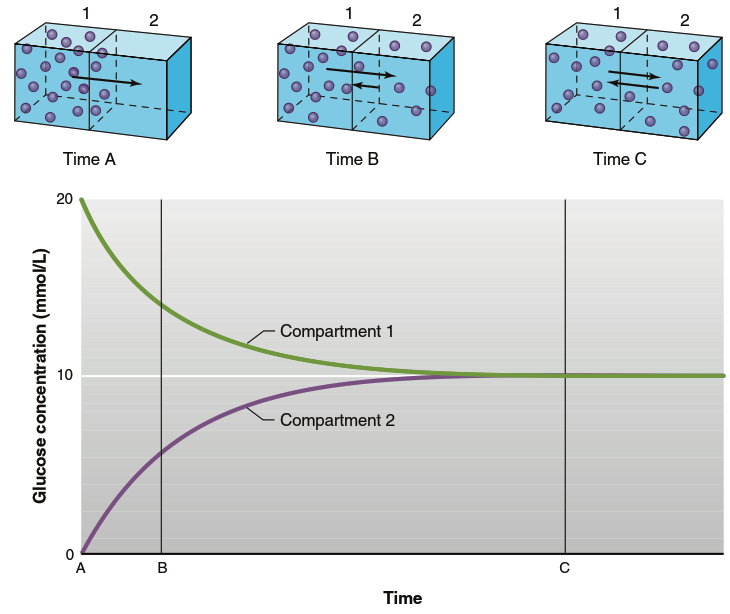
Figure 4.2. Diffusion of glucose between two compartments of equal volume separated by a barrier permeable to glucose. Initially, at time A, compartment 1 contains glucose at a concentration of 20 mmol/L and no glucose is present in compartment 2. At time B, some glucose molecules have moved into compartment 2 and some of these are moving back into compartment 1. The length of the arrows represents the magnitudes of the one-way movements. At time C, diffusion equilibrium has been reached, the concentrations of glucose are equal in the two compartments (10 mmol/L), and the net movement is zero. In the graph at the bottom of the figure, the green line represents the concentration in compartment 1, and the purple line represents the concentration in compartment 2. Note that at time C, glucose concentration is 10 mmol/L in both compartments. At that time, diffusion equilibrium has been reached.
After some glucose enters compartment 2, a reverse flux from compartment 2 back to compartment 1 begins (Figure 4.2, time B). The magnitude of this reverse flux depends on the instantaneous concentration in compartment 2. The net flux at any moment is the arithmetic difference between these two opposing one-way fluxes. This net flux dictates the rate of net gain in the receiving compartment and net loss from the source compartment.
The system progresses until concentrations equalize at 10 mmol/L in both compartments. At this diffusion equilibrium (Figure 4.2, time C), random molecular movement continues, so one-way fluxes persist. However, they become equal in magnitude and opposite in direction, resulting in a net flux of zero. No further net change occurs, as the rates of molecular exchange are balanced.
Key Factors Influencing Net Flux. This model highlights three distinct fluxes: the two opposing one-way fluxes and the resultant net flux (Figure 4.3). The net flux is the critical measure of material transfer rate. Although individual molecular motion is random, the net flux is always directional from regions of higher concentration to lower concentration, described as moving "downhill." The concentration difference, or concentration gradient, is the primary determinant of both the direction and the magnitude of the net flux.
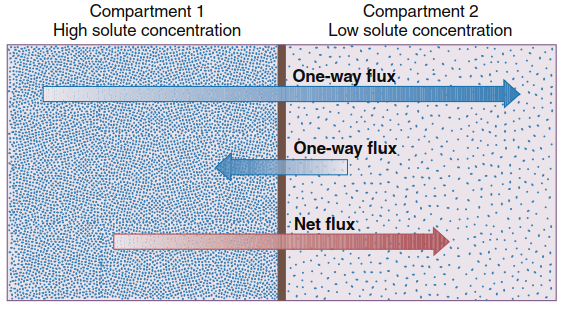
Figure 4.3. The two one-way fluxes occurring during simple diffusion of solute across a boundary and the net flux (the difference between the two one-way fluxes). The net flux always occurs in the direction from higher to lower concentration. Lengths of arrows indicate magnitude of the flux.
For a given concentration gradient, the magnitude of the net flux is modulated by several physical factors:
1. Temperature: Increased temperature raises molecular kinetic energy, accelerating movement and net flux.
2. Molecular Mass: Larger molecules (e.g., proteins) have greater mass and move more slowly than smaller molecules (e.g., glucose), leading to a slower net flux.
3. Surface Area: A larger cross-sectional area for diffusion allows more molecules to pass per unit time, increasing the net flux.
4. Medium Properties: Molecules diffuse faster in gases (like air) than in liquids (like water) due to fewer intermolecular collisions. When diffusion occurs across a plasma membrane, the membrane's specific lipid composition and thickness become additional, critical determinants of the rate.
In summary, simple diffusion is a passive, entropy-driven process vital for cellular function. Its rate and direction are governed by the concentration gradient and influenced by temperature, molecular size, available surface area, and the physical properties of the diffusion medium.
Date added: 2026-07-14; views: 94;