
Biodiversity: Definition, Patterns, and Ecosystem Functions
Biological diversity—or biodiversity—is one of the most striking elements of planet Earth and has always fascinated people. By provisioning food, shelter and all materials needed for survival, biodiversity has been the very foundation of human life for thousands of years. Perhaps not surprisingly, early human cultures obviously adored the many creatures living with them, and they left remarkable legacies of their view of life in the oldest human cave paintings, dating back to the Upper Palaeolithic, approx. 17,000 years BC.
The many naturalists and artists travelling around the world in the seventeenth and eighteenth centuries also beautifully documented the astonishing diversity of life as they entered new territories. Even today, biodiversity is an inexhaustible source of inspiration and creativity in arts, and many people make excursions to watch birds and plants or to simply enjoy being outside in nature. The affinity towards and admiration of the rich diversity of life forms and ecosystems around us are obviously fundamental features of human life, which has been recognised as the biophilia hypothesis by Erich Fromm (1964) and Edward O. Wilson (1984).
Biodiversity has also been an important subject of study in ecology: trying to understand the development of biodiversity over time, the causes of its spatial distribution, and more recently, its functional implications, are some of the topics that scientists continue to work on. It has been found that biodiversity developed through evolutionary processes by adaptation to abiotic conditions and resources and in interaction with established competitors, herbivores or pathogens. But why do some plants form communities with few species and others with many species? What regulates the assembly of species, and how does this influence ecosystem processes? What kind of human management results in losses or gains in biodiversity? The answers to these and other questions remain largely unknown (Fig. 20.1).
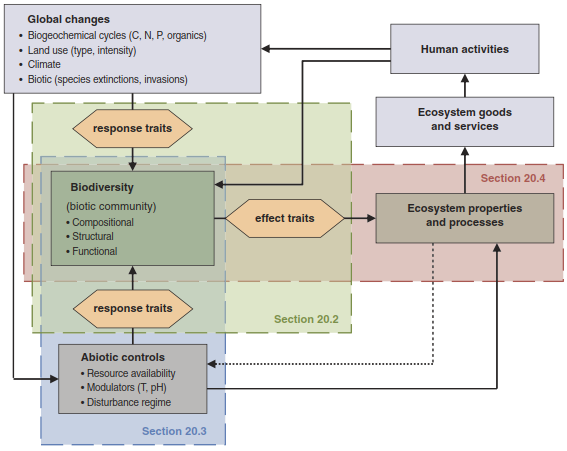
Fig. 20.1. Conceptual framework of this chapter. The biotic community can be characterised by different biodiversity components (Sect. 20.2). Biodiversity is controlled by the environment (Sect. 20.3) but also affects ecosystem functioning (Sect. 20.4). Interactions within biotic communities are described in Chap. 19, while influences and feedbacks between ecosystem services, human activities, global changes and ecosystems are dealt with in Chap. 23. Solid lines represent direct influences and the dotted line shows a feedback loop. Modified from Hooper et al. (2005), reproduced with permission from John Wiley & Sons
Beyond science, biodiversity attracted the interest of the general public following the Earth Summit in Rio de Janeiro in 1992, as a result of which the conservation of biodiversity, the sustainable use of its components and the fair and equitable sharing of the benefits arising from the utilisation of genetic resources became regulated (United Nations Convention on Biological Diversity, CBD). People from all walks of life, including politicians, became aware of the global loss of species, a loss caused by a situation in which human influences grew to become significantly greater than natural rates of extinction.
Scientists recognised that knowledge of biodiversity was rather modest and feared that numerous organisms would become extinct without ever having been scientifically recorded. Since that time, research on the functional consequences of biodiversity has gained strong momentum. Mere numbers of species were not regarded sufficient to understand communities in their habitats; it was recognised that other aspects of biodiversity, such as the functional characteristics of species, also play an important role in how ecosystems work. Plants and animals were to be regarded not only as resources but as decisive factors controlling processes in ecosystems.
Currently, ecosystems are being increasingly disturbed by different drivers of global change, including altered biogeochemical cycles and eutrophication, changing land use and its intensity, changing climate and biotic changes (Chap. 23). In consequence, habitats and species are being lost and gained, while new conditions are created by human interference; for instance, human management is responsible for the previously unknown diversity in traditional agricultural landscapes of central Europe. Therefore, it is very urgent to clarify important questions on the development, loss and function of biodiversity.
This chapter presents the various facets and definitions of biodiversity, focusing on compositional, structural and functional aspects, where feedbacks between ecosystem services, human activities, global changes and ecosystems are dealt with in Chap. 23. Solid lines represent direct influences and the dotted line shows a feedback loop. Modified from Hooper et al. (2005), reproduced with permission from John Wiley & Sons also the concept of plant traits will be introduced (Sect. 20.2). In a subsequent part, observed patterns of biodiversity in response to environmental factors will be presented (Sect. 20.3). Finally, Sect. 20.4 discusses the effects that biodiversity changes have on the properties and functions of ecosystems. The effects of management and human activities are dealt with in Chaps. 17 and 23.
Date added: 2026-04-26; views: 254;