
Influences of Abiotic Environment on Plant-Animal Interactions
The interactions between plants and their abiotic environment can influence plant-animal interactions to a similar extent as the interactions between plants and one type of animal can affect their interactions with another type of animal. A well-known case is, for example, UV radiation. Field experiments show that plants as different as southern beeches (Nothofagus spec.) and jim- sonweed (Datura spec.) ward off insect herbiv- ory more effectively if they had received higher UV-B radiation during plant growth (Ballare et al. 1996; Rousseaux et al. 2004).
The underlying mechanism is called priming and relies on the fact that either the same or biochemically similar components are used in defence against biotic and abiotic stressors. Plants can thus react more quickly or more vigorously against a second stressor (e.g. herbivores) if UV radiation had already stimulated the production of defensive compounds or precursors thereof. Priming is an important phenomenon in plants because they cannot spatially evade their stressors and predators. This can also explain why in species that are polymorphic in floral colour it is usually the anthocyanin-pigmented morph that is not only more tolerant to abiotic conditions such as drought, extreme temperatures and high irradi- ance but also avoided by herbivores (Strauss and Whittall 2006).
Many complex phenotypes in plants may be best explained by the interplay between abiotic and biotic factors acting upon plant traits. This probably applies to the conspicuous changes in leaf colouration during senescence but also in emerging leaves because this colour change is strongly influenced by illumination and temperature but can also affect herbivores. It likewise applies to the red colouration of peduncles and pedicels in the infructescences of many plant species from different families (Fig. 19.30).
Again, the colouration of peduncles is typically a light- induced response—suggesting that non-green pigmentation serves primarily a photoprotective function—but it can also serve a communicative function to attract seed dispersers by increasing conspicuousness through contrasts to the green foliage and through indicating the quality of nutritional fruit rewards, which is typically higher in strongly illuminated plants owing to higher photosynthetic rates (Schaefer and Braun 2009). The environmental effects on plant-animal interactions provide a mechanistic explanation for why coevolutionary dynamics between populations of plants and animals are temporally and spatially variable (Thompson 2005).
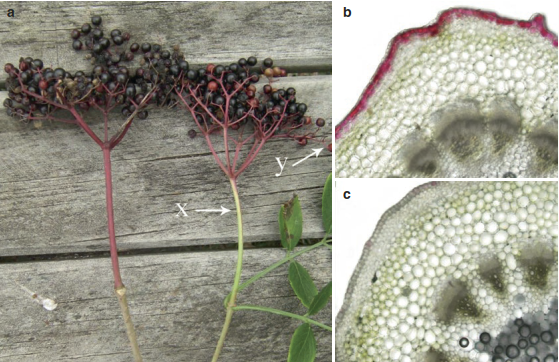
Fig. 19.30. Phenotypic plasticity influencing seed dispersal. The red peduncles of black elder (Sambucus nigra) are a stress response that may also be related to senescence, and they attract seed dispersers to the infructescence. The peduncles (X) vary predictably in their colour from red to green a according to the intensity of ambient light. Pedicles (Y) are mostly red. Anthocyanin pigmentation in the peduncle is restricted to the outermost layers of hypodermal collenchyma b and absent in green peduncles c. (Cooney et al. 2015)
In sum, plants use biochemicals to mediate their interactions with the biotic and abiotic environment. They interact simultaneously with a variety of organisms and abiotic factors. These interactions are interdependent, which leads to variable outcomes depending on the composition of the community and the abiotic environment. The interdependence of plant-animal interactions makes the study of plant ecology a particularly fascinating and intellectually challenging topic. An important implication is that, similar to other fields of ecology, care needs to be taken when generalising from single studies. Nevertheless, many dynamics in the market between plants and their interacting organisms have been elucidated. One of the lessons from those studies and the many factors acting upon plants is that studies should thrive to assess the relative importance of different selective forces in order to understand the evolution of the ecological processes in plants.
References:Aarssen LW (1989) Competitive ability and species coexistence: a “plant’s-eye” view. Oikos 3:386-401
Adler LS (2000) The ecological significance of toxic nectar. Oikos 91:409-420
Agosta SJ, Klemens JA (2008) Ecological fitting by phenotypically flexible genotypes: implications for species associations, community assembly and evolution. Ecol Lett 11:1123-1134
Antor RJ, Garcia MB (1995) A new mite-plant association: mites living amidst the adhesive traps of carnivorous plants. Oecologia 101:51-54
Archetti M (2000) The origin of autumn colours by coevolution. J Theor Biol 205:625-630
Ballare CL, Scope AL, Stapleton AE, Yanovsky MJ (1996) Solar ultraviolet-B radiation affects seedling emergence, DNA integrity, plant morphology, growth rate, and attractiveness to herbivore insects in Datura ferox. Plant Physiol 112:161-170
Belnap J, Lange OL (eds) (2001) Biological soil crusts. Structure, function and management, Ecological studies, vol 150. Springer, Berlin
Bergstrom G, Dobson HEM, Groth I (1995) Spatial fragrance patterns within the flowers of Ranunculus acris (Ranunculaceae). Plant Syst Evol 195:221-242 Bertin RI (1989) Pollination biology. In: Abrahamson WG (ed) Plant-animal interactions. McGraw-Hill, New York, pp 23-83
Date added: 2026-04-26; views: 254;