
Bowl with story of Jonah
North Africa, 2nd half 4th century Red earthenware Diam. 18.8 cm. Mainz, Romisch-Germanisches Zentralmuseum, 0.39677. The bowl was broken into several pieces, none missing. Around the border and in the center runs a pattern of incised lines.
The story of Jonah is depicted in four episodes: a boat sailing to the right with three men (heads only), the nude Jonah being thrown overboard, and the ketos approaching from the right, ready to swallow him (Jon. 1:15); the nude Jonah sitting on rocks with a pensive gesture, looking to the right; Jonah disgorged by the monster (Jon. 2:11); and Jonah nude, resting under the gourd vine, his right arm stretched out pointing at it (Jon. 4:6).
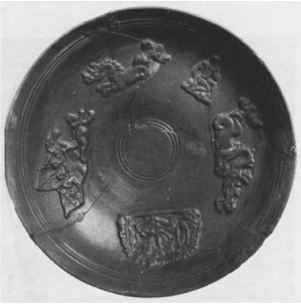
This cycle presents several iconographical peculiarities : usually the sailors are represented in half or full figure, one of them throwing Jonah overboard (no. 361). Parallels to the relief on the bowl showing only the heads of the sailors occur on other redware (e.g., bowl in the Staatliche Museen, Berlin; fragments in the Benaki Museum, Athens, of Egyptian origin; and in the Museum of Djemila [Salomonson, 1969, pp. 45, 99, 103, figs. 119, 54]).
The figure of the sitting Jonah is rare, and it is not quite clear which scene is represented, perhaps Jonah's distress (Jon. 4:1) or Jonah contemplating the fate of Nineveh (Jon. 4:5); the scene is not in chronological order, perhaps for reasons of composition. A similar picture occurs in several catacomb paintings, but Jonah is sitting under the gourd vine (Mitius, 1897, pp. 38-40; Wilpert, 1903, p. 348). Another peculiarity appears in the last scene: Jonah, usually depicted asleep with one arm bent over his head, is shown awake. Close parallels to this are found on two redware fragments published by Garrucci (1881, VI, pi. 465, figs. 3, 4), now lost; it is even possible that the same matrix was used (Salomonson, 1969, figs. 82, 83).
The style is naturalistic and vigorous but not very refined. The artist is interested in showing details, such as the terrifying body of the monster. The bowl belongs to the group of redware classified by Salomonson (1969, pp. 17, 101) as sigillata chiara C, form A (cf. no. 379). These bowls were widespread in the Mediterranean region. Some of them have been found in tombs in North Africa. For the significance of the theme, see no. 385.
Date added: 2026-07-14; views: 152;