
Wall painting with the Three Hebrews in the Fiery Furnace
Rome, late 3rd-beginning of 4th century Fresco. 50 x 87 cm. Catacomb of Priscilla. The fresco is located on the right-hand wall of the cubiculum of the Velatio. Damage to left shoulder of central figure; bottom part (with furnace) destroyed by a later tomb cut into the wall below.
The three Hebrews wearing green crested caps and green Oriental dress adorned with a yellow (golden) girdle and stripe, are standing in frontal position, arms raised in the orant gesture. Red flames lick up at their feet. Of the furnace only a few brown stones are still extant. Above the Hebrews, a dove flies from the right with a twig in its beak.
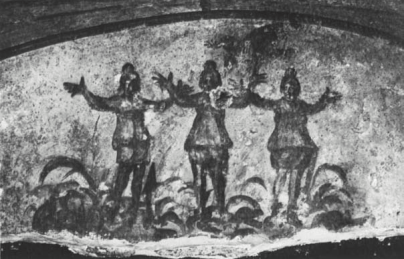
The miracle of the Three Hebrews in the Fiery Furnace is recorded in Dan. 3, the prayer in the furnace occurring in the Greek text only (verses 24-90). The representation of this theme in Early Christian art (no. 374) must be seen against the background of contemporary piety, which understood the three Hebrews as a paradigm of steadfast belief and deliverance from death. In the Velatio chamber this significance is clearly expressed by their placement opposite Abraham sacrificing Isaac; both scenes are linked as types of obedience and salvation from death. The motif of the dove with the olive twig, apparently unique with the depiction of the three Hebrews and adapted from the Noah scene, adds to the symbolic aspect.
The colors are applied in irregular bright patches, the contours heavily lined in dark colors, the figures flat but organic. The placement of the Velatio paintings in the stylistic development of the period and, consequently, their dating are controversial. Suggestions range from 230-240 (de Wit, 1938, p. 30) up to the Tetrarchic period (Hempel, 1956); for controversial datings, see Dassmann, 1973, p. 15 n. 41. Kollwitz (1969) places them at the beginning of the fourth century, and Tolotti, in his recent topographical study (1970), concurs. The fresco belongs to the early phase of this pictorial theme and possibly is the earliest occurrence. The cubiculum was discovered in 1593 by A. Bosio, the first systematic explorer of Roman catacombs, and was published in his Roma sotter- ranea, 1632.
bibliography: Wilpert, 1903, p. 358, pi. 78 fig. 1; Hempel, 1956, pp. 44-45; Kollwitz, 1969, pp. 40-44; du Bourguet, 1970, p. 25; Tolotti, 1970, pp. 195-198; Dassmann, 1973, pp. 15, 63-75, 258-259, 434-436; Nestori, 1975, p. 23, no. 7.
Date added: 2026-07-14; views: 159;