
Bowl with scenes from the Old Testament
Cologne, 326 Gold glass. 8.6 cm., diam. 11.4 cm. Cologne, Romisch-Germanisches Museum, 991. The hollow-cast bowl has been broken several times and glued back together; a small piece of the edge has been restored. The circular pattern was first cut into the interior of the glass bowl. Then a thin gold foil was attached to the outside, and representations were incised on it. Through renewed heating the gold was bound to the glass. Contrary to custom, there was no second layer of glass applied here to cover the gold foil. Therefore, the gold foil is lost, save for very few traces.
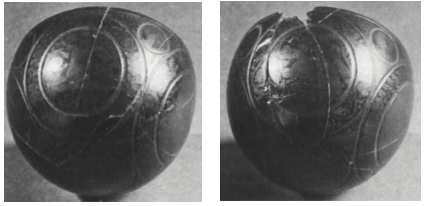
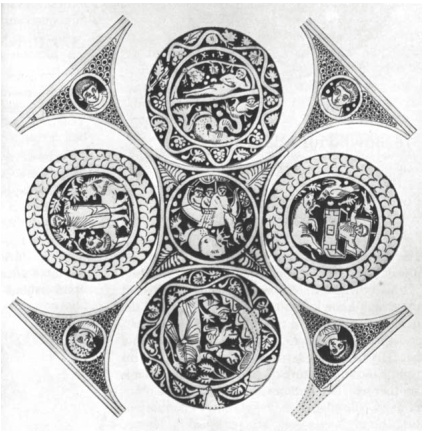
The sides of the hemispherical bowl are divided into four large medallions framed by broad leaf ornaments. A fifth, smaller medallion is at the bottom. Each depicts a scene from the Old Testament. In the center, Jonah is thrown to the sea monster from a boat with shortened sails. The other two episodes from the Jonah trilogy, Jonah cast up by the sea monster and his rest under the gourd vine, have been combined in the medallion above. In the medallion on the right, Noah appears as an orant in the ark, which is formed like a chest with a lock. At the upper left is the dove with the olive branch, and below the raven that was sent out first, pecking out the eye of a drowned cow. The. raven's pecking is told only in Jewish and Christian legends (Gutmann, 1977). It is also depicted, among other examples, in the fresco of S. Paolo fuori le mura in Rome. The fourth medallion shows Moses Striking the Rock, with three Israelites drinking from the gushing water, and the fifth, Daniel in the lions' den, standing, like Noah, as an orant between two lions. He is not naked here (cf. no. 371), but is clothed in a short tunic, a feature attributed by Klauser ([2], 1961, p. 180) to Jewish influence, since the rabbis had prescribed some form of clothing during prayer at least since the second century.
In the spandrels are four smaller medallions with busts of the sons of Constantine the Great, starting to the right of Jonah with Crispus, Constantius II, Constantinus II, and Constans. Most probably this precious bowl was made on the occasion of Constantine's vicennalia in 326; in the following year Crispus died and suffered damnatio. The Cologne glass, then, is one of the few monuments of the minor arts from Constantine's time with a fixed date. It is also the best-preserved and most beautiful example of Early Christian gold glass.
The scenes from the Old Testament in funeral art symbolically refer to the deceased. Here, however, since they adorn an object from daily life, they show that in Early Christian art the same biblical themes were used for the sepulchral realm and daily life, especially in the decorative arts.
The hemispherical form of the bowl, the incised circles, and the many figured scenes suggest an origin in Cologne (Fremersdorf, 1967). La Baume (1974) presumes an imperial workshop in Rome, the place where Constantine celebrated his vicennalia. The bowl was found in Cologne together with an earthenware pot as a funeral gift in a sarcophagus, which can be dated by its form to the first half of the fourth century.
bibliography: Fremersdorf, 1930, I; Cologne, 1965, pp. 70-73, figs. 17-18; Reusch, 1965, no. 124; Cologne, 1967, no. D 101; Fremersdorf, 1967, pp. 203-207, pis. 285-293; La Baume,T974, no. I 3, pi. 46, fig. 4.
Date added: 2026-07-14; views: 171;