
Diptych with Old and New Testament scenes
Rome (?), about 400. Ivory. 29.6 X 12.7 cm. Florence, Museo Nazionale del Bargello, Carrand Collection 20. The two leaves of this well-preserved diptych oppose scenes from the Old and New Testaments. On the left, Adam is seated in paradise surrounded by animals (from upper left): eagle, bird, leopard, lioness, lion, bear, boar, fox, elephant, horse, goat, lizard, serpent, ox, grasshopper, sheep, stag, and doe. The four rivers of Eden are depicted at the bottom of the plaque. Whereas the scene may relate to the naming of the animals described in Gen. 2:20, the carver, who fashioned his portrayal after representations of Orpheus (no. 161), may have intended only a general reference to Adam in paradise. The right leaf illustrates episodes from the Acts of the Apostles.
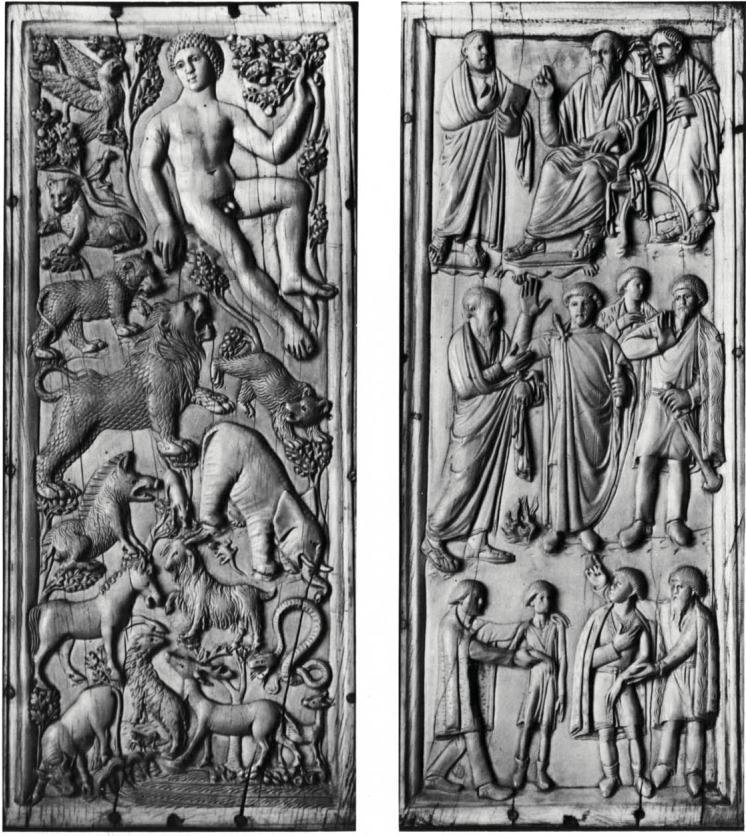
At the top, Paul (recognizable by his bald head and beard) addresses a man who stands on a platform before him. The scene may portray Paul in Caesarea, defending his belief in Christ's Resurrection to King Agrippa (Acts 25:13-32). The following scenes present two miraculous events that took place when Paul was shipwrecked on Malta. Paul is attacked but not killed by a viper that had emerged from a fire (Acts 28:1-6). The sick men of Malta are brought to Paul to be healed (Acts 28:7-10); one of them clearly is Publius' father, who was wasted by "recurrent bouts of fever and dysentery"; the other suffers from a paralyzed arm.
The refined style and precise execution of the diptych recall the finest ivories of the Early Christian period—among others, the Brescia casket (fig. 87) and Stilicho diptych in Monza (Volbach, 1976, no. 63). The supple draperies revealing limbs beneath the garments, clear details, differentiation of textures, and varied poses display striking affinities with features of these and other ivories produced in Italy around the turn of the fifth century. Several scholars have, nonetheless, attributed the diptych to Constantinople. Stylistic disparities occur between the two wings, probably because the Genesis and Acts scenes were copied from different models and were intended to serve different purposes. The Old Testament depiction is a single, bucolic image in which figures are important but in which space is not needed to present action; the illustrations from Paul's life, on the other hand, were taken from an illustrated Book of Acts and are strictly narrative in character.
The unusual juxtaposition of Adam with scenes of St. Paul may reflect fifth-century religious concerns. The illustrations of Acts 25-28 on the ivory are extremely rare in the history of medieval art, and it may be significant that the best parallels to them are found among the nearly contemporary frescoes in S. Paolo fuori le mura (no. 439). The miracle of the viper had special meaning in Rome at the start of the fifth century. Prudentius opens his powerful defense of Christianity against the pagan aristocracy in Rome, Contra orationem Sym- machi (written about 405), by recounting the episode at length. He likens the viper that attacked Paul to the Roman prefect Symmachus, whose “poisonous talent was poured out without effect and stopped short on the surface of the Christians' skin" (1. 78-79 [Thomson, 1962,1, pp. 345-349]). In this context, Adam in paradise would simply stand for the commencement of the sacred history, while the scenes from Acts would recall Paul, “the herald of God, who first with his holy pen subdued the wild hearts of the Gentiles and . . . propagated the knowledge of Christ" (1. 1-3). According to Prudentius, Paul's mission was being completed just when the diptych was produced in Rome, a city “still sick with pagan errors."
Reported first in the region of Mainz, the diptych entered the Museo Nazionale del Bargello as part of the Carrand collection.
bibliography: Volbach, 1976, no. 108.
Date added: 2026-07-14; views: 255;