
Relief with Good Shepherd
Italy, late 3rd-early 4th century. White marble. 36x 30x 7 cm. Princeton, The Art Museum, Princeton University, 52-169. The relief is in good condition with only slight fracturing at the edges and on the back. It is presumed to have belonged originally to a larger relief panel, probably from a sarcophagus; if so, it has been cut down and finished on the sides. The relief is chiseled and drilled; the back is roughly hewn.
The figure of a shepherd stands beneath an architectural frame of a pedimented gable resting on two spirally fluted Corinthian columns. The shepherd is dressed in a belted, sleeved tunic, laced boots, and leggings. He supports a ram on his shoulders, grasping its legs with both hands, and two rams are at his feet. The shepherd is represented as a beardless, Apollo-like figure, his hair fashioned from large, irregularly ordered, circular locks. At either side grow broadleaved plants or trees; in the left one sits a large bird.
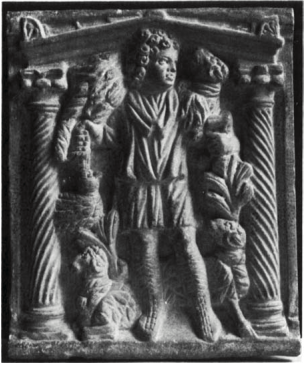
The youthful ram-bearing shepherd has a long tradition of pagan usage (offering bearer, bucolic figure, personification of Winter, Hermes psy- chopompos), but in the Late Antique period this image acquired a general philanthropic savior symbolism. As such it was adopted by the Christians as the Good Shepherd (John 10:1-16; Luke 15:3-7)—Christ as the Savior of the Christian flock (Clem. Al. Protr. 11. 116. 1). In funerary contexts, the shepherd image manifested the doctrinal belief in the salvation of the soul, being similar in intent to Noah, Daniel, and Jonah imagery, and it remained a viable "substitute" image for Christ through the early Constantinian period (first quarter of the fourth century). It then lost favor to more specific representations (cf. nos. 386, 472, 503).
The broadness of the chisel strokes, the summary treatment of patterns and textures, and especially the exaggerated size of the compositional parts (fingers, face, leaves, fleece) suggest that this relief is to be dated to the Tetrarchic to early Constantinian period (late third to early fourth century). It compares favorably with sarcophagi thought to have been produced in Ostia (cf. Stern [2], 1973, figs. 7-9).
The present state of its preservation leaves in question an understanding of the relief's function. If it came from a sarcophagus, it probably served as the central or left end section in the five-part program of a strigilated sarcophagus, although its height would suggest a sarcophagus of unusually small size. Alternatively, it may have been part of a double register sarcophagus or part of a sarcophagus lid frieze.
Provenance unknown. bibliography: Jones, 1954, p. 243, ill.; Calkins, 1968, no. 4, p. 102, ill.; Waltham, 1968, no. 30, pi. 17.
Date added: 2026-07-14; views: 299;