
Bottom of bowl with traditio legis
Rome, late 4th-early 5th century. Gold glass. Max. W. 12.4 cm. Toledo, Ohio, The Toledo Museum of Art, Gift of Edward Drummond Libbey, 67.12. The glass is broken irregularly around the edge, cutting off part of the gold design in the lower right. The surface is blurred in places, and many small air bubbles are trapped between the layers of glass. The scene of the giving of the law is surrounded by a square frame with four triangular motifs at the sides. Christ, with short hair and beard, stands on the rocky mount of paradise, beneath which a river flows. He raises his right hand in proclamation; with his left he hands a slender scroll, inscribed dominus LEGE(m) dat, to Peter on the right. The apostle holds a cross-staff in his left hand and receives the scroll in his covered right hand. Paul acclaims Christ on the left. From beyond the picture frame, two date palms arch over the apostles; a nimbed phoenix perches in the tree behind Paul.
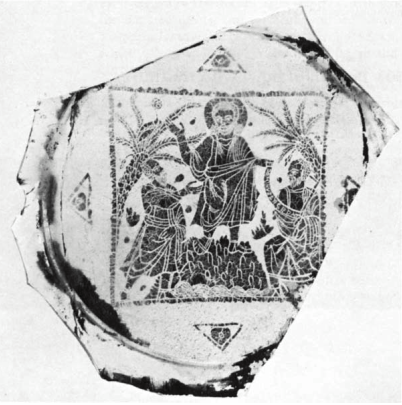
The glass is closely related to a fragment in the Vatican (Morey, 1959, no. 78), not only in the arrangement of the figures but also in such details as the river—identified as the Jordan on the Vatican piece—and in the abbreviated foliage of paradise scattered over the background. The themes of Christ's majesty, of resurrection and rebirth in Christ through baptism, so important to the traditio legis, are clearly emphasized (see Schumacher [1], 1959, pp. 151-152). The Toledo scene, however, is considerably abbreviated, omitting the apocalyptic vision of the lambs in the exergue of the Vatican glass. It also differs in such details as the young Christ (cf. mosaic of Sta. Costanza, fig. 74) and the pose of the figures (cf. incised plaque at Anagni [Testini, 1973-1974]).
The similarities in iconography of the two glass medallions indicate that they were probably made in the same Roman workshop, but the Toledo fragment is by a different artist. The figures on our piece are more linear and more incisively designed. Considerable attention was given to the engraving of the faces, where the eyes, especially of Peter, are elegantly elongated. They resemble the eyes of Peter and Paul on a gold glass in Verona dated in the late fourth century (Zanchi Roppo, 1969, no. 262).
The glass was in the Sangiorgi collection, Rome. bibliography: Riefstahl, 1967; Toledo, Ohio, 1969, p. 29; "Recent Important Acquisitions,” 1969.
Date added: 2026-07-14; views: 308;