
Two plaques with SS. Peter and Paul
South Gaul, 5th century. Ivory. Each, 29.2 x 11.4 cm. New York, The Metropolitan Museum of Art, Gift of J. Pierpont Morgan, 1917, 17.190.54, 55. The plaques depict two youthful saints: Peter holding his keys and another apostle, probably Paul, holding a book, both with draped hands. (Occasionally, Paul and Peter are shown with short hair and beardless; cf. no. 507.) St. Peter's plaque is broken on the upper sides and top. The background of both plaques is very thin; a number of breaks occur around the figures. Incisions, perhaps for hinges, are cut on the back inner sides, and the ivories are pierced by numerous nail holes. The apostles, dressed in himation and chiton, are placed in arcades consisting of broadly faceted columns with Corinthian capitals and arches decorated with four sheep proceeding from two city gates, Jerusalem and Bethlehem, toward a central cross.
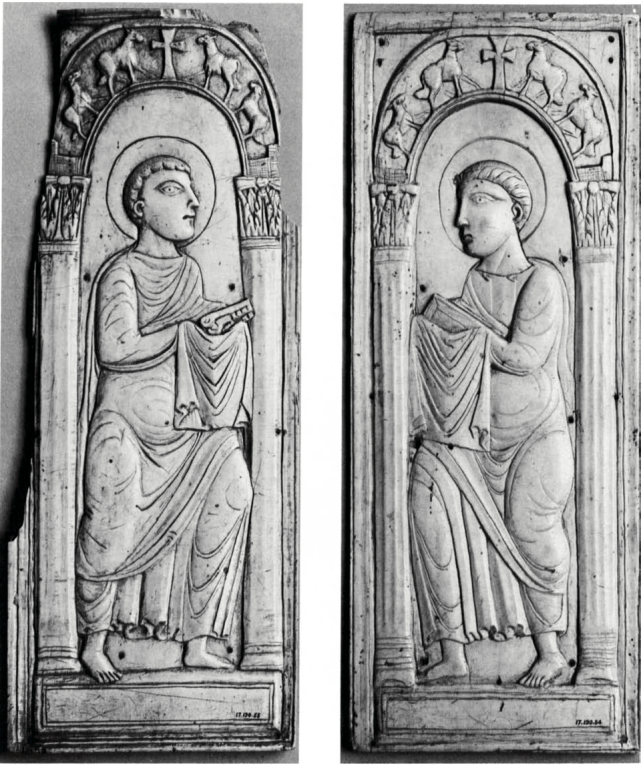
It has been conjectured that Peter and Paul walk toward Christ enthroned on a lost central plaque (Friend, 1923, p. 59), carrying before them the symbols of their apostolic mission. Similar homage scenes with apostles acclaiming Christ decorated the apses of several fourth- and fifth- century churches in Rome (Ihm, 1960, pp. 15-21) and were frequently depicted on sarcophagi (e.g., Le Blant, 1886, pi. xi; Bovini and Brandenburg, 1967, I, no. 678). The apocalyptic vision of the lambs sometimes accompanied these homage scenes (e.g., Pola casket, fig. 83 [Buddensieg, 1959; Ihm, 1960, pi. vi]), although it was more commonly shown with the traditio legis (Nikolasch, 1969, p. 40). The lambs' portrayal in the arcades is unique on these ivories, however. Morey (1953, p. 176) suggests mensa tables as a possible source (see no. 576).
Dated in the late fifth century, the plaques are closely related in style to a group of ivories that has been localized in the West (Delbrueck [1], 1952, pp. 186—187) and, based on their resemblance to late fourth-century sarcophagi, to southern Gaul (Volbach, 1952, p. 49). Arresting parallels for the carving of the faces of Peter and Paul, and for the mannered drapery that flattens and widens their bodies are found on two sarcophagi in Marseilles and Arles (Benoit, 1954, nos. 10, 37). The Metropolitan plaques, however, stand alone among fifth- century ivories in their extreme reduction of human and architectural forms (see Morey, 1953, pp. 176-177, and Clemen, 1892, pp. 129-130).
Although the use of the plaques has not yet been determined, they may have decorated a piece of liturgical furniture, perhaps an episcopal throne, as Friend suggested (1923, pp. 58-59; cf. figs. 60, 65).
Formerly in the parish church of Kranenburg in West Germany (see Schnitzler, 1957, I, no. 38). bibliography: Volbach, 1976, no. 147.
Date added: 2026-07-14; views: 326;