
Plaques with scenes of the infancy and miracles of Christ
Rome, 410-420. Ivory. 406: 20 x 8.1 cm. Berlin, Staatliche Museen Preussischer Kulturbesitz, Fruhchristlich-Byzantinische Sammlung, 2719. 407: 19.5 x 7.7 cm. Paris, Musee du Louvre, OA. 7876, 7877, 7878.
In both plaques small pieces broken off at the rim, several drill holes; the three sections of the Paris plaque have been separated into three pieces and their frames are partly broken off or trimmed down.
The cycle of the infancy of Christ begins with the massacre of the innocents at Bethlehem on the plaque in Berlin: under Herod's orders a soldier smashes a newborn child to the ground, while two wailing mothers stand behind him. The Baptism of Christ in the River Jordan follows, the river extending over the entire height of the scene; from the beak of the dove at the top a ray falls upon Christ. The Miracle of Cana occupies the lowest field. The three panels in Paris show the miraculous healing of the Gerasene possessed by demons, together with the herd of swine into which the demons went; the healing of the woman with the issue of blood; and the healing of the paralytic, who carries off his sickbed. Each scene is framed by an egg-and-dart motif.
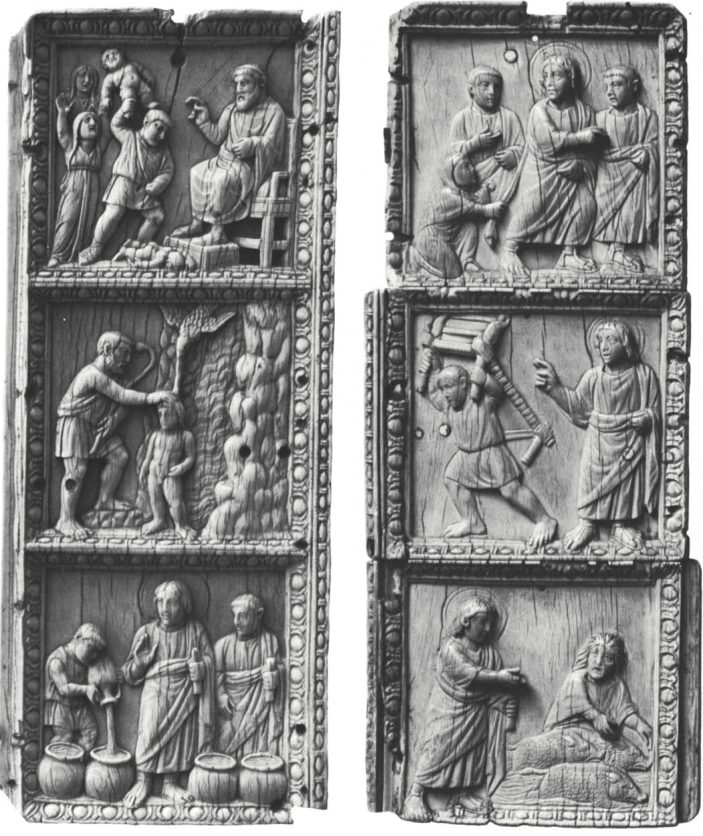
These representations follow to a large extent the iconography of Roman sepulchral art. The massacre of the innocents finds its nearest parallel in the Lot sarcophagus of the S. Sebastiano catacomb in Rome (Bovini and Brandenburg, 1967, I, no. 188). This scene reappears on the five-part ivory diptych in the treasury of the Cathedral of Milan (fig. 64), in which several other unusual details also correspond—for instance, the cornucopia of one of the Magi and the pointed amphora in the Miracle of Cana. The tablets in Berlin and Paris must on stylistic grounds be assigned to a larger group of metropolitan Roman ivories to which the Reider tablet in Munich (fig. 67), the Lampadii diptych (Volbach, 1976, no. 54), and the small London Passion tablets (no. 452) also belong. Their extraordinarily careful execution— the softly modeled transitions, especially in the garments, and the different motions of the figures and inclinations of their heads—place the little tablets perhaps nearest to the Lampadii diptych; the Reider tablet probably belongs to a somewhat earlier and the London tablets to a somewhat later stylistic period.
The tablets are generally thought to have once been parts of a diptych. An ivory in Nevers with the Nativity and Adoration, often considered to be part of the same monument, deviates slightly, however, in style and measurements from the others and, though closely related, probably must be assigned to a different context. Since there are grooves down the backs of the tablets in Berlin and Paris, Elbern (1967) presumes them to be parts of a small rectangular casket standing on its small side. Schnitzler (1970) has emphasized that these fragments are parts of a five-part diptych; because of their grooves, he assigns the tablet in Berlin to the right side of one leaf, and the tablets with the woman with the issue of blood to the right and the tablets with the paralytic and the man possessed by demons to the left side of the other leaf; he thinks that only the fragment in Nevers is the remnant of a small casket. On the lateral panels of one leaf therefore would have been presented scenes of the childhood of Christ and on the other miraculous healings—a division that one can also observe on East Roman diptychs (Volbach, 1976, no. 145).
The small plaques in Berlin and Paris, which in Carolingian times certainly were no longer in their original context, evidently served as models for a Carolingian book cover (Oxford, Bodleian Library, Ms. Douce 176 [Aachen, 1965, no. 508]). The tablet in Berlin was acquired from M. Mallet, Amiens, in 1902; the pieces in Paris were obtained for the Louvre from the collection of A. de Bastard in 1926.
bibliography: Wessel, 1948-1949, pp. 122-124, figs. 1-3; Elbern, 1967, pp. 1-10, figs. 1-8; Kotzsche-Breitenbruch, 1968-1969, p. 108, pi. 18; Schnitzler, 1970, pp. 24—32, figs. 1-8; Volbach, 1976, nos. 112, 113.
Date added: 2026-07-14; views: 176;