
Christian house church. Dura Europos, Syria, about 240-256
Externally indistinguishable from its neighbors, the house was entered from an alley. Its courtyard was enclosed on three sides by rooms of varying sizes and on the fourth by a portico. The remodeling of the house involved little structural change. A partition wall between two rooms on the south side of the courtyard was demolished to create an assembly hall (16 feet 5 inches x 42 feet 8 inches) for as many as sixty-five to seventy-five persons, and a low platform was set against its short eastern wall.
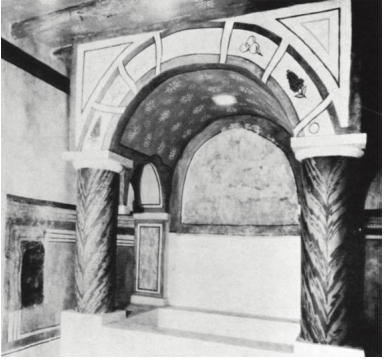
This dais evidently marked the spot where the presiding official of the congregation either sat or stood, but its precise use is otherwise unknown. In the northwest corner room a large brick and rubble basin, set into the floor for a font and surmounted by a heavy vaulted baldachin, was installed against its west wall. As in other religious structures in Dura Europos, including the synagogue (nos. 341, 358), the walls of this room were completely covered with paintings (now in bad condition; no. 360); but it was the only room so adorned.
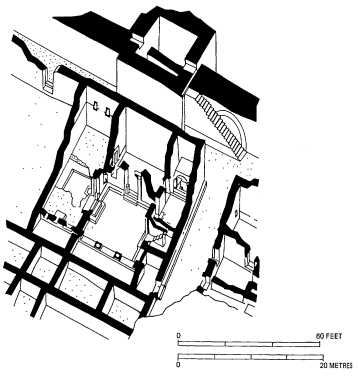
As in those other structures, the most important part of the religious edifice was provided with murals, with one wall as the focal area. The room is thought by most scholars to be a baptistery. The room to the south (13 x 23 feet) may have served not only for the instruction of candidates for baptism, but also for the catechumens, who could hear, but not see, the Mass of the Faithful in the hall of assembly in the south wing of the house.
The house may not have been built until about 232/233; its conversion to a house church, including the installation of the font and canopy, has been attributed to the 240s. Since Dura Europos was destroyed by the Sassanian Persians in about 256, the converted house served the Christians for no more than ten to fifteen years.
This provides important information about the origins of early church architecture. It represents one of several types of the Early Christian house churches and must be typical of the Mesopotamian but not of the Mediterranean form of the house church. This building is the earliest, the best- preserved, and the most securely dated house church so far found; and it is the only surviving church antedating the fifth century with a cycle of pictorial biblical wall decoration.
bibliography: Von Gerkan, 1964; Wessel, 1966; Kraeling, 1967.
Date added: 2026-07-14; views: 183;