
Acts of the Apostles. Egypt, about 400
Vellum. 109fols.; 12.4 x 9.8 cm. New York, Pierpont Morgan Library, William S. Glazier Collection, G. 67. Although the codex, called the Glazier codex after its former owner, contains only chapters 1 through 15:2 of the Acts text, it seems to be one of the few manuscripts from the Early Christian period to have survived intact. Presumably, the second half of Acts was contained in a companion volume. The text is written in an archaic Coptic dialect known as Middle Egyptian Proper. Even the binding seems to be original. The wooden boards fastened by a tooled leather spine and closed by wrapping bands and ornamented bone pieces provide rare evidence of early binding techniques.
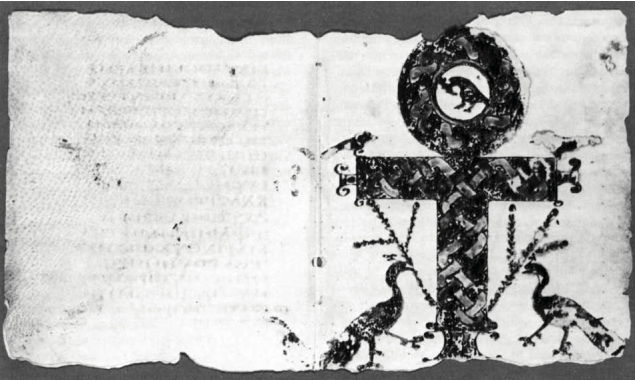
A full-page miniature of a large cross surrounded by peacocks, branches, and doves at the end of the manuscript is the sole decoration. The miniature conforms to a widespread Early Christian practice of terminating books with ornamental crosses (cf. the Latin mss., Bologna, Biblioteca Universitaria, Cod. 701; Dublin, Trinity College, Cod. Ussheri- anus 1). The form of the cross in the Glazier codex is, however, peculiarly Coptic. The looped upper arm derives from an Egyptian hieroglyph, the ankh, meaning "life." Ankh-crosses appear on many Coptic textiles and sculptures, because Egyptian Christians read the hieroglyph as prophetic evidence of Christ's coming and adopted the hieroglyphic form for their own use. The ankh- cross is one of numerous examples of Christian willingness to assimilate pagan motifs in religious art. The branches and birds, which as symbols of peace appear frequently on Early Christian monuments, may in this context refer to the Resurrection.
Interlaced ribbons, like those that decorate the surface of the cross, appear in many Coptic works, but the Glazier codex is the only surviving example of interlace patterns in a manuscript. Cross pages ornamented with interlace designs are a feature of later Hiberno-Saxon manuscripts (cf. the famous Book of Durrow, Dublin, Trinity College, Ms. 57) and Bober (1967) has suggested that the spectacular development of seventh-century Northumbrian art may have been based, in part, on Coptic sources. To support his hypothesis, Bober cites such an anticlassical feature as the color mutations along the interlace bands that appear in the Glazier manuscript and in insular books.
No record of the manuscript exists prior to 1961. William S. Glazier acquired the codex in 1962; it is now in the Pierpont Morgan Library with the Glazier collection.
bibliography: Kebabian, 1967; Bober, 1967; Plummer, 1968, pp. 7-8; Nordenfalk, 1970, pp. 64-65, 138; Leroy, 1974, pi. 2. fig. 1.
Date added: 2026-07-14; views: 173;