
David plates from Cyprus. Constantinople, 628—630. Silver
Nine silver plates embossed with scenes from the life of David appear to be a complete set. They were discovered in 1902, in Karavas (northern Cyprus), sealed in a wall niche with a horde of jewelry and gold (no. 292). Although A. and J. Stylianou (1969) and Dodd (1961) have maintained that each plate is composed of two sheets, one in front decorated in repousse and another to cover the back, the plates are actually single, solid pieces of silver that were chased. Except for some pitting, the plates are in nearly perfect condition.
The series illustrates the early years of David's career, from his anointment to his covenant with Jonathan. The largest plate focuses on the climactic event of David's youth: his victory over Goliath. Four middle-size plates present ceremonial scenes in the young man's life; and four small plates depict transitional events.
The Cyprus plates provide palpable evidence of the persistent Hellenism in Byzantine art. The biblical tale is enacted by figures that move and interact in an illusionistic space. Believable anatomy and clothing heighten the dramatic effect in such scenes as the battle, in which David, his cape whipping in the air, lurches backward to fend off Goliath. Throughout most of the Middle Ages, the classical heritage was preserved in Constantinople and is particularly conspicuous in metalwork produced for the court. The debt to earlier imperial silver is evident. Figures, costume details, and compositional principles recall such fourth- century creations as the Missorium of Theodosius (no. 64) and the Congesti amphora (no. 149). The seventh-century silversmiths emulated the Late Antique style with skill, but some difficulties are apparent in the Cyprus silver: Saul's left arm appears shriveled (no. 427), for example, and the stances of many figures seem unstable.
An illustrated manuscript must have been among the prototypes used by the seventh-century smiths. Close connections have long been noted between the silver plates and such Middle Byzantine manuscripts as the Paris psalter (Bibliotheque Nationale, Cod. gr. 139) and the Vatican Book of Kings (Cod. gr. 333). In copying the manuscript model, the artisans made numerous changes. To accommodate the narrative to circular fields, they arranged the figures symmetrically, adding or eliminating some to achieve a central focus. They also introduced conventions from imperial art to emphasize the regal aspects of the David legend.
The relief decoration made the plates unsuited for practical use, either domestic or liturgical, and the set must have been intended to adorn a wall or table. Wander's recent proposal (1973) that the small and middle-size plates were alternated in a circle around the battle dish (no. 431) is persuasive on both narrative and aesthetic grounds.
Imperial stamps on the back of each plate fix the date of their manufacture to the reign of the emperor Heraclius (specifically to 613-629/630). Because of the quality and style of workmanship, it is assumed that the set was issued by the imperial workshop in Constantinople. It is likely that the plates were made for Heraclius himself to commemorate his victory over the Persian general Razatis in 627; the emperor's triumph evokes comparison to that of the Old Testament monarch. The plates were hidden not long after they were made to prevent their plunder by the Arabs who conquered and destroyed the Byzantine town of Lambousa in 653-654.
425 (I): David enters the biblical drama when, as God's elect, he is anointed by the prophet Samuel (1 Sam. 16:3). Here, Samuel holds a horn of oil above David, who lowers his head in humility; David's father, Jesse, and two of his brothers witness the solemn event. The smith derived his composition from an illustrated book; nearly identical versions appear in later Byzantine manuscripts (e.g., Paris, Bibliotheque Nationale, cod. gr. 139, fol. 3, and Vatican, cod. gr. 333, fol. 22). He transformed the narrative prototype into a static ceremony, however, by reducing the number of figures from nine to five and by posing them symmetrically. The portico, which serves as a backdrop, establishes a hierarchy dominated by the child David; it is a device borrowed from imperial art (no. 64) and offsets the figure beneath the arch as superior to the others. The altar, slaughtered heifer, and sword in the exergue allude to the sacrifice prepared by Samuel (1 Sam. 16:2- 3); the ram and staff refer to David's earlier occupation as a shepherd (1 Sam. 16:11).
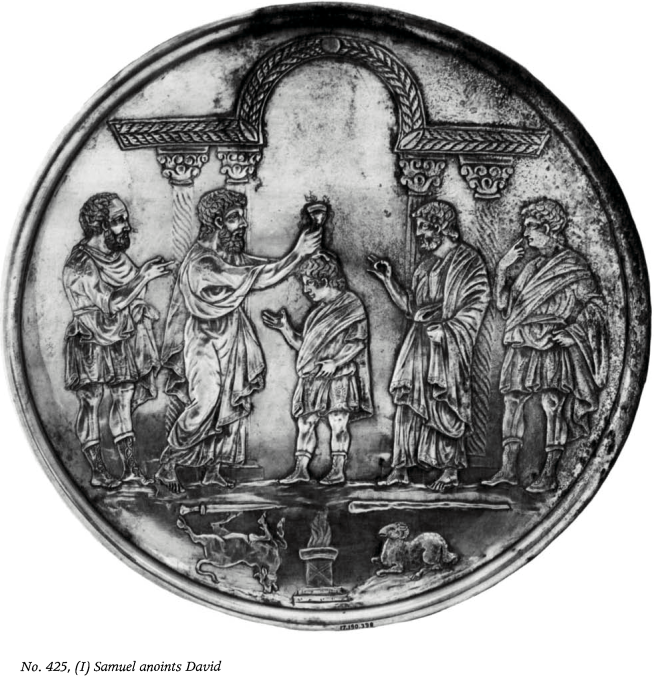
With his anointment, “the spirit of the Lord came upon David and was with him from that day onwards" (1 Sam. 16:13), enabling the young shepherd to defeat GoUath and, ultimately, to succeed Saul as king—events presented on the other plates. The choice of the anointment to begin the series may have had a theological as well as a narrative foundation. At the Baptism of Christ, when his grace was proclaimed, a heavenly voice was heard to declare, “This is my beloved Son, in whom I am well pleased" (Matt. 3:17). By portraying Samuel laying his hand on David's head—John's gesture in depictions of the Baptism (no. 287, 406)—the artist may have intended to draw a parallel between the Old and New Testament figures.
426 (II): In 1 Sam. 16:16-20, David is summoned to Saul when the tormented king calls for someone who can play the harp and sends "messengers to Jesse and asks him to send him his son David who was with the sheep." The episode was rarely illustrated, although a similar composition does appear on the battered fourth-century door of the church of S. Ambrogio in Milan. Curiously, it is the messenger on this plate who most closely resembles the David of the other compositions; but the young man with the lyre is certainly the exalted shepherd and poet. The confusion may have resulted from the silversmiths' practice of using stock figures for different characters. Attempts to identify the episode as the summoning of David to Samuel (1 Sam. 16:12) or as David's arrival before Saul (1 Sam. 16:21) are not convincing.
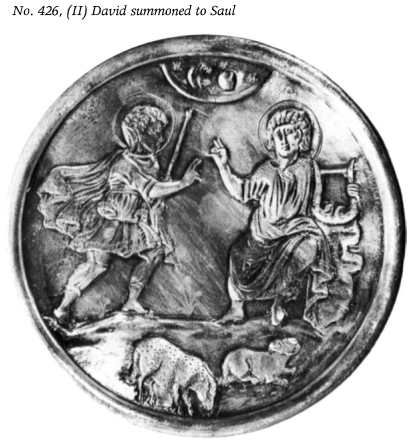
In contrast to the formal scene of no. 425, the sheep grazing in the foreground and the interchange of the two men across an implied space create an informal, bucolic mood that recalls such mythological silver plates as the Meleager dish (no. 141).
427 (III): Before engaging Goliath in battle, David went to Saul to persuade the king of his might (1 Sam. 17:32 ff.). The event is here presented as a ritual appearance in the Byzantine court. Clad in the imperial chlamys of a basileus, Saul sits on a cushioned throne; a nimbus circles his head. David, at the left and also nimbed, pleads his case before the king; Samuel (or possibly David's brother Eliab) stands opposite him. Two arms-bearers, identifiable by their costume and hairstyle as the German bodyguards of the Byzantine emperor, complete the composition. Like the imperial portico, the guards find close parallels on the Missorium of Theodosius (no. 64). The artist conceived the biblical tale in terms of Byzantine court ceremonies, copying the hieratic composition and details of dress from a secular work, such as the fourth-century missorium. Even the bags and basket at the base of the plate are biblical elements presented in imperial terms. They allude to the gifts promised to whoever killed Goliath (1 Sam. 17:24), but they are represented as the sparsio (no. 48). David's appearance before Saul, like the other episodes presented on the Cyprus plates, was probably derived from a narrative model, but it was radically transformed under the influence of imperial metalwork.
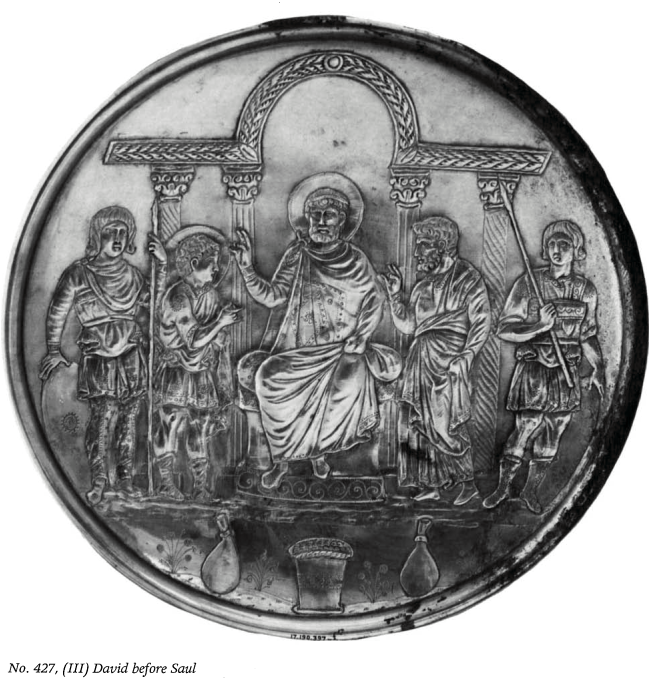
428 (IV): When David appeared before Saul, he cited as proof of his martial prowess his killing of a lion and a bear to protect his flock (1 Sam. 17:34 ff.). David's battles with the two beasts are represented here on two complementary plates, which form a fitting prelude to the climax of David's earlier career—his victory over the Philistine giant Goliath.
The battle with the bear is effectively portrayed. David, his body energetically twisted, grabs the fur between the animal's ears, thrusts his knee into its back, and prepares to bludgeon it with a tapered weapon. A sense of physical power, not very different from that in works produced centuries earlier (no. 137), is successfully conveyed by the long line of David's arms, the taut muscles of his legs and hands, and his flying cape.
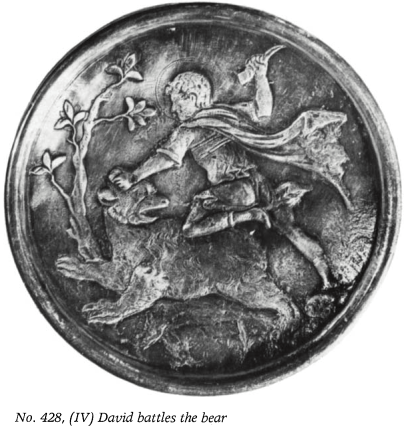
429 (V): In manuscript illustrations of this No. 428, (IV) David battles the bear theme, David and the lion face each other; but to accommodate the circular field, the silversmith transformed the biblical narrative in imitation of a Heracles or Samson scene, where the hero grasps the attacker's mane and subdues it from the rear.
The resulting composition is aesthetically unsatisfactory: David seems suspended above the animal and his right arm is distorted and cramped. Another silver plate depicting the same subject was found in the Kama region of the Soviet Union and is known today only in a photograph (fig. 61). It shows David shielding himself from the springing lion in a pose much like his stance in no. 431.
In the Kama plate, which appears to have been produced in Constantinople during the reign of Heraclius, the silversmith created a different composition with the same repertory of figures as that on the Cyprus David plates. David's battles with the lion and bear are referred to only obliquely in the Bible and seem not to have been illustrated in narrative cycles based on the Book of Kings.
Nonetheless, these plates, too, may have been based on a manuscript model; the episodes were depicted in the biographical prefaces of Middle Byzantine psalters, such as the Marciana codex (Venice, Biblioteca Nazionale, Cod. gr. 17, fol. 13 [Buchthal, 1938, pi. xvn]).
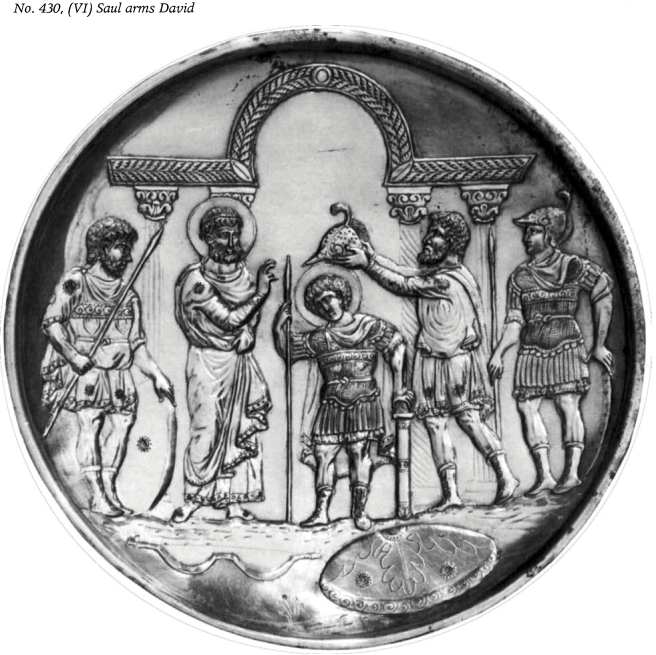
430 (VI): Convinced by David's victories over the bear and lion, Saul agreed to send the young shepherd to take on Goliath: "He put his own tunic on David, placed a bronze helmet on his head, and gave him a coat of mail to wear; he then fastened his sword on David over his tunic" (1 Sam. 17:38). As an indication that sovereignty is passing to the youth, David occupies the center of the plate, while Saul, at the left, directs one of his men to clothe him. Flanking bodyguards complete the composition. The bow and shield in the exergue appear to be part of David's equipage; in addition, the bow may refer to the rabbinic tale that David was so strong that he could bend a brass bow (Tehillim, 18. 155).
The episode of Saul arming David is entirely superfluous, for, according to 1 Sam. 17:39, David immediately removed the armor. The scene was included in the Cyprus silver as part of the courtly ceremonies traced in the four middle-size plates.
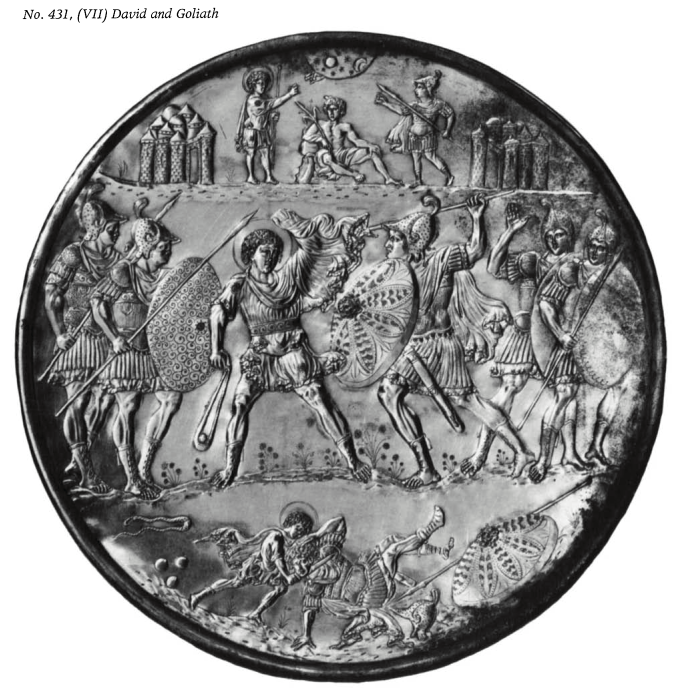
431 (VII): The largest of the nine plates presents the climax of the story in three vignettes. At the top, Goliath curses David and is rebuffed by the unarmed shepherd, who enjoys the protection of God's hand emerging from the firmament (1 Sam. 17:41 ff.). The men meet between the walled cities of Socoh and Azekah, separated by a river god that personifies the stream of the Valley of Elah, from which David gathered stones to slay the Philistine. The most dramatic moment occupies the center of the plate. Goliath, his shield raised and lance ready, menaces David; and David, in a futile attempt to protect himself, recoils and lifts his shieldless arm. The denouement is fore-shadowed by the soldiers at left and right. Two Israelites, anticipating the outcome, advance toward the Philistines, who flee in terror. (In the manuscript model, these soldiers must have been part of the subsequent scene.) In the exergue, Goliath, one hand raised to his head in agony, crashes to the ground as David beheads him with a sword seized from the Philistine's own sheath (1 Sam. 17:51). To emphasize the odds against David and to balance Goliath's lance and shield, the artist included at the far left the simple sling and stones that overwhelmed the giant.
The plate is the masterpiece of seventh-century narrative art. Its precise rendering of anatomy and costume, complex movement in space, and genuine feeling of dramatic encounter contrast strikingly with the carefully balanced, ceremonial compositions of the other plates; the qualities of animation and tension directly reflect the character of the illumination that served as its prototype (cf. Paris, Bibliotheque Nationale, Cod. gr. 139, fol. 4v).
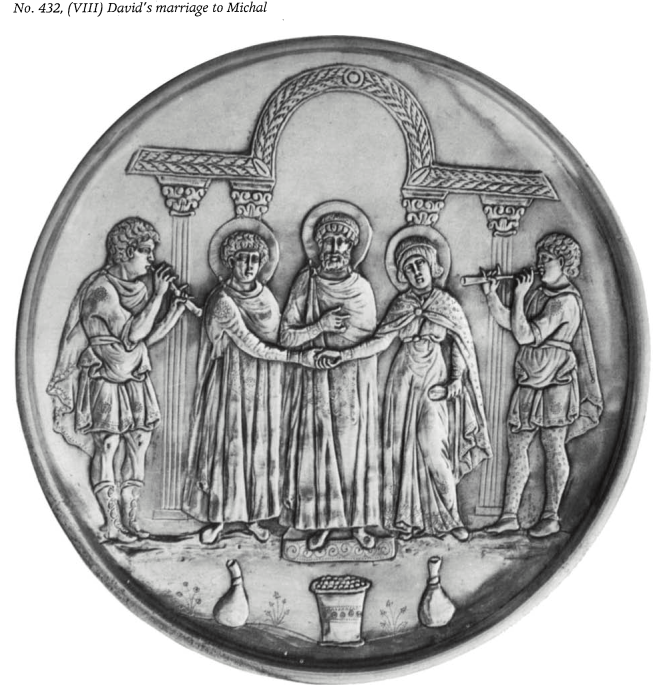
432 (VIII): Although Saul had promised his daughter to whoever killed Goliath (1 Sam. 17:25), he spitefully allowed his eldest daughter, Merab, to marry someone else and set David the task of killing a hundred Philistines. David was again victorious and claimed Saul's second daughter, Michal, as his wife. The Bible tells us simply that "Saul married his daughter Michal to David" (1 Sam. 18:27), but the silversmith conceived the episode as an imperial wedding. Saul, dressed in the robes of a basileus, presides over the rite of dextrarum junctio, the clasping of right hands. Nearly identical compositions, appearing on imperial marriage medallions (no. 262), must have inspired the artist. Flute players, like the guards on the other ceremonial plates, were added to complete the composition within the circle; the basket and bags in the exergue suggest Michal's dowry.
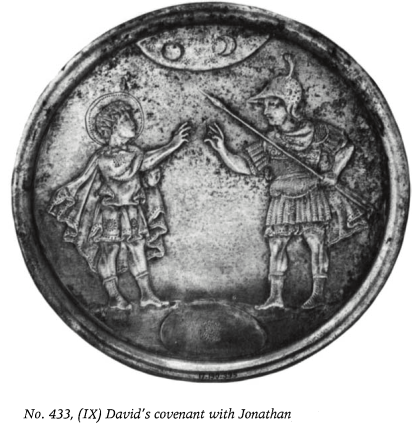
433 (IX): Because of its lack of identifying details, the small plate showing David confronting a soldier has eluded certain interpretation. The similar composition at the top of the battle plate (no. 431) has led most scholars to conclude that this plate repeats the scene of GoUath's challenge, but such a repetition makes no sense in the series. Dodd's (1961) suggestion that the scene depicts David's encounter with the Egyptian (1 Sam. 30: 1 ff.) is less persuasive than Wander's proposal (1973) that it illustrates David's confrontation with his brother Eliab. According to 1 Sam. 17:28-30, Eliab, who had served as one of Saul's soldiers, rebuked his young brother for leaving the flock to engage Goliath. Wright's identification (1967) of the scene as David's convenant with Jonathan (1 Sam. 23:16 ff.) fits the details and mood of the scene still more closely and is supported by a comparison with the illustrated Book of Kings in the Vatican (Cod. gr. 333, fol. 31v). The individual figures may have been copied from the Goliath scene, but the plate seems to present the culminating event of David's youth, when he made an alliance with Saul's son and heir.
bibliography: Matzulevich, 1947; Dodd, 1961, pp. 178- 195; Wright, 1967, pp. 75-76; A. and J. Stylianou, 1969, pp. 47-111; Weitzmann (2), 1970; van Grunsven Eygen- raam, 1973; Wander, 1973; Wander, 1975; Alexander, 1977.
Date added: 2026-07-14; views: 184;