
Wall painting with Jacob's blessing
Rome, 2nd quarter 4th century Fresco. 77 x 98 cm. Rome, Via Latina catacomb (cubiculum B)
The new catacomb on the Via Latina in Rome, a small, private burial ground, was discovered in 1955. While larger subterranean cemeteries mostly contain extensive undecorated passages and simple graves, the ten burial cubicula and subsidiary rooms of the Via Latina catacomb were painted throughout. In addition to bucolic representations, themes from classical mythology, and a few New Testament scenes, the Via Latina catacomb presents more Old Testament episodes than any other Roman catacomb.
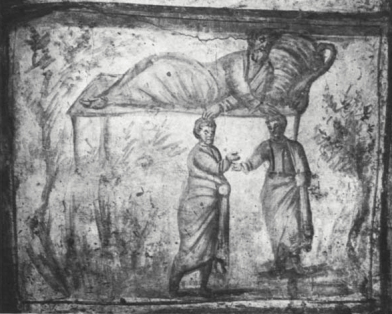
A fresco in the arch of an arcosolium in cubi- culum В shows Jacob on his bed blessing Joseph's sons, Ephraim and Manasseh. Jacob's arms are crossed, and he rests his right hand on the head of Ephraim, the younger grandson, thereby giving him precedence over the first-born, Manasseh (Gen. 48).
The composition belongs, with a group of frescoes (cubicula A-C), to the earliest paintings in the Via Latina catacomb. In contrast to the second group (no. 423), the figures in these paintings are rendered with subtle gradations of color that suggest volume. The artist has endeavored to convey a sense of depth, as in this example, where Jacob's bed is placed on a diagonal.
The scene of Jacob's blessing does not appear in any other catacomb and is found on only one sarcophagus (catacomb of S. Callisto). Its closest iconographic parallels are found among the frescoes in the synagogue of Dura Europos (no. 341) and in the Middle Byzantine Octateuch manuscripts. As Weitzmann ([4], 1971, p. 77) has shown, the Dura fresco belongs to the same picture Bottom panel of no. 420: stoning of Moses recension as the illustrations in the Octateuchs; the Via Latina catacomb paintings show that this cycle of illustrations was known in Rome during the fourth century. Apparently, those text illustrations entered the repertory of catacomb painting because of the cycle's special interest to the patron of this tomb. The Via Latina catacomb seems to have belonged to members of the Roman nobihty who, in all probability, owned illuminated books.
bibliography: Ferrua, 1960, p. 50, pi. xxv; Schubert et al., 1974, pp. 23-24, fig. 16; Stemberger, 1974, pp. 45-46; Kotzsche-Breitenbruch, 1976, pp. 74-76, pi. 16.
Date added: 2026-07-14; views: 152;