
Textile roundel with Joseph story
Egypt, 8th century Wool. Diam. about 26.7 cm. New York, The Metropolitan Museum of Art, Gift of Mr. and Mrs. Charles K. Wilkinson, 1963, 63.178.2
Originally made to be worn at the shoulder or near the hem of a linen tunic, this large, tapestry- woven medallion has suffered fragmentation along its right edge and has lost some colored woolen wefts from its left side. A sequence of nine narrative episodes from the Ufe of Joseph (Gen. 37:9- 39:1) begins at the central disc and continues, counterclockwise from the top left, around the circle: 1, Joseph's second dream; 2, his departure from Shechem; 3, Joseph directed toward Dothan (?); 4, Joseph in the well; 5, the staining of Joseph's coat; 6, Joseph sold to the Ishmaelites; 7, Reuben's lament; 8, Joseph brought to Egypt; and, 9, Joseph sold to Potiphar.
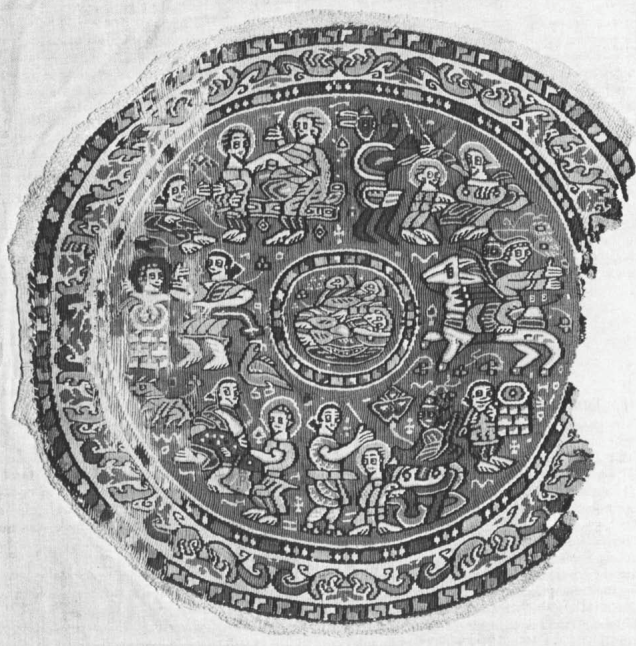
The rhythmic, expressive design of this textile is executed in shades of tan and green over a brilliant red field. Its figures show a higher degree of abstraction and angularity than those appearing on earlier Joseph roundels, such as the one at Trier. While this stylization obscures the monographic content, it enhances the decorative quality of the medallion.
In the vast body of surviving Coptic textiles, Christian figurative subjects play a distinctly subordinate role. Within this group, however, the Joseph story stands out both for its popularity and for its unusual narrative breadth. The New York textile is but one of a sizable group of closely related roundels and cuffbands that narrate the same cycle (Thompson, forthcoming). Thus, it bears witness to the extraordinary status of Joseph among Egyptian Christians—and Jews—who saw in him a national hero and, from the time of Philo Judaeus (see On Joseph), viewed him as a model of personal conduct.
A narrative cycle that includes nine episodes for just one biblical chapter and appears on mass- produced textiles presupposes as its ultimate model an illustrated manuscript. It is therefore of special significance that at least three episodes (Joseph's departure for Shechem, Joseph in the well, and Reuben's lament) show important compositional parallels to corresponding scenes in the Cotton Genesis recension, a distinct tradition of biblical illustration named from a copiously illustrated Genesis manuscript usually localized to sixth- century Alexandria (no. 408). The undisputed Egyptian provenance of these Joseph textiles adds further support to Weitzmann's (1955) contention that the Cotton recension itself is of Alexandrian origin.
bibliography: Thompson, forthcoming, no. 84, n. 1.
Date added: 2026-07-14; views: 163;