
Early Christian Art and Biblical Manuscript Illumination
The dependence of Early Christian art on the sacred narrative embodied in the Bible distinguished it from the art of pagan antiquity and set its form and content. Whereas the Greeks and Romans possessed no all-embracing text, Christians had a scripture that recorded man's tenure on earth and established the nature of his relation to God and the tenets of his faith. Inevitably, therefore, Christian art emerged as a book art. Themes drawn from the Bible were illustrated in many media; most characteristic was the illuminated manuscript.
Early Christian art reflects the heterogeneity of the Bible itself. The work of a series of inspired men who wrote over the course of a thousand years, the Bible contains a broad diversity of literary genres: laws, proverbs, poems, letters, and the prose of prophecy. Primarily, however, it is a narrative, a purported account of world history from Creation to the Second Coming. The narrative is told as a series of episodes, each initiated by a divine speech and culminating in a denouement of theological, rather than narrative, significance. For the most part, the narrative episodes stand separately, rarely connected by transitional passages, and the text contains few descriptions and characterizations. These the artists were left to provide, drawing details from extrabiblical tradition and lore, exegesis, and the art of antiquity and the imperial court.
Mirroring the scripture's intrinsically varied and sectional character, illuminated manuscripts almost never comprised the full Bible. With such rare exceptions as the Syriac manuscript in Paris (no. 437), the complete Bible was illustrated as a unit only in the later Middle Ages. During the Early Christian period, individual books or small compilations— Genesis, Pentateuch, Kings, Gospels, Acts—were illuminated separately. Working with limited textual material, artists were not compelled to invent new methods of illustration; instead, they could simply apply to the Bible text the ancient system of illustrating papyrus rolls (nos. 205, 222). This consisted of depicting each significant moment of a story with a picture inserted in a column of script. Of all surviving Early Christian manuscripts, only the Cotton Genesis (no. 408), once illustrated with some 330 miniatures, preserves this mode of illustration. But dense sequences of miniatures in other manuscripts (nos. 410, 422, 424), as well as in fresco, mosaic, textile, and various plastic media, are adaptations of the same system; and it is perpetuated in numerous later works.
Jews had applied the papyrus style technique of illustration to the biblical text; illustrated Jewish books furnished part of the inheritance of Early Christian artists. While the mode was well suited to Old Testament narrative, however, it was not altogether appropriate to Christian needs. Because the Gospels repeat the same basic story and include long serializations of Christ's parables and accounts of his miracles, the ancient system made for redundant illustration. Middle Byzantine manuscripts in Florence (Laurenziana, cod. Plut. VI, 23 [Velmans, 1971]) and Paris (Bibliotheque Nationale, cod. grec. 74) provide evidence that Gospel books were illustrated in the Hellenistic manner; but, from an early date, Christian artists avoided tedious repetition by composing chronological cycles independent of the Gospel text (no. 445). To construct the cycles, these artists selected scenes from a richly illustrated Gospel book, or, more rarely, as in the Christian baptistery at Dura Europos (no. 360), they may have followed Tatian's Diatessaron, a second-century version in which the Gospel story is written as a continuous narrative.
The Christians' overwhelming preference for the codex over the roll form of book also resulted in modifications of the ancient narrative style. Many artists simply transferred the old system of illustration to the new format (no. 408), but others experimented with the possibilities offered by the rigidity of the flat page and, more importantly, the larger working surface. In the Quedlinburg Itala (no. 424) and Ashburnham Pentateuch (no. 422), scenes culled from the text columns of papyrus style models were organized into full-page miniatures; and in the Rossano Gospels (no. 443), illustrations extracted from the narrative texts were reordered to follow liturgical practice and were juxtaposed with Old Testament prophecies. Artists also incorporated on the flat pages of books the complex, nonsequential compositions developed on a grand scale in wall painting; examples of such adaptations are to be found in the Rossano and Rabbula Gospels (nos. 443, 445).
Because they accommodated a wealth of pictures in a compact form, illustrated books must have been especially popular during the centuries of persecution. And, from the beginning, books also served as the source of narrative depictions in diverse media: fresco, mosaic, ceramic, ivory, metal, wood, textile, and stone. Protracted representations in the murals of Dura Europos (nos. 341, 360) manifest the influence of manuscript illumination on other art forms as early as 232; and, when Christian art emerged as an official enterprise after the Edict of Milan in 313, the extensive and authoritative iconographic tradition of manuscript art became a principal source for public works. The frescoes in the Via Latina catacomb (nos. 419, 423), the carved wood doors of Sta. Sabina (no. 438), and the ivory plaques in London (nos. 452, 455) are but a few of the Early Christian monuments derived from illustrated manuscripts.
In translating book illustrations into other materials, artists transformed the style, configuration, and iconography of their models. Painters and mosaicists, for example, combined elements from several narrative moments to create focused, monumental compositions that are intelligible from a distance. Weavers and metalsmiths, on the other hand, reduced the subtle illusionism of their painted models to stylized conventions and adjusted the compositions to the often awkward shapes of utilitarian objects. Episodes excerpted from dense manuscript cycles were put to new purposes, and, dissociated from the Bible text, they became susceptible to new influences. On the facing walls of the naves of Early Christian basilicas, narrative cycles established the harmony of the Old and New Testaments and, thereby, the continuity of the Church (nos. 439, 440). By the sixth century, according to the descriptions of Elpidius Rusticus (Migne, PL 62, cols. 543-546), artists had devised specific correlations in monumental cycles, pairing such scenes as the temptation of Eve and the Annunciation to Mary, the Tower of Babel and the apostles preaching, and the Gift of Manna and the Feeding of the Four Thousand. Scenes from Joseph's life, in turn, were chosen to decorate the Maximianus cathedra (fig. 60), because the Old Testament patriarch was considered a model for the Christian bishop. Episodes from the story of David were selected from a Book of Kings and refashioned for the Cyprus plates (nos. 425-433), according to imperial conventions, to parallel the achievements of the emperor-patron. Memorial features were introduced into biblical compositions on souvenir objects produced near the holy sites (nos. 524-527).
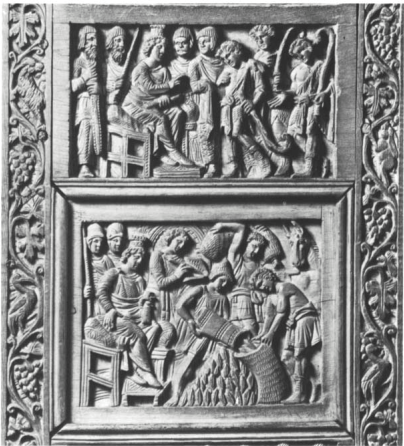
Fig. 60. Joseph scenes. Detail from Maximianus cathedra. Ravenna, Museo Arcivescovile
Even when divorced from the book, Early Christian illustrations generally retained the close relationship to the Bible text inherited with the Hellenistic techniques of illumination. But elements borrowed from extrabiblical sources, introduced both to heighten drama and to stress religious significance, are also prevalent in narrative works.
To flesh out the sketchy physical descriptions in the scriptural narrative, artists drew upon a standard repertory of figures and scenes. Certain stock figures and compositions, therefore, appear in several entirely different contexts. The Quedlinburg Kings manuscript (no. 424), for example, shares with the illuminated Vergil from the same Roman workshop (no. 203) a number of details of pose, costume, and setting. To suggest the riverside setting of David's confrontation with Goliath, the silversmith of one of the Cyprus plates (no. 431) inserted a pagan personification of a river god between the two biblical combatants, and the lurching figure of David in the battle scene on the same plate was reused in the depiction of David killing the lion on the lost Kama plate (fig. 61). The portrayals of man's Creation in both the Cotton Genesis (no. 408) and the Cyriaca sarcophagus (no. 411) were patterned after antique representations of Prometheus (fig. 62).
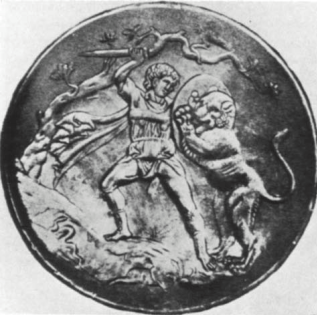
Fig. 61. Silver plate from. Kama with David killing the lion. Whereabouts unknown
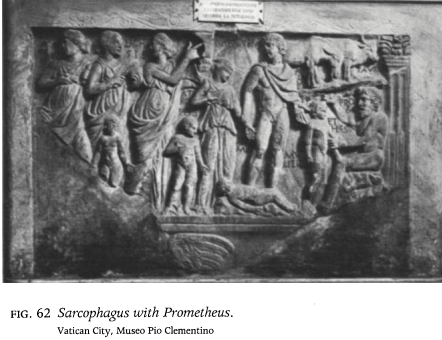
While such borrowings were intended to make the biblical tales more understandable to an audience familiar with pagan mythology, they occasionally obscured or even altered the Bible texts. When the silversmith of the Cyprus plates repeated the same figure types in different situations, he made it difficult to identify the episodes precisely (no. 431, 433). Because the carver of the fifth-century ivory in London (no. 455) fashioned his portrayal of St. Peter bringing forth baptismal water after a depiction of Moses' Water Miracle (no. 361), the scene has, until recently, escaped correct identification.
Conventions of imperial art were particularly influential in the formation of Christian narrative representations. Old and New Testament rulers were conceived as contemporary emperors—Solomon on the North African terra sigillata plate (no. 434) and Joseph on the Maximianus cathedra (fig. 60) are two of numerous examples. Entire biblical episodes were rendered as court rituals: in the Rossano Gospels (no. 443), Christ before Pilate is staged as a Roman judicial proceeding (fig. 63); on one of the Cyprus plates (no. 432), the marriage of David and Michal is portrayed as a royal Byzantine wedding. Imperial formulae were applied with particular consistency to Christ in order to confer on the celestial Lord the supreme status of the terrestrial ruler. Christ's Entry into Jerusalem (nos. 376, 470) was patterned after the emperor's adventus (nos. 41, 44) and Christ carrying the cross (no. 452) was based on a Roman motif of the victorious ruler bearing his trophy. Perhaps the most important contribution of court art to Christian iconography was the "imperial mode," which enabled artists to establish a hierarchical ranking even in a narrative representation. The silversmith who composed the scene of David before Saul on the Cyprus plate (no. 427)—like the artist of the Theodosius Missorium (no. 64)—adjusted the size, placement, and degree of physical involvement of the figures to indicate the status of each. On the Andrews diptych (no. 450), Christ is subtly distinguished from the other participants in each scene.
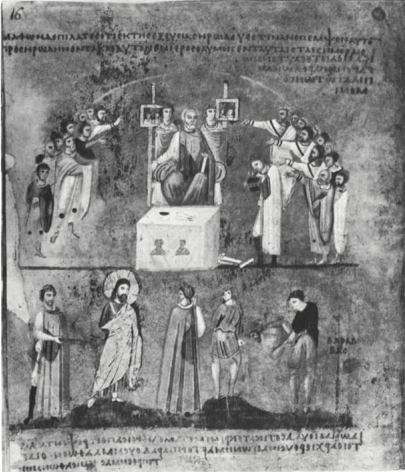
Fig. 63. Christ before Pilate from Rossano Gospels. Rossano, Cathedral Library, fol. 8v
Anecdotal material from legend and pseudepigra- phical writings was also incorporated to supplement the biblical account. In the Annunciation scene on an ivory in Milan (fig. 64), the Virgin is seen filling a water pitcher in accordance with the description in the Protevangelium of James (11.1). The same text furnished for a carving in Leningrad (no. 459) the annunciation to St. Anne, an event nowhere reported in the scriptures. In the Ashburnham Pentateuch (no. 422), the story of Adam and Eve following the Expulsion includes a portrayal of the couple mourning the loss of Eden in a roofed booth, an event described not in Genesis but in the Vita Adae et Evae (1.1), an apocryphal text based on Jewish legends. On a fifth-century ivory casket in London (no. 455), apocryphal episodes are mingled with scenes from the canonical Acts.
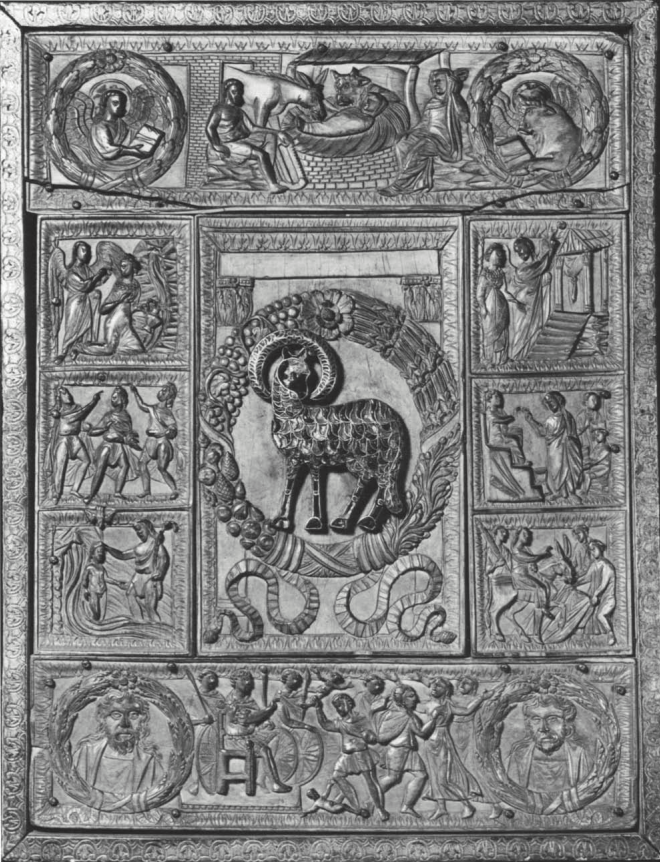
Fig. 64 Leaf of ivory diptych with New Testament scenes. Milan, Cathedral Treasury
In some instances, themes drawn from extra biblical literary sources served to make or stress theological points. The Nativity scene on the Maximianus cathedra (fig. 65), for example, includes the figure of Salome, the midwife described in the Protevangelium of James (19.1), who tested the virginity of Mary. Salome's presence emphasizes the miraculous nature of Christ's birth. The legendary account of Joseph's divining cup, depicted on the Leningrad pyxis (no. 418), seems to connect the Old Testament tale to the ritual of the Eucharist.
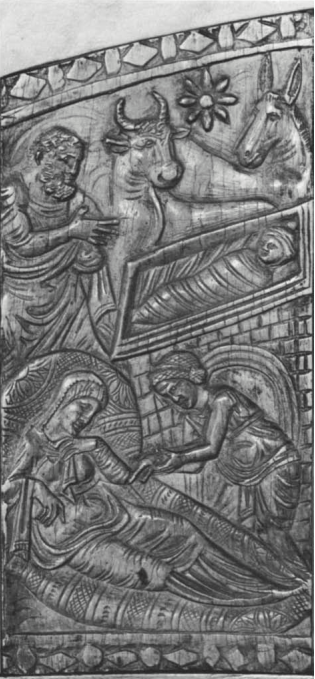
Fig. 65 Nativity of Christ. Detail from Maximianus cathedra. Ravenna, Museo Arcivescovile
Theological interpretations also permeated Early Christian art through biblical exegesis. Such familiar features as the ox and ass in Nativity scenes (nos. 447, 449) derive not from the Gospels but from commentaries on Isa. 1:3: "The ox knows its master and the ass its master's stall; but Israel, my own people, has no knowledge, no discernment." Early theologians related this Old Testament passage to the Nativity, interpreting the ox and ass as the Jews and heathens to whom Christ's birth would bring salvation; and the interpretation was incorporated into the apocryphal account of the Nativity by the Pseudo-Matthew (14.1). Exegetical material infiltrated the Christian interest in establishing the continuity of the two principal sections of scripture.
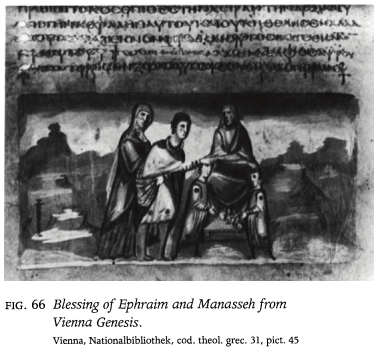
Thus, in accordance with speculation about the Logos, the Cotton Genesis presents Christ as the agent of creation (no. 408). To the same end, the artist of the Vienna Genesis (no. 410) gave visual expression to a Christian interpretation of the blessing of Ephraim and Manasseh (fig. 66) by emphasizing the cruciform pattern of Jacob's arms.
Probably no better examples of the complexity resulting from the interweaving of scriptural and extrabiblical strains can be found than in depictions of Christ's Ascension. The Bible offers only a rough sketch in Acts 1:9-12 to be much and diversely elaborated upon. An ivory plaque of about 400 in Munich (fig. 67) presents the Western concept of the event. Clasping the hand of God, Christ strides up the mountain to enter heaven, while below him two apostles watch in surprise.
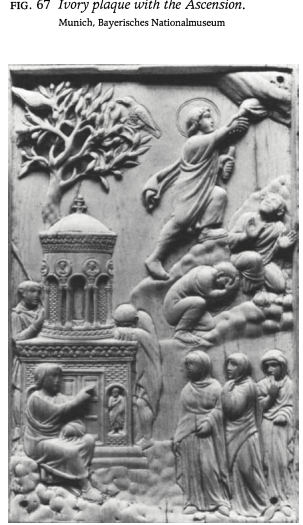
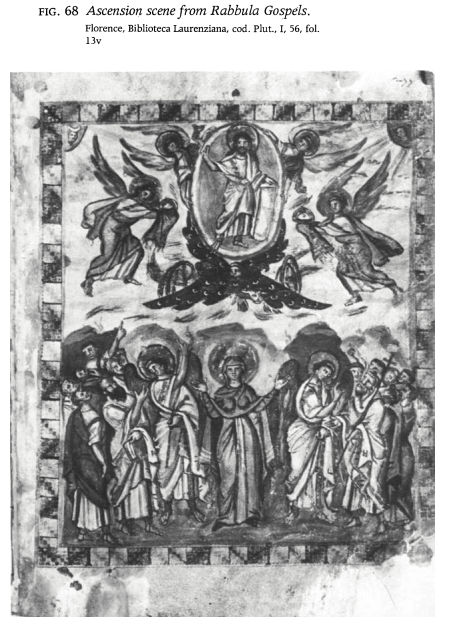
The isolation of two disciples reveals the artist's familiarity with the Apocryphon Jacobi, which reports that Christ selected Peter and James to witness his Ascension. Christ's vigorous stance seems to have been patterned after depictions of Moses receiving the law, such as that on the Moggio pyxis (no. 421); like Christ, Moses approaches God atop a mountain. The parallel between the Old and New Testament ascents was remembered when Exod. 19 was read in church on Ascension Day. The hand clasping may have been derived from representations of the emperor's apotheosis, in which the dextrarum junctio signifies spiritual union. A strikingly different iconography of the Ascension emerged in Eastern art. The tetramorph bearing Christ to heaven in the Rabbula Gospels (fig. 68) was based on the vision of Ezekiel (Ezek. 1, 10), which was recited on Ascension Day in Eastern Syria; the angels bearing crowns are adaptations from imperial triumphal art in which Victories were shown bearing wreaths (no. 28). Among the apostles shown watching the event, Paul is featured because he was especially venerated in the East; and Mary is included in the episode to emphasize Christ's dual nature and to symbolize the establishment of the terrestrial Church.
Such distinct conceptions of the same biblical event permit the classification of Early Christian narrative art by local traditions. The Cotton Genesis (no. 408) and numerous other Genesis illustrations (no. 412, for example) share features that can be traced to an Alexandrian original; in contrast, the Cyprus silver plates (nos. 425-433) and several Middle Byzantine manuscripts were all based on a Book of Kings tradition popular in Constantinople. Narrative cycles migrated widely. The Cotton Genesis cycle became especially favored in the West (cf., e.g., the S. Paolo fuori le mura frescoes, nos. 439, 440), and the Greek Octateuch illustrations, known best in eleventh- and twelfth-century copies, appeared as early as the third century at Dura Europos (no. 341) and were known in Rome during the fourth century (no. 419). The pictorial families, or recensions, retained their distinctiveness, however, and they can still be identified among works of the High Middle Ages that were based on Early Christian prototypes.
Medieval artists inherited from Early Christian narrative art a twofold legacy. The Hellenistic system of text illustration applied to the Bible formed the basis of later manuscript illumination, and the early narrative forms that gave pictorial expression to the significance of the events portrayed provided a foundation for the complex, interpretive art of the High Middle Ages.
bibliography: Grabar, 1936; Weitzmann (I), 1957; Weitzmann, 1960; Kraeling, 1967; Grabar (1), 1968; Weitzmann (1), 1970; Weitzmann (2), 1971; Weitzmann (3), 1971; Schapiro, 1973; Kitzinger, 1975; Loerke, 1975; Weitzmann (1), 1975; Weitzmann (2), 1975
Date added: 2026-07-14; views: 155;