
Engraved ring stone with Adoration of the Magi
Rome (?), 4th century. Bloodstone. 1.5x2 cm. Oxford, Ashmolean Museum, 1938.1109. The gem is undamaged, the surface slightly convex, the back flat, the edges chamfered. The mount is modern.
The Magi are shown striding from the left on a groundline. They hold round bowls filled with gifts and wear girdled tunics, crested Oriental caps, and short mantles flowing up like wings. At the right, Mary, on a rocklike seat, holds the (naked ?) Christ child; the child leans forward to the Magi with animated gestures. Behind Mary stands a man, dressed in a pallium, who points upward at a star above the child.
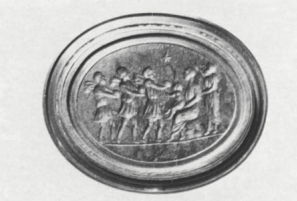
The cutting is cursory, neglecting the final treatment of details, but the representation is lively, the figures natural, and the composition skillfully adapted to the minute scale. The rounded, swelling forms were produced by a round-ended drill.
Beginning during the age of Constantine, with the growing liturgical emphasis on the Incarnation festivals (Shepherd, 1967, pp. 76-77), the picture theme of the Adoration of the Magi (Matt. 2:1-12) became widespread. Its forms are derived from Roman imperial art depicting vanquished Orientals offering their gifts to the victorious ruler (Grabar, 1968, p. 45). The gem adds to the usual pattern a typological notion: the figure behind Mary is the Old Testament seer Balaam, whose prophecy "a star shall rise from Jacob" (Num. 24:17) was related by the early Church to Christ's Epiphany and the Magi's journey (Kirschbaum, 1954). The iconography, unique among the rare Early Christian gems with New Testament scenes, has a striking analogy in the epitaph of Severa (fig. 57), found in 1751 in the Priscilla catacomb, Rome. The hairstyle of Severa suggests a date between 325 and 350 (cf. von Heintze, 1971, pis. 9, 10).
Both gem and plaque belong to the same pictorial tradition located in Constantinian Rome, where the Balaam theme was favored (cf. Timmers, 1968, s.v. Balaam, p. 239). The two pieces must have had a common model, now lost, whose reflection can also be observed on Roman sarcophagi of the first half of the fourth century. Kirschbaum (1966) therefore assigns the gem to the earlier Constantinian period and suggests a Roman origin. The cursory technique also supports a fourth-century date. The lively pose of the child and the winglike mantles of the Magi may have been influenced by types of Erotes in Roman art (cf. Boardman, 1968, fig. 61).
The mottled red and dark gray blue stone was described by the first owner, Sir Arthur Evans, as "red jasper," a stone that, like hematite, enjoyed special popularity in the later Roman period. Magical effects were ascribed to both (Richter [2], 1956, pp. 61-63).
The gem, acquired in 1907 in Naples by Evans, came to the Ashmolean Museum with his collection in 1938.
bibliography: Evahs, 1930, III, pp. 474-475; Kirschbaum, 1966.
Date added: 2026-07-14; views: 157;