
Textile fragment with scenes from the Old and New Testaments
Egypt, 5 th century. Dyed linen. 82.8 X 87.6 cm. London, Victoria and Albert Museum, 722—1897
This is a fragment of a large piece of cloth, much frayed. It is decorated in the resist-print technique, using blue with natural color. On the technique, see no. 390.
Two picture zones are preserved. In the upper right Moses, who is identified by an inscription, climbs a mountain and receives, into his covered hands, a roll out of the arc of heaven in the upper right. In the frequent occurrences of this scene in Early Christian art, only the details differ: for example, the alternate use of roll and tablets. The roll seems to embody God's command to Moses on Mt. Horeb (Exod. 3); the tablets, mainly appearing on sarcophagi, indicate the acceptance of the Ten Commandments on Mt. Sinai (Exod. 20). A representation very similar to the London fragment occurs in the lower strip of no. 390 and on the so-called Reinhardt cloth, formerly in Leipzig (Strzygowski, 1901, pi. Vi). In the Reinhardt cloth a second figure stands behind Moses, his right hand raised. On the London fragment the figure behind Moses can be identified as Christ by the cross-nimbus.
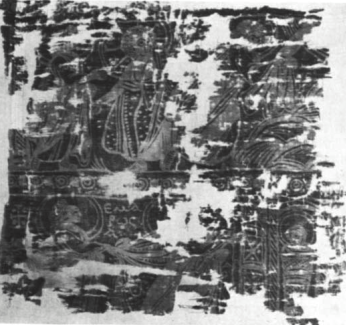
To the right are the remains of an inscription. Christ looks up at Moses climbing. His right hand is, however, stretched out to a figure at the left, who turns to him and raises his right hand in the gesture of speech. This group has been identified by Illgen (1968) as the calling of Moses at the burning bush: Christ appears in place of the voice of God in the burning bush. This combination of scenes of the calling and the receiving of God's command appears earlier in the synagogue of Dura Europos above the Torah niche (no. 341), as well as on the wooden door of Sta. Sabina (no. 438) and in the Presby- terium mosaic of S. Vitale in Ravenna.
In the lower zone, which is separated from the first by a band of flowers and circles, are two combined scenes from the New Testament. On the left a woman identified as the woman with the issue of blood by an inscription  holds the garment of Christ, who turns with raised right hand to Lazarus in an open tomb aedicula. On the left next to the paneled door is the inscription
  . Christ is dressed in the same dotted garment as above. It appears that here, too, as far as the condition of the cloth allows us to judge, Old and New Testament scenes have been combined, yet kept in separate zones as on the piece in Cleveland (no. 390). No typological relationship is evident, however.
The style, technique, and figure types relate this fragment so closely to one with the Nativity (no. 392) that the pieces must surely have been made at the same time and probably in the same workshop.
bibliography: Strzygowski, 1901, pp. 105-106; Kendrick, 1922, III, pp. 65-66, no. 787, pi. XX; Ulgen, 1968, pp. 43-48.
Textile with Nativity. Egypt, 5th century Dyed linen. 47 x 82.5 cm. London, Victoria and Albert Museum, 1103-1900.
This part of a large cloth is much frayed. It is decorated in the resist-print technique, using blue with the natural color. For the technique, see no. 390.
From the left a winged angel, his right hand raised in the gesture of speech, approaches Mary, inscribed MAPIA. To each side of the angel are crosses. Mary lies on a couch and turns around toward the angel. At the right is a masonry crib with the swaddled Christ child. An ox and ass lean over it. Only one of the ass's ears is preserved. Above the ox is the inscription IC in a circle, which corresponds to another circle now lost, with the letters XC (“Jesus Christ"). In the lower part of the crib is a niche, a feature that appears frequently in Syro-Palestinian renderings of the Nativity, probably as an allusion to the grotto of the Nativity in Bethlehem (cf. no. 521). How the scene continued is uncertain, perhaps with the apocryphal figure of the incredulous midwife Salome extending her withered hand to touch the child. To the left, behind the angel, is a column; the upper edge is formed by a strip of circular ornaments, above which was surely a second picture zone (cf. no. 391).
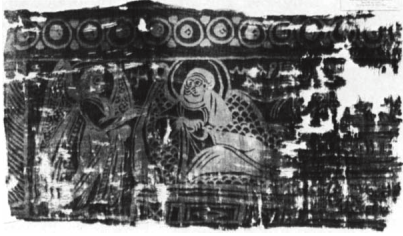
Similar column and ornaments occur on a fragment with the Annunciation, also in the Victoria and Albert Museum, which was probably part of the same piece. The fragment belongs to a group of linen cloths that are mostly dyed blue, occasionally purple, and are believed to come almost entirely from tombs in Upper Egypt. Among these, several of noteworthy large dimensions show mythological scenes: Dionysos (Louvre); Artemis, Aphrodite (Riggisberg, Abegg- Stiftung); hunting scenes (Leningrad, Hermitage); or scenes from the Old and New Testaments, apostles or saints (London, Victoria and Albert Museum). They were not originally meant for burials but served as curtains or wall hangings.
Said to come from Akhmim (ancient Panopolis); gift of Dudley B. Myers, Esq., 1900.
bibliography: Strzygowski, 1901, p. 105; Dalton, 1911, pp. 602-604, fig. 381; Kendrick, 1922, III, p. 65, no. 786, pi. xix; Peirce and Tyler, 1932,1, pi. 103; Essen, 1963, no. 254; Illgen, 1968, pp. 18-22.
Date added: 2026-07-14; views: 141;