
Door from Sta. Sabina, Rome, with Old and New Testament scenes
Rome (?), 432-440. Cypress wood. 3.30 x 3.12 m. Cast: New York, The Metropolitan Museum of Art, Willard Collection, 1883-1891, 1404
The Sta. Sabina doors are the best-preserved wood carvings from the Western Empire. Eighteen of twenty-eight figurative panels somewhat altered and restored remain on the outer side and nineteen ornamental panels on the inner side.
Because a third of the scenes are missing and their original order has been changed, it is difficult to interpret the program of the cycle. Five panels portray Old Testament scenes; they are the most developed and richest in narrative elements. The Ascension of Elijah (2 Kings 2:11; fourth valve) is iconographically amplified by narrative and picturesque details that do not appear in other monuments. The angel, for example, is not mentioned in the text, but is similar to pagan Nike figures; and Elijah ascending in a biga may have been based on representations of Helios. The angel's magic wand is an unusual element, as is the hoe held by one disciple (probably an allusion to the miracle of the floating axe, 2 Kings 6:1-7). Naturalistic details, such as the snail and lizard on the rock and the dramatic gestures of the disciples, enliven the scene. The panel with Habakkuk about to be transported to Babylon (Dan. 14:33-36) shows an angel ordering the prophet to bring food to the imprisoned Daniel. The theme of Daniel in the lions' den, which may have been portrayed on one of the missing panels, was widely depicted in Early Christian art as a paradigm of salvation.
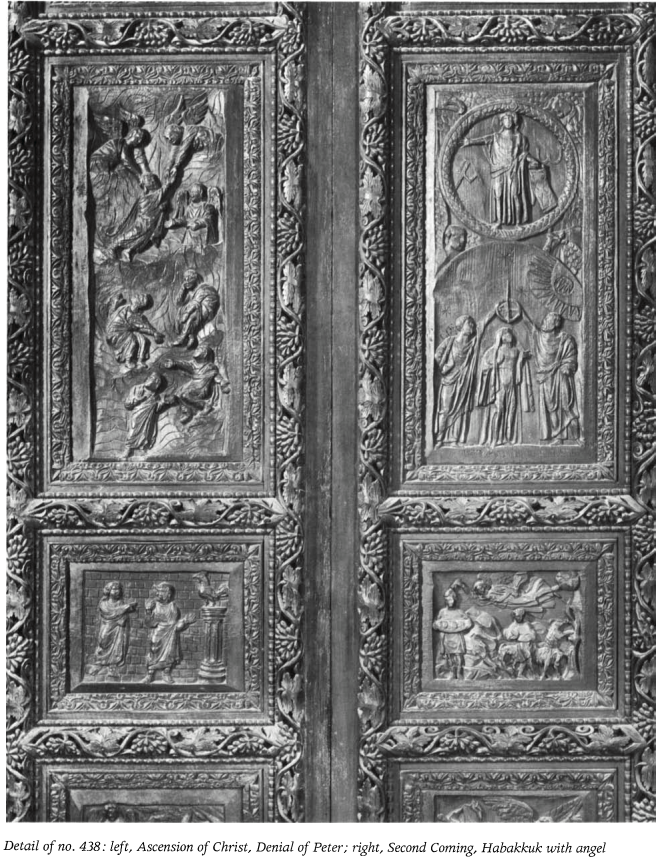
The narrative elements are more developed at Sta. Sabina than in other monuments and may derive from a text illustration. With the exception of the Ascension of Christ, the New Testament scenes are abbreviated. The Crucifixion, for example, is limited to Christ and the thieves. In the depiction of Christ before Caiaphas, the high priest is clad in a tunic and chlamys like a Roman dignitary and sits on a Roman campstool. Christ, bearded and with his right hand raised as in the other Passion scenes, stands before him. The depiction, which differs from other representations (no. 452) by showing Caiaphas alone and Christ followed by a group of soldiers, may have been patterned after a Roman trial scene. The panel showing Christ flanked by the Alpha and Omega, which represents the Second Coming (Rev. 12:12-13), is without close parallel. According to Jeremias (1970), the enigmatic "Acclamation” scene may be related to a contemporary event and may portray the founder of Sta. Sabina, Petrus Illyricus. Certain panels, miracles of Moses/miracles of Christ and Ascension of Elijah/Ascension of Christ, indicate that a parallelism between Old and New Testament scenes may have been intended.
Two distinct carving styles are discernible. One, which Delbrueck (1952) termed the "brilliant” style, depicts slender, well-modeled figures in high relief (Ascension of Elijah). It may have been influenced by Eastern, specifically Constantinopolitan, art. The other, the "plain" style, presents squat, flat figures in crowded compositions reminiscent of those on Roman sarcophagi.
While admitting influences from other regions of the empire, scholars now tend to ascribe the doors to a Roman workshop. The carvings were executed either during the reign of Pope Celestine I (422-432), when the church was founded or, more likely, under Sixtus III (432-440), when Sta. Sabina was consecrated.
bibliography: Kantorowicz, 1944; Delbrueck (2), 1952; Darsy, 1954; Tsuji, 1962; Jeremias, 1970. No. 439, Sacrifice of Isaac
Date added: 2026-07-14; views: 163;