
Baptistery wall paintings with New Testament scenes
Dura Europos, about 240 Fresco. 2.92 x 6.50 m.; register divider 1.80 m. above floor level New Haven, Connecticut, Yale University Art Gallery. The ground plan demonstrates that this earliest pre-Constantinian domus ecclesiae was originally a private building with an open inner court (no. 580). Erected probably in the first century, it was transformed, as an inscription indicates, into a Christian building in 232. The wall paintings in room six, which served as a baptistery, were added later on, perhaps around 240.
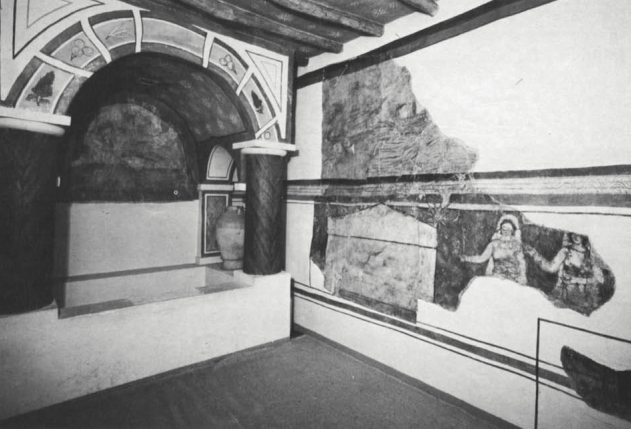
The paintings on the north wall are among the best preserved. At its western part in the upper register the healing of the paralytic (Mark 2:1-12) is depicted in two episodes: the sick man lying upon a bed and the same walking off with his bed on his back. Christ stands in the background, beardless and without halo, his right arm pointing to the bedridden man. Another scene to the right shows Christ at the left and Peter at the right (head destroyed) walking on the water (Matt. 14 : 22-34) and, in the background, a large ship with the disciples. Christ is identified by his costume, a long-sleeved chiton and himation; he has a beard and thick hair.
In the lower register is a rare representation: the Women at the Tomb—a sarcophagus with large stars at the corners inside the tomb chamber. The women approach from the right: each holds a torch in her right hand and a bowl of unguent in her left. Three women are partly preserved. Very small fragments of two more were still visible after the discovery of the building in 1932. This corresponds to the five women (feet only still visible) at the east wall of the room. At the extreme right of the lower north register an open door is partly preserved. Thus, three parts of a narrative composition can be identified, as Kraeling (1967, pp. 86-88) has proved on the basis of Tatian's Diatessaron. According to this text, five women approach the tomb (east wall), with its open door (north wall, east corner). Inside the tomb chamber, the women need the light of their candles. The stars adorning the corners of the sarcophagus symbolize the angels who announce to the visitors that Christ is risen.
Since the register division is apparently maintained on both the east and west walls, one must assume that a cycle of "God's Mighty Works" was represented there in eight more scenes.
The art historical significance of the paintings lies in the occurrence of abbreviated and narrative scenes side by side and in the combination of two short scenes in one composition, as in the healing of the paralytic.
The New Testament scenes appear here for the first time in the history of art, raising the question of whether Christian art had an earlier beginning in the Eastern Church than in the Western. Though the frescoes are of rather modest quality, their historical value with regard to the origins of Early Christian art can hardly be overestimated.
bibliography: Kraeling, 1967.
Date added: 2026-07-14; views: 176;