
Baptistery of the Orthodox
Ravenna, late 4th century (?), remodeled about 450-460. 12.11 m. (39 ft. 9 in.) interior diam. between corners, 11.24-11.47 m. (36 ft. 10 in.-37 ft. 7 in.)
The Baptistery of the Orthodox—so-called to distinguish it from the later Baptistery of the Arians, also in Ravenna—provides a rare example of a nearly complete Early Christian interior decor. The building was probably erected under Bishop Ursus (d. 396 or about 429), who also sponsored the adjoining cathedral. The baptistery is octagonal, with four projecting niches in alternate sides. There is a clerestory with eight windows, and a pendentive dome, concealed on the exterior by vertical extensions of the octagonal walls (with late medieval arcading) and a tiled roof. Inside, the zone of niches is articulated by eight blind arches; the windows above are framed by triple arcades resting on Ionic columns and impost blocks. Modillions inserted over the corner imposts support the dome pendentives, which curve over the windows to echo the arcading of the zone below.
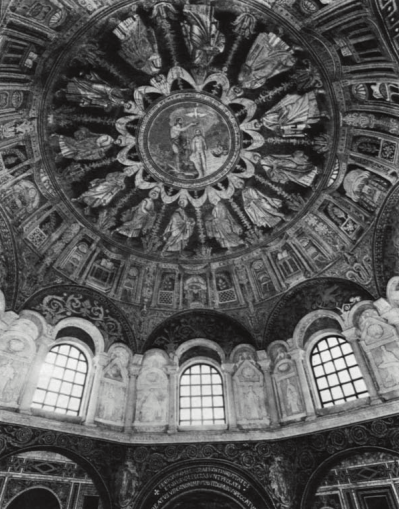
Because of subsidence in the marshy terrain, the lowest parts of the baptistery walls are now underground. In compensation, the pavement was raised nearly ten feet, perhaps in the Middle Ages, and the columns that first framed the niches were replaced by shorter ones with different capitals. The much reworked opus sectile has been transferred from the lower parts of the straight walls to the lunettes. The mosaics in the adjoining niches are gone, except for inscriptions on the framing arches, and the stucco scrolls in the lunettes over the windows are also lost, though now simulated in paint. All of the baptistery's other ornamentation is intact, albeit restored in many places.
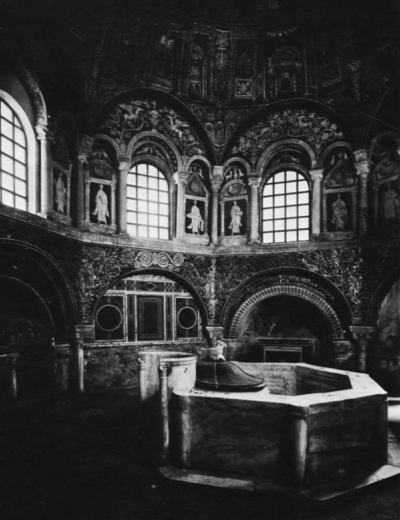
The decoration was commissioned by Bishop Neon (about 451-after 458). He ordered only one structural alteration: the replacement of the original wooden ceiling with the present dome. Thanks to its construction in tubi fittili (cf. no. 593), the dome is so astonishingly thin (about 10 inches) that it could be dropped like an eggshell over the preexisting eight walls, themselves only about 3 feet thick, without the need for reinforcements. The remodeled interior was completely enveloped with a brilliant mantle of mosaics and poly chromed stucco. Standing figures with books and scrolls, depicted in stucco in the clerestory and in mosaic in the ground-floor spandrels, are presumably Old Testament predecessors of the crown-bearing apostles who appear in the dome. In the apex of the dome is an image of the Baptism of Christ, at once a celestial vision and the historical prototype for every neophyte who stood in the font below.
After the Eucharist, Baptism was the most important sacrament in the early Church, and a highly symbolic rite. As explained by St. Paul (Rom. 6:4), the catechumen with his burden of sin died in the font, and was resurrected as an immaculate neophyte, garbed in white. The baptistery mirrored this ritual: for example, the neophytes' procession to the altar was echoed by the apostles, solemnly moving around the dome. The eight enclosing walls, found also in tombs (cf. no. 104), represent the spiritual rebirth, for eight, the number of the octave and of the first day of the new week, was a number of new beginnings and therefore of resurrection.
BIBLIOGRAPHY: Kostof, 1965; Bovini, 1974; Deichmann, 1974, II, 1, pp. 15-47.
Date added: 2026-07-14; views: 189;