
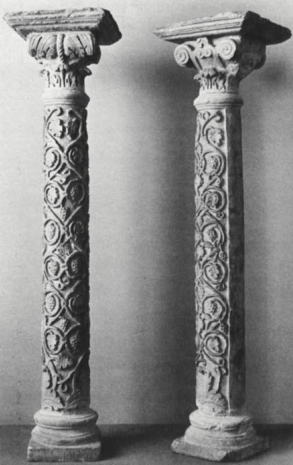
Two columns from Notre Dame de la Daurade
Toulouse, 5th century (?). Marble. 185 cm.; 189 cm. New York, The Metropolitan Museum of Art, Rogers Fund, 1921, 21.172. 1-2
These vine scroll columns with unorthodox Corinthian capitals are two of the approximately twenty that, with a few mosaic tesserae, are the only remains of the famous “Golden Church" of Toulouse. At the time of its demolition in 1761, La Daurade comprised an ancient seven-sided sanctuary and a nave of later date. The original building —of which the sanctuary was a part—is thought to have been an attenuated decagon. Three sides would have been eliminated during the Middle Ages in order to add the nave. The original church was of brick construction and domed, with an opening (opaion) in the apex some 5 feet in diameter.
The once numerous columns framed niches that ran, in three registers, along all of the original walls. The niches, the intervening wall surfaces, and possibly also the dome were covered with figured mosaics on gold backgrounds, the source of the popular appellation “La Daurade." The lowest row of niches contained images of Old Testament patriarchs and prophets; the middle row presented prophets, apostles, evangelists, archangels, Christ, and the Virgin. The upper niches had scenes from Christ's infancy, emphasizing the role of the Virgin Mary, to whom, apparently, the church was dedicated.
The columns were made in or around Toulouse, of marble quarried in the nearby Pyrenees. They are closely related in style to the numerous sarcophagi produced in the fifth century and possibly later by ateliers of marble carvers located in Aquitaine and Languedoc. These skillful craftsmen were trained in an ultimately classical tradition, as evidenced by the strongly Gallo-Roman character of these columns. Yet many liberties have been taken, as in the form of the capitals; and the vine scroll “grows" according to rules of decorative symmetry rather than verisimilitude. Once installed in La Daurade, the columns' decorative character was enhanced by painting and gilding that brought them in harmony with the colors of the mosaics.
The earliest history of La Daurade is unknown. Whether it originated as a pagan mausoleum or as a church and whether the decoration was made with the building or added to it later are issues in dispute. The decoration seems datable to the fifth or sixth century, a time when Toulouse was a barbarian seat; first of the Visigoths, who made it their capital in 419, and then of the Franks, who expelled the Visigoths in 508. Yet there was nothing “barbarian" about La Daurade. Its remains, though provincial, clearly represent the continuance of the artistic traditions of pre-Gothic Roman Gaul, mingled—especially in the mosaics —with more recent influences from Rome and Italy.
Bibliography: Breck, 1922; Woodruff, 1931; Ward-Perkins, 1938; Lamotte, 1962; Jalabert, 1965, pp. 17-33.
Date added: 2026-07-14; views: 149;