
Church of St. Symeon Stylites and monastery
Qal'at Sim'an, Syria, about 475-500, and later L. of church including narthex: east to west 89.9 m. (295 ft.); north to south, 79.3 m. (260 ft.); W. each basilican arm 24.9 m. (82 ft.)
Perhaps the most monumental and important church built in the east Mediterranean before Justinian's Hagia Sophia in Constantinople (no. 592) was the cruciform church and adjoining monastic complex at Qal'at Sim'an in the uplands east of Antioch-on-the-Orontes, northern Syria. It commemorated the place where St. Symeon Stylites (about 390-459) had lived atop three successively taller pillars. As the ascetic's fame and influence spread from Arabia to Spain and Gaul, pilgrims came to the site to hear his sermons and to receive his blessings.
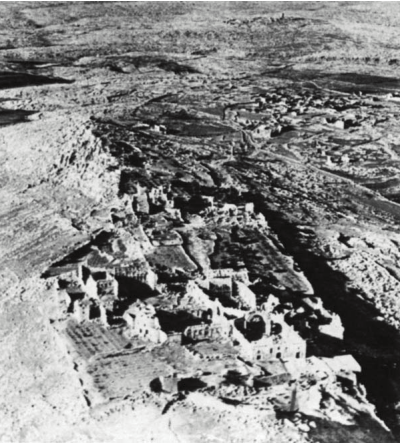
This church occupies the width of the crest of a rocky hill. An octagon, centered on the saint's ultimate column (cf. the Holy Sepulcher, no. 582; the Vatican Basilica, no. 581), opens on alternate sides into four basilican arms. The eastern arm contains triple apses. Access for throngs of pilgrims was through a narthex at the southern arm and through twenty-seven doors in the perimeter walls. The exterior walls were constructed of regularly cut limestone and were richly articulated with columns, brackets, and moldings; the abundant carved architectural sculpture was classical, of high quality, and, in some cases, painted.
A domical or pyramidal covering in timber for the octagon must have been projected, but whether it was ever executed is unconfirmed. When Evagrius wrote about the church in a.d. 560 [Ecclesiastical History 1. 14), the octagon was an open courtyard.
The first example of the cruciform plan was the Church of the Holy Apostles in Constantinople, built by Constantine or his son Constantius II. Similar to it was the cruciform church, probably the martyrium of St. Babylas, in Kaoussie, on the outskirts of Antioch, and the fifth-century cruci form martyrium of St. John the Evangelist in Ephesus. The closest parallel to Qal'at Sim'an was probably the martyrium in Nyssa in Asia Minor, built in about 370, now destroyed.
The church stands in a vast compound. To the south and east of it was situated a monastic complex, including a small, aisled basilican church and a three-story dormitory. Farther to the south lay a baptistery and church, and nearby were quarters for monks or pilgrims. At the foot of the holy hill was located Deir Sim'an, whose monasteries and hostelries served the huge tourist trade.
The church and baptistery were started first, probably after the death of St. Symeon and perhaps only in the last quarter of the fifth century under the initiative of the emperor Zeno, but, curiously, construction of the site is unrecorded. The erection of the remaining buildings dragged on for about a century. The workmen were Syrian. The church was restored and a fortress was erected under the Byzantine emperors Basil II and Constantine VIII in 979, following their reconquest of the region from the Moslems.
bibliography: Vogue, 1865, I, pp. 141-154; 1877, II, pis. 139-151; Butler, 1920, pp. 261-284; Krencker and Naumann, 1939; Lassus, 1947, pp. 129-132, passim; Tchalenko, 1953, I, pp. 223-276.
Date added: 2026-07-14; views: 153;