
Hexagonal pilgrim flasks
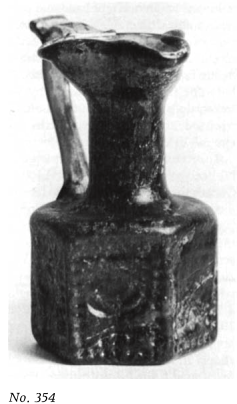
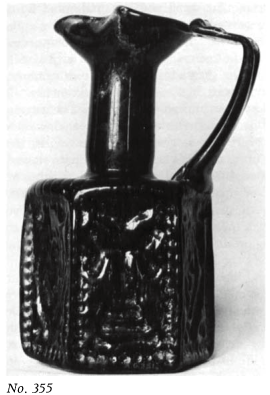
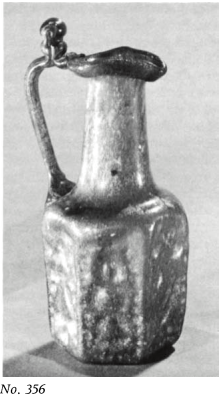
Jerusalem, 578-636 Glass. 354 - 12.7 cm. Toledo, Ohio, The Toledo Museum of Art, Gift of Edward Drummond Libbey, 23.1360. 355 - 13.8 cm. New York, The Metropolitan Museum of Art, Dodge Fund, 1959, 59.22.1. 356 - 14 cm. Toledo, Ohio, The Toledo Museum of Art, Gift of Edward Drummond Libbey, 23.1353
The many hexagonal and octagonal glass flasks that bear Jewish, Christian, or other symbols were probably used to transport consecrated oil from holy places in and around Jerusalem. They may all have been used as blessed eulogiae, souvenirs from holy places, believed to carry special properties, especially with regard to resurrection of the dead. Christians took the oil from shrines such as the Holy Sepulcher, the Rotunda of the Ascension, the Church of the Eleona, and others, while Jews probably took it from the many synagogues around David's tomb on Mt. Zion, or from the neighborhood of the Western Wall. They were found all over Europe—many in tombs—and the indications are that they were produced in the same workshop, as Barag proved (1970; [1], 1971; [2], 1971).
He pointed to the similar motifs in all types, similar glass consistency, shapes, sometimes identical measurements and molds, and dated the entire range of flasks between 578 and 626. He assumed that the crux fourchee of the Christian flasks was to be identified with the crux gemmata, which was placed on the rock of Golgotha by Theodosius II in a.d. 420 (Frolow, 1948, pp. 78 ff.) but was first depicted on coins of Tiberius II Constantine (578-582). A forked cross surmounting a globe resting on steps, which is depicted in another class of flasks, appears on coins of Heraclius (610-641). The ultimate date for Christian flasks could have been 636, with the conquest of the Holy Land by the Moslems, and for the Jewish flasks 629, when the Jews were forbidden to enter Jerusalem.
The use of glass flasks for carrying holy oil was concurrent with the use of Christian lead ampullae (nos. 524, 526, 527), but there are no Jewish metal ampullae extant.
To produce such flasks, the sides of the body were first blown into a mold with movable panels. Then, the bottom and the neck were blown and shaped, and finally the tubular handle and flange were added. This method becomes quite clear from the fact that one or more vessels were found with the motif upside down. Of the three main types, the three examples in this exhibition all represent the second type, which has an elongated neck, a tubular handle, and sometimes a flange on top. The similarity in their shapes and in some motifs stresses the differences in the identifying symbols in their decoration. The decorated panels of all the classes are framed by beaded dots.
The Jewish flask (no. 354; cf. Barag, 1970, pp. 45, 57, class v, no. 9, fig. 22) is translucent light brown. One panel carries a seven-branched me- norah on a three-legged base; others a stylized palm, which may be identified as a tree of life, and an arch resting on columns perhaps symbolizing a Torah ark of a temple facade; and two show two concentric lozenges, which may indicate the sacred character of the objects in Jewish as well as in Christian art as they do in early tombs and leather bindings of Gospel books (Goodenough, 1953, I, pp. 86, 169; Barag, 1970, p. 43). The sixth panel has an unidentified X-shaped element, terminating in stylized ivy leaves. Motifs in other Jewish flasks include a shofar and shovel flanking the menorah, or an amphora.
On the Christian flask (no. 355), also translucent light brown, three of the six panels are decorated with three different forked crosses, alternating with three concentric lozenges. One of the crosses, that of the Golgotha, is standing on three steps. The second cross stems from a bulbous base, placed within two circles; this may be identified as the Omphalos of the Earth. The third cross has equal arms, tipped with short crossbars, standing on a tree trunk (?) flanked by stylized leaves, which can be defined as a “life-giving cross," connecting the tree of life and paradise with the cross of Golgotha and the Holy Sepulcher (Barag, 1970, pp. 39-42). The concentric lozenges appearing in alternate panels should be interpreted as signifying the sacred character of the flask. All the Christian flasks are hexagonal, possibly because the ciboria above the Holy Sepulcher as well as above the Golgotha were hexagonal (Barag [2], 1971). Other motifs in the Christian flasks include a cross on an anchor or a cross on a ring and others which may represent later types of actual crosses of the Holy Sepulcher.
The unassigned flask (no. 356; cf. Barag [1], 1970, p. 49, class iv, no. 1, fig. 37), of blue glass, bears motifs also found on Christian and Jewish vessels; the group was intended for use by either Jews or Christians, since no vessels have pagan symbols (Barag [1], 1971, pp. 45-46). The first panel is decorated with an amphora, the second shows an unidentified object, with a triangular top. The third, fifth, and sixth depict other amphorae, or represent a stylized human figure. The fourth panel has two concentric lozenges. Other motifs on "unassigned" flasks represent various trees, birds, and fish.
bibliography: Barag, 1970; Barag (1), 1971; Barag (2), 1971. 357
Plaque against the "evil eye"
Syria-Palestine, 5th century Limestone. 31.5 x 27 cm. Jerusalem, Israel Museum, Collection of the Archaeological Institute, The Hebrew University, 2473. The rectangular stone plaque surmounted by a gable is worked in shallow bas-relief. The plaque is decorated with an arch containing a colonnaded shrine in the center and with a stylized conch above it. The shrine is flanked by two menorot, each with three legs and V-shaped branches, all formed by rows of beadlike segments. The narrow base is decorated with three birds pecking each other.
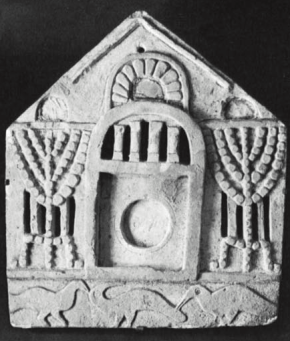
There is a large round depression in the center of the shrine and three lunette-shaped depressions above the menorot and within the conch, originally inlaid with mirrors or glass. Some of the glass still survives. A small hole above the conch indicates that the plaque was made to be hung on the wall. Signs of repair appear at the bottom of the back.
Several limestone or clay plaques with similar Jewish symbols and remnants of inlaid glass have been found (Mayer and Reifenberg, 1937). While the menorot and the shrine symbolize the Jewish hope for deliverance, the birds may symbolize eternal life in paradise and personal salvation in life after death. Christian and pagan plaques and many figurines with such inlaid glass have also been found, a few in graves, while others are of unknown origin (Rahmani, 1964).
Yael Israeli of the Israel Museum, who studied the glass and mirror plaques and figurines of pagan, Christian, and Jewish origins, found them all to be of Syro-Palestinian and Egyptian provenance, mainly from the fifth and sixth centuries. The lack of archaeological data and the primitive workmanship prevent exact dating.
No one knows for sure the function of the plaques inlaid with glass or mirrors. Mayer and Reifenberg (1937) suggested that those with holes for hanging on the wall were used in Judaism as a prototype for a "mizrah," that is, the east, pointing in the direction of prayer, toward Jerusalem. This does not explain the plaques found in graves, those without hanging holes, or the many Christian plaques and pagan figurines. Rahmani (1964) suggested that they were used by all religions for either ceremonial, magical, or symbolical reasons, and assumed that they were used for personal protection against evil spirits, as an “autofascination of the evil eye." These “served their owners in life, and were placed in their tombs with some hope that they might here, too, prove effective against the perils of after-life."
bibliography: Mayer and Reifenberg, 1937; Goodenough, 1953, I, pp. 174-177; III, figs. 440, 442, 445, 446; 1954, IV, p. 124, fig. 49; Willoughby, 1957, pp. 65 ff.; Rahmani, 1964, pp. 55 ff.
Date added: 2026-07-14; views: 139;