
Coin from Apamea Kibotos with Noah's Ark. Oil lamp with menorah
Asia Minor, 222-235 Bronze. Diam. 3.3 cm. ; 20.22 gm. Private Collection. This is one of several coins of its type from Apamea Kibotos in ancient Phrygia. Others were struck in Apamea under the rule of Septimius Severus (193-211), Gordian III (238-244), Philipus I Arabus (244-249), and Trebonianus Gallus (251— 253). All have bust portraits of the Caesars and similar renderings of the Noah episode, except for the last, on which the scene is reversed from left to right. The names of the various magistrates of games mentioned on the coins do not help to date them more accurately, since we have no records of the chronological sequence of these magistrates.
The coin was struck while P. Aelius Tryphon was archon; he held this post three times (IG Rom., IV, 795) during the reign of Alexander Severus, but it is impossible to be more precise about chronology.
Apamea Kibotos, which was situated near the source of the River Maeander, became an im portant transit center for merchants dealing with the East. There is no explanation for why the city of Apamea is called kibotos ("chest") or why Noah's episodes are depicted on the coins. According to local tradition, the mountain above the city, on which the fortress of Celaenae once stood, is identified as Mt. Ararat, on which Noah's Ark came to rest (Gen. 8:4). The well-established Jewish community of Apamea may have had depictions of the story of Noah in its synagogue, and this may have become a model for the coin. The rarity of the coins may be explained by the fact that they were probably struck only periodically for the national Panegyrian games.
Noah's scenes occur in Roman catacomb paintings and in floor mosaics like those of the synagogue of Gerasa and the church or synagogue of Mopsuestia (now Misis) in Cilicia.
There is no doubt that the coins were minted by a pagan government in Apamea familiar with Jewish tradition and perhaps with a relic of Noah's Ark. The Christians may later have fashioned Noah in his chest-ark according to a Jewish model. Found at the base of Mt. Ararat.
bibliography: Hill, 1899, p. 170; Reinach, 1903, pp. 61-63, pi. xi; Grabar (2), 1951; Goodenough, 1953, II, pp. 119- 120; III, fig. 700; Kindler, 1971, pp. 24-32, pi. v.
Oil lamp with menorah. Syria-Palestine, late 3rd-early 4th century. Terracotta 3 x 7.5 x 10 cm. Jerusalem, Israel Museum, Collection of the Archaeological Institute, The Hebrew University, 780
The mold-cast round lamp has a protruding, fanshaped nozzle with a wick hole on one side, and a projecting, triangular handle on the other. The central disc, with two filling holes, is decorated with a three-legged, seven-branched menorah. The lower pair of the semicircular branches is decorated with alternating roundels and squares. The others resemble palm branches, with rows of beads between them. The menorah is flanked by an ethrog on the left and mahtah on the right. A wide frame round the central disc is decorated with concentric bands of foliage scrolls, a row of beads, and palm leaves. The nozzle is decorated with linear geometric forms.
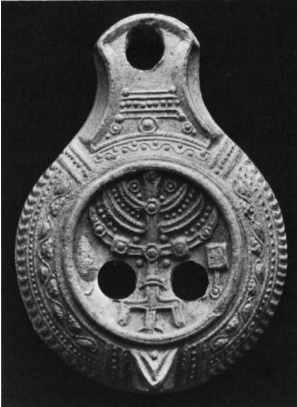
Jewish oil lamps of the second to sixth century are usually decorated with a seven-branched menorah. The provenance of this lamp is unknown, but oil lamps similar in shape, style, and workmanship have been found in a cistern used by a potter's workshop in Beth Natif in the Judean hills. Coins found with them date from the end of the third to the beginning of the fourth century. The lamps found in this cistern were decorated with various symbols which identify them as Jewish, pagan, or Christian. It is apparent that such oil lamps were used by households of the various religions: at home, as well as in public places and burial chambers, for practical as well as ritual and commemorative purposes.
bibliography: Baramki, 1936, pp. 3-10, pis. vi-vii, x-xii; Reifenberg, 1936, pp. 166-179, figs. 9, 10; Sukenik, 1949; Goodenough, 1953, I, p. 159; III, figs. 334, 336, 337.
Date added: 2026-07-14; views: 153;