
Front of sarcophagus with menorah. Bottom of a cup with Torah ark and temple implements
Rome, 4th quarter 3rd century Marble 72 X 126 cm. (28 3/8 X 49 5/8 in.) Rome, Museo Nazionale Romano, 67611. The large slab is part of the front of a Four Seasons sarcophagus. In the center are two winged Victories holding a clipeus in which is depicted a seven-branched menorah instead of the usual pagan or Christian portrait-bust of the deceased. The branches of the menorah are like strands of beads and are surmounted by lamps. The menorah stands on a three-legged base. Of the personifications of the Four Seasons, originally represented as two winged genii on each side, only Autumn is preserved. He stands on the right looking left and carries a basket of fruit in his right hand, a pair of geese in the left. Further right are fragments of the personification of Winter, holding up a boar. To the left of the clipeus were no doubt the personifications of Spring and Summer. Under the menorah clipeata are three Dionysiac putti treading grapes in a vat. Other putti appear next to the feet of the genii, one riding a hare and the other a boar.
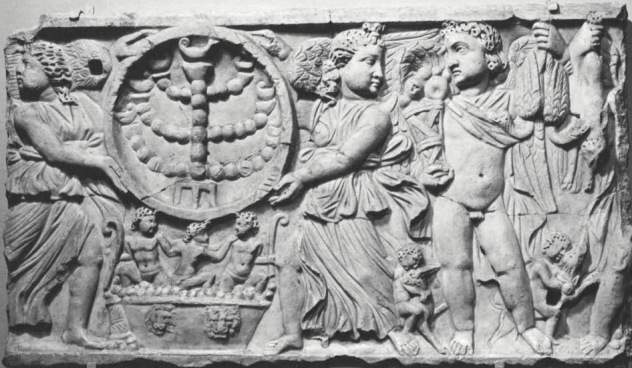
As in any pagan sarcophagus, the seasons and the putti represent salvation and eternal life. The menorah, instead of the portrait, represents the identity of the deceased with the Jewish nation and his hope for salvation. No doubt the sarcophagus was not specifically intended for use by a Jew. Such a sarcophagus could have been found at a pagan Roman stonecutter's workshop, and the. menorah was probably added when it was acquired for Jewish use. The seasons sarcophagus had by that time become interreligious.
The iconography of the “seasons sarcophagi" was well established in the Roman world, exemplified in such monuments as the Barberini sarcophagus of a.d. 330 in Dumbarton Oaks, that in the Campo Santo in Pisa of a.d. 260, and others (e.g., no. 159). In style, however, our slab is less elegant than these, dating probably from the last quarter of the third century.
From the Jewish catacomb at Vigna Rondanini; formerly in the Kircher collection.
bibliography: Cumont, 1942, pp. 484-498, pi. xlvii, 1-3; Hanfmann, 1951, II, p. 179, no. 493; Goodenough, 1953, II, pp. 26-28; III, 1954, fig. 789.
Bottom of a cup with Torah ark and temple implements. Color plate XI. Rome, 1st half 4th century. Gold glass. Diam. 9.8-10 cm. (37/8 in.) Jerusalem, Israel Museum, Gift of Jakob Michael, New York, in memory of his wife, Erna Sondheimer-Michael, 66.36.14
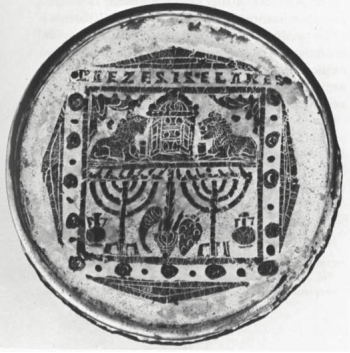
The thinly beaten gold leaf, placed between two layers of fused glass, has incised decoration. The very fine glass is greenish with many small bubbles and blurred in places, with no patina. The low, encircling foot ring is broken in places. The central part of the decoration is rectangular, divided horizontally into two registers. In the upper one the arched and couched open Torah ark reveals six Torah scrolls on three shelves. The shrine is flanked by two crouching lions of Judah, each with a scroll between its paws. A curtain is drawn back to either side. Two three-legged menorot, each with seven semicircular branches and red flames converging toward the central shaft, dominate the lower register. In the center are a lulav with an ethrog to the right and a shofar to the left. Two blue sprigs, probably aravah branches, emerge from each side of the hold of the lulav. On the outside of each menorah stands an oil amphora. Above the rectangular frame is inscribed a Greek toast transliterated into Latin characters: pie zeses elares, meaning “Drink, so you may live, Elares." The remaining three sides are bordered with alternating blue and red roundels dotted with gold. Four separate gold-leaf triangles form the outer border.
This gold glass and similar ones were found in Roman catacombs, pressed into the mortar of newly sealed tombs. Most of the Jewish gold-leaf glasses depict various sanctuary implements, mainly Torah shrines and menorot, which symbolize the Jewish national aspirations; the inscription conveys in addition the hope for personal salvation. The Christian (no. 388) and contemporary gold-glass fragments, on the other hand, depict among other subjects portraits of the deceased, sometimes with additional Christian symbols emphasizing only the personal salvation of the deceased through belief in Christ.
Formerly in the Goluchow Castle collection, Poland, and then in the Zealinska collection in Paris.
Date added: 2026-07-14; views: 164;