
Fragments of cup bottom with Torah ark and temple implements. Medallion with menorah
Rome, 1st half 4th century Gold glass a) 8.9x 3.8 cm. ; b) 3.8X 3.2 cm. New York, The Metropolitan Museum of Art, Rogers Fund, 1918, 18.145.1, a, b. Two fragments from the base of a drinking vessel (cf. no. 347). The compositional division into upper and lower registers can still be seen, though little remains of the lower register. Some of the left part of the upper register is missing. In the center of the upper register is a gabled Torah ark with acroteria, two Corinthian columns, and open doors revealing six Torah scrolls on four shelves, partly covered by a curtain hanging inside the ark. The shrine is flanked by two different types of seven- branched menorot.
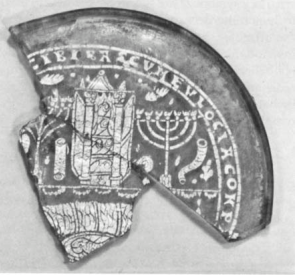
The one on the right has semicircular branches, with the lighted lamps connected by a crossbar. The flames bend toward the central shaft, which has a solid base. To the right of this menorah is a shofar, and to the left, near the shrine, is a small unidentified roundel. The branches of the menorah on the left are treelike, and have a crossbar on top. To its right stands a scroll and-to left the remains of an ethrog. The background is filled in with ornamental foliage. In the lower register a banqueting dais is represented. A fish can be seen on a round table in front of a semicircular, strapped bolster, above which hang swags. The remains of a Latin inscription, encircling the composition, reads: ci bib as cvm evlogia cONP(arare), or “Drink with blessing in preparation...."
A similar Jewish gold glass, in Berlin (Good- enough, 1953, III, fig. 974), has its lower register intact with the fish on a round tripod table.
Banqueting scenes with tripod tables and a fish are also known in Christian and pagan funerary art. They symbolize the agape, the fellowship meal, to honor the deceased and ensure his felicity in the afterlife. Our glass base is, according to the inscription, a cup of blessing for a deceased Jew. His belief that he will be saved through the national redemption of his people is symbolized by the eschatological scene in the upper register: the temple implements and the Torah shrine.
bibliography: Frey, 1952, no. 518; Garrucci, 1864, pi. V, no. 3; Reifenberg, 1950, p. 151; Goodenough, 1953, II, pp. 111-112; III, fig. 973; Schuler, 1966, pp. 56, 60, no. 7, fig. 14; Barag, 1972, cols. 604-612.
Medallion with menorah. Asia Minor, 7th century. Gold. Diam. about 6.5 cm. London, The Jewish Museum, JM 2. The very thin gold relief of this medallion is worn in places, but is still in one piece. The main feature is the seven-branched menorah, with a crossbar on top of the branches and a three-legged base. On the right is a lulav within a case, and on the left a shofar upside down. The Greek inscription at the top is carelessly written in capital letters. It reads: vnep EVXHC I/AKCOB APXITOV/niNNWNA (“For the vow of Jacob the Leader, the pearlseller"). The medallion is framed by a beaded border and has a hole for hanging at the top.
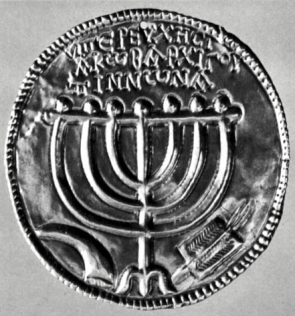
The medallion is unique, and its specific use is not known. Because the name of a community leader appears in its inscription, it can hardly be an amulet for private use. In a synagogue, such inscriptions stating the fulfillment of a vow are common on floor mosaics, wall paintings, and stone reliefs but are very rarely found on minor objects, perhaps because so few have survived. In a synagogue a medallion of this size might have hung on the staves of a Torah scroll, which Jacob probably donated together with a dedicatory inscription, since no writing except that of the Pentateuch is allowed on the scroll. Gold and silver pendants of this kind are known from the post-Renaissance period as “breastplates" (Barnett, 1974, pp. 30-33) and may be descended from such ornamentations from the Late Antique and early medieval periods. Unlike Byzantine Christian medallions, the Jewish have no human images and are therefore difficult to place and date.
The provenance is unknown. The monumental script, the schematic rendering of the implements, and the denseness of the composition suggest an origin in the eastern Mediterranean, possibly seventh-century Asia Minor. Presented in 1938.
bibliography: Barnett, 1938, p. 255; Barnett, 1974, p. 4, no. 2, pi. 1, pp. 30-33, nos. 136-147A, pis. lxii-lxv; Appelbaum, 1971, fig. 81.
Date added: 2026-07-14; views: 152;