
Fragments of a synagogue floor mosaic
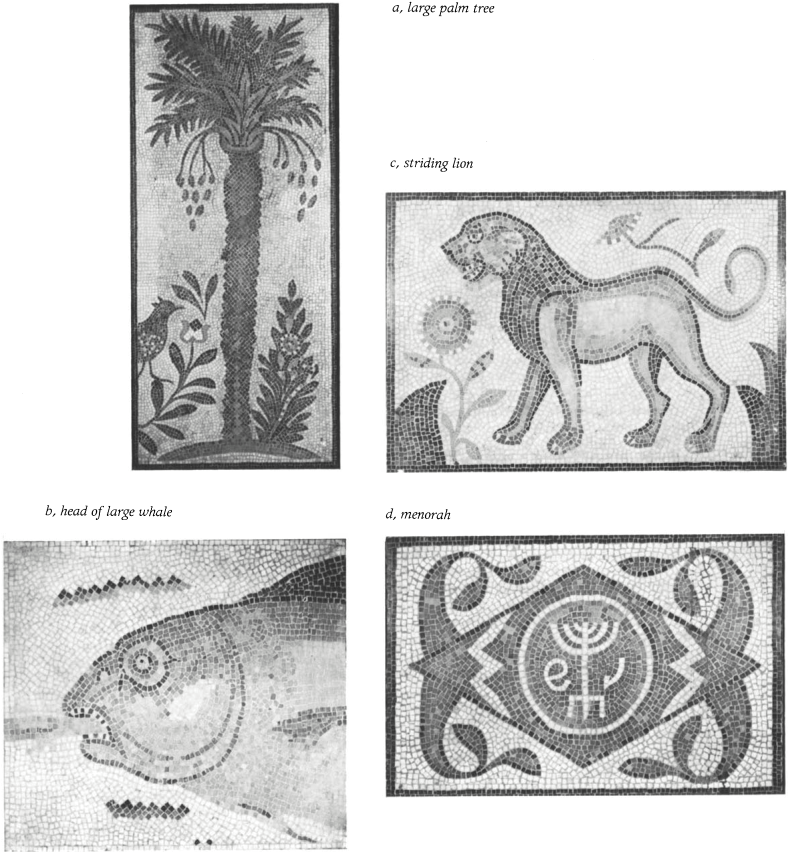
Naro (Hammam-Lif), Tunisia, 2nd half 5th century (a) large palm tree: 173 X 79 cm. (68 1/8 x 31 1/8 in.) (b) head of large whale: 71 x 82 cm. (27 15/16 x 32 5/16 in.) (c) striding lion: 72 x 107 cm. (28 3/8 X 42 1/8 in.) (d) menorah: 57 x 88 cm. (22 7/16 x 345/8 in.) New York, The Brooklyn Museum, (a) 05.14; (b) 05.15; (c) 05.18; and (d) 05.26. The synagogue of Hammam-Lif was discovered in 1883 within the garden of a building about 9.32 miles from the city of Tunis. The building probably existed in the third century, but the present mosaic floor is later, possibly from the second half of the fifth century. The entire floor was covered by mosaic, preserved until its discovery, when it was cut into panels and sold separately. The design of the floor in the main hall of the synagogue was copied together with a plan of the complex and published in color in Renan (1883). A more accurate sketch of the mosaic by M. Balagny was published in 1886 (Reinach).
The main hall is a broadhouse with a round Torah niche in the long wall, not in its center but nearer the entrance, as Goodenough has shown (1953, II, p. 91). It is preceded by a narthex with an entrance on the short wall. Both narthex and hall floor mosaics, now in the Musee National du Bardo, Tunis, have Latin inscriptions. That on the threshold of the narthex reads: "Asterius, the son of the archisynagogos Rusticus [and his wife] Margarita, daughter of Riddeus, paved this part [of the synagogue] with [mosaic] tesserae." That in the center of the hall reads: "The holy synagogue of Naro was paved with mosaic at the expense of thy servant Juliana P., for her salvation"; the line ends , with a menorah. A third inscription, in a room opposite the apse, refers to "instruments of thy servants in Naro," which may mean the scroll of the Pentateuch, and may indicate, according to Goodenough (1953, II, p. 91), that this was the room where the Torah was kept. The mosaic in the hall is divided into three uneven sections and was to be observed from the apse of the Torah niche.
The central section is divided in two by the inscription, which is flanked by two menorot, each within lozenges, the left with a stylized shofar, and lulav (or shofar) with an ethrog (d). The top part of this section has a seascape with a large whale (b), a dolphin, ducks, a wheel, and rays descending from the sky. The bottom part has a large standing vase as a fountain, with peacocks perched on it, flanked by two large palm trees (a), and two other birds. In the right section are a lion (c) and a duck within a double scroll. In the left section are other sea birds, a quadruped, and two wicker baskets, all within double undulating scrolls. Besides the inscriptions, which mention the synagogue, an archisynagogos, and three menorot, the repertory is pagan with some Christian overtones. The large whale, the dolphin, the wheel, the rays from heaven, and the large vase with peacocks may also indicate Jewish symbols of salvation and eternal life.
The style of the Naro synagogue mosaic is rather flat and not very crowded. Highlights and shading are produced by linear modulation.
bibliography: Renan, 1883; Reinach, 1886, pp. 217—223; Biebel, 1936, pp. 541-551; Goodenough, 1953, II, pp. 89-100; III, figs. 890-891, 897-906, 919-921.
Date added: 2026-07-14; views: 171;