
Synagogue floor mosaic with ark, temple implements, Helios, and zodiac signs
Hamat Tiberias, Israel, about 300 About 6.8 X 3 m. (22 ft. 4 in. X 9 ft. 9 in.). The well-preserved mosaic floor of Hamat Tiberias belongs to a synagogue built in the late third or early fourth century, on the site of an earlier synagogue. The building was in use until the eighth century.
The four halls of this synagogue were paved mainly with ornamental mosaic in about thirty colors. The nave mosaic is partly figurative, and is divided into three panels. In the southern, top panel is a representation of the ark,, symbolizing the temple, flanked by lighted menorot, as well as the lulav, ethrog, aravah, hadas, shofar, and incense shovel. In the middle panel are the signs of the zodiac, each inscribed in Hebrew, surrounding the figure of the sun god Helios riding his celestial chariot above the sea. This figure and the chariot were partly destroyed by the builders of the later synagogues. Helios wears a rayed crown surrounded by a nimbus, and a red paludamentum; his right hand is raised in benediction and the other holds the globe, symbol of sovereignty. There are also stars and a moon in the background. The corners of the panel depict female busts, personifications of the four seasons, each inscribed with its Hebrew name.
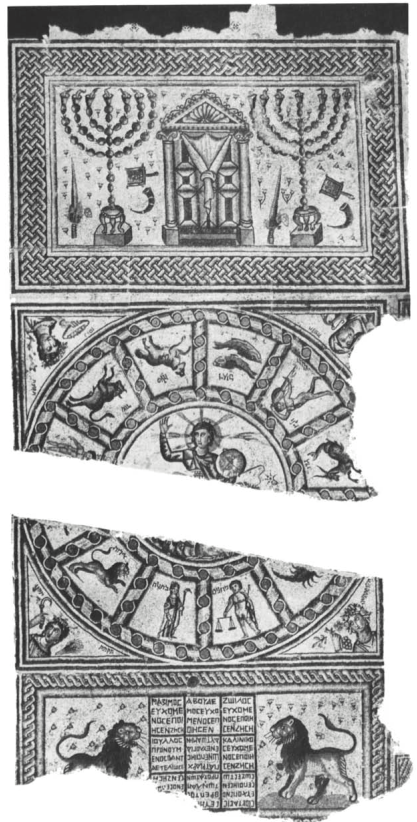
The northern panel contains a dedicatory inscription in Greek to the founders of the synagogue, flanked by two lions. The two eastern halls contain geometric mosaics and three inscriptions, one in Aramaic and two in Greek. From the main Greek inscription in the nave we learn that the principal founder was Severos, probably a highly successful disciple and a member of the entourage of the presidents of the Sanhedrin at Tiberias. The text ends with a blessing to him and to a certain Youllos, probably the administrator of the synagogue. The Aramaic inscription asserts that the building was a “holy site," that is, a synagogue.
The figure of Helios has all the attributes of Roman emperors, who were widely depicted in Roman art of the third and the beginning of the fourth centuries a.d., as “Sol Invictus," and in the Mithraic cult as Mithras. The Christian representation of Sol was widespread, as in the mosaics of the mausoleum of the Julii below St. Peter's basilica (no. 467); and in the liturgy, where he was identified with Christ as Cosmocrator.
The figure of Helios, surrounded by the signs of the zodiac and the four seasons, was found in three other synagogues in Israel: in Beth Alpha, Na'aran, and Husefa. They may have represented to an agricultural Jewish community the perpetuation of the annual cycle of the universe, or, as was suggested by Avi-Yonah (1964), the central part of a calendar.
The style of the human representations is close to that of the mosaics of Antioch dated to the days of Constantine the Great, such as the so-called Constantinian villa (Levi, 1947,1, pp. 226-257; II, pis. CLX-CLXIl).
The architectural style of the synagogue, together with finds of coins and pottery, indicate that the mosaic dates to the beginning of the fourth century.
bibliography: Levi, 1947,1, pp. 226-257; II, pis. clx-clxii; Avi-Yonah, 1964; Dothan (1), 1968; Dothan (2), 1968; Dothan, 1970.
Date added: 2026-07-14; views: 175;