
Fragment of a synagogue screen
Ashkelon, Israel, 6th-7th century 19 X 43-46.5 x 10 cm. (7 ½ X 16 15/16-18 15/16 x 3 15/16 in.) Jerusalem, Israel Museum, lent by the Deutsches Evangelisches Institut fur Altertumswissenschaft des Heiligen Landes, Jerusalem
The fragment of an elongated block of marble is decorated in shallow relief on two faces. On each side a guilloche is filled with different kinds of rosettes of four to eight petals, framed by a row of lozenges and roundels on top and a foliage scroll at the bottom, and terminating in a seven-branched menorah, flanked by a lulav and ethrog on the left and a shofar on the right. The stylized menorah has a three-legged base and a bar across the top of the seven branches. On the obverse this bar is surmounted by four three-petaled leaves; on the reverse by seven triangles simulating fire.
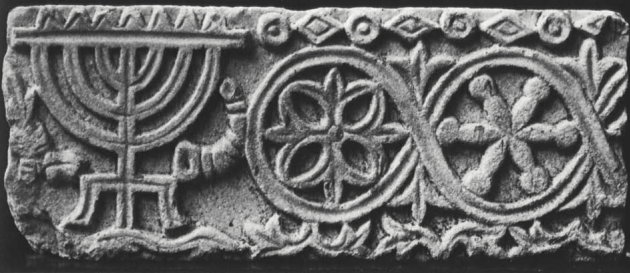
The appearance of the menorah on the right side of the guilloche on the obverse and on the left of the guilloche on the reverse may indicate that the damaged fragment was the center of a slab. On the top side of the slab are two parallel lines cut into the stone 1 1/4 inches apart. Along the bottom of the slab is a groove 1 ½ inches wide and ½ inch deep, which may indicate that the slab was originally placed atop a large oblong slab of marble that formed the main part of a conventional screen in the synagogue, between the Torah ark and the congregation.
Several such large stone slabs decorated with the menorah and other Jewish symbols are known from the fifth and sixth centuries (Sukenik, 1935, pp. 58-69). Such screens may have originated in Christian churches as partitions between priest and congregation, a usage unknown in Jewish ritual; they may also have been used to separate women's quarters in a synagogue from the men's (Sukenik, 1935, pp. 72-73).
Two other blocks of similar size were found together with this one in a grave near Ashkelon, according to the man who sold them to the Institute. The other two blocks bear fragments of dedicatory inscriptions on both faces, in two lines with a narrow line between them. The inscriptions say that а Кода Aofxva, Кdqoq Mapi son of Novvog, and Kofijiodoq ("Lady Domna, Lord Marison of Nunos, and Lord Komodos") presented this for their salvation in the year 709. Dalman (1903) thinks that the inscriptions refer to the time of emperor Commodus, and the date, counting from the Seleucid era, corresponds to a.d. 397. Cler- mont-Ganneau (1905) suggests that the inscription is later in style and paleography and reads it differently. The date refers to the era of Ashkelon (starting from 104 b.c.) and is accordingly a.d. 604. Both inscribed blocks have grooves in their top and bottom surfaces.
Though of the same size, the decorated block may be of a somewhat earlier date than the inscribed one. The stylized, crude, and shallow relief does not allow for the exact stylistic dating of the slab.
bibliography: Dalman, 1903, pp. 23-28; Clermont-Ganneau, 1905; Sukenik, 1935, pp. 62-65, pis. xv, xvi, fig. 21; Goodenough, 1953, I, pp. 219-221; III, figs. 575, 576.
Date added: 2026-07-14; views: 145;