
Biblical Art and Imagery in Late Antiquity Jewish History
The Second Commandment, "Thou shalt not make unto thee any graven image ..." (Exod. 20:4), did not deter the Jews from expressing their beliefs artistically. Even during the time of Moses, the Second Commandment was evidently understood together with its complementary verse, "Thou shalt not bow down to them nor serve them" (Exod. 20:5). Thus, God ordered Moses to install in the Holy of Holies of the sanctuary images of two cherubim above the Ark of the Covenant, between whom God dwelt (Exod. 25:18-22). The Temple of Solomon was likewise adorned with images of cherubim (1 Kings 6:23-29) and twelve oxen carrying the Molten Sea (1 Kings 7:24-26).
Ever since, the Jews have created images, except when there was a danger that the nation would turn to idolatry or when they lived under iconophobic rule. A typical example of the first case is the period of persecution by Antiochus Epiphanes, the Seleucid Hellenistic king of the second century B.c., who forced the Jews to worship pagan idols. This was the direct cause of the Hasmonaean revolt, which resulted in a strong revulsion against Hellenistic culture, mainly in its physical and visual manifestations. The second case is illustrated by the Jews' abstention from the use of human images on religious objects under Islamic rule. The Moslems interpreted the Second Commandment as prohibition from representing images on religious artifacts, but not on secular ones.
The wealth of artistic material produced and used by the Jews in the Late Antique period includes wall paintings, floor mosaics, sculptured objects, and household artifacts. Representational and narrative scenes are incorporated in this group, as well as decorative and symbolic elements. Since the discovery in the 1930s of the third-century painted synagogue of Dura Europos on the Euphrates, Syria (no. 341), and the sixth-century floor mosaic of the synagogue of Beth Alpha in the Beth Shean valley, Israel (no. 343), the existence of Jewish narrative art in the Late Antique and early Middle Ages can hardly be disputed.
An example of a narrative scene is the David lifting his sling to kill Goliath embossed on a clay lamp, probably used in a Jewish home in Alexandria (no. 352). The scene was probably chosen to encourage a depressed Jewish community, which was weakened and oppressed after the many uprisings against the Roman emperors during the first half of the second century. Another example of a biblical episode appears between 193 and 253 on a coin from Apamea in Phrygia, representing Noah and his wife leaving the ark (no. 350). The coin was produced by a proud, Greek-speaking community that believed a section of the ark to be in its possession. Another example is a picture of the Judgment of Solomon, enacted by pygmies, which was found painted on the wall of a house in Pompeii (fig. 42).
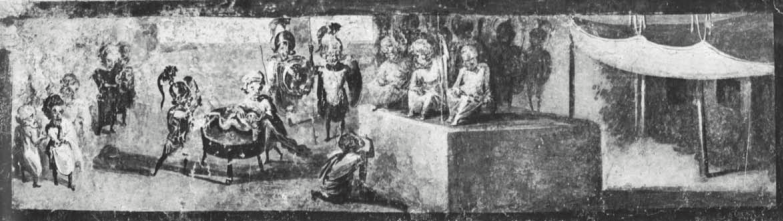
fig. 42. Fresco with Judgment of Solomon from Pompeii. Naples, Museo Nazionale
Biblical scenes must therefore have been used by Hellenized Jews to adorn monumental and minor art objects during the Late Antique period, in the East as well as in the West. In most cases such narrative scenes were dependent on earlier representations of mythological or historical scenes in Greek art. The artist of Solomon's judgment could have used as a model a similar judgment of the legendary wise Egyptian king, Bocchoris, giving it a Jewish interpretation. In the same way, the story of David could have been modeled on the story of one of the Greek heroes. The classical episodes were probably adapted from sketch and model books with conventional gestures to illustrate biblical episodes. In turn, illustrated scrolls and codices of the Bible text or biblical picture books without any text could have served as convenient models.
The use of a manuscript as a model is suggested by the inclusion of more than one scene within a single composition. A representation of this kind occurs on the coin from Apamea, where Noah and his wife are depicted twice, once within the ark and once standing by it (no. 350). Third and fourth scenes are implied by the appearance of both the raven and the dove on top of the ark. Such an assemblage of scenes was fairly common during the Late Antique pictures of the finding of Moses, episodes from the Books of Esther and Ezekiel, and the depiction of the Exodus from Egypt and the crossing of the Red Sea (Exod. 13:17-14:29; fig. 43). This latter depiction has four scenes reading from right to left within a wide, rectangular frame: the armed Israelites leaving Egypt; a very large figure of Moses lifting his rod period and indicates the conflation of consecutive scenes into a single one in an attempt to create a symbolic or monumental representation.
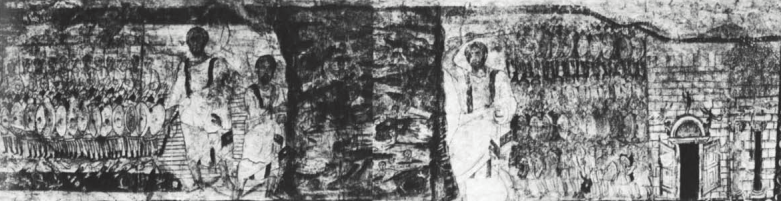
Fig. 43. Fresco with Exodus from Egypt and crossing of the Red Sea, from Dura Europos synagogue. Damascus, National Museum
The Dura Europos synagogue, of the mid-third century (no. 341), contains many examples of combined scenes that point to models with more detailed narrative cycles depending on texts, possibly illustrated manuscripts. Examples are the conflated to cleave the sea; the reunited sea, in which the Egyptians are drowning, while another figure of Moses points with his rod to the middle of the sea; and a third figure of Moses pointing to the twelve paths into which the sea was cleaved for the passage of the Israelites. It is therefore clear that the artist of Dura used a model with several consecutive episodes depicting the story of Exodus, rearranging their sequence. By placing the drowning Egyptians in the center, he avoided showing the Israelites advancing toward the reunited sea. The reversed position of the scenes stresses the individuality of each scene in the artist's model. The rearrangement need not have been made by the Dura artist himself; it could have existed in his immediate model. Ultimately, however, an earlier model had to depend directly on a written or oral text, possibly an illustrated manuscript with single scenes depicted next to the relevant text.
It would be interesting to determine the sort of text the ultimate model contained. This can perhaps be deduced by studying the iconographical nature of the Dura synagogue paintings. It appears that numerous scenes in the Dura synagogue are not related directly to the biblical text. For instance, in the Exodus picture the Israelites are crossing the Red Sea by twelve paths in accordance with the Midrash (Exod. Raba 24:1) and with the Aramaic Pseudo- Jonathan translation of Exod. 14:21.
The Midrash and the Targum incorporate exegeses of the Hebrew Bible with additional stories and legendary material, called in Hebrew "aggadah." The term Midrash is borrowed from a method of interpreting one biblical verse by quoting another. Early Midrashim are incorporated in the Mishnah (compiled about 200) and in the Aramaic Targumim (third to fifth century). The latter were recited verse by verse while reading the Torah in the synagogue every Sabbath.
The nonbiblical illustrations in the Dura synagogue can only be interpreted with the knowledge of specific Jewish exegeses, perhaps taken from an illustrated Midrash, a Targum paraphrase, or a consecutive picture cycle with additional captions quoted from the Targum. Similar types of illustrated paraphrases in the Jewish or Christian realms are known to us from later periods.
The illustrated Targumim and Midrashim could hardly have been made before their compilation at the beginning of the third century. These illustrations were probably added to the text before the middle of the third century, when they may have been used as models for the decoration of the walls of the Dura synagogue.
Some biblical illustrations exist in synagogue floor mosaics in and around Israel of the fifth and sixth centuries: Noah and his sons coming out of the ark with a herd of animals, in a fifth-century synagogue in Gerasa, Jordan (fig. 44); Daniel and the lions, from Na'aran, near Jericho, Israel; and the Sacrifice of Isaac from Beth Alpha, both of the sixth century (fig. 45). These are but a few scenes from what must have been an extensive range of biblical pictures. Among these, some midrashic elements appear: for example, the ram in the Beth Alpha synagogue is not caught in a thicket but tied to a tree, as in all Targumim (Gen. 22:13).
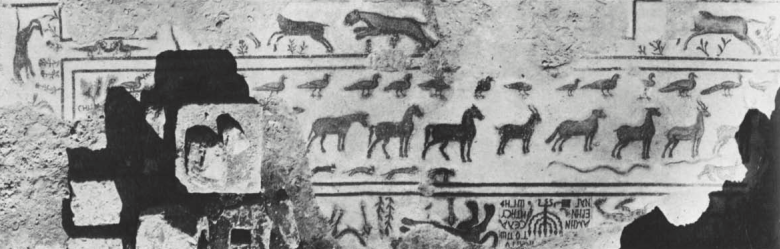
Fig. 44. Mosaic with animals from Noah's Ark. Gerasa, Jordan, synagogue
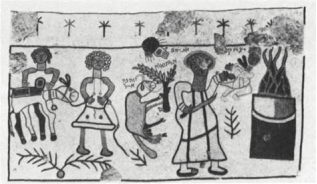
Fig. 45. Mosaic with Sacrifice of Isaac. Beth Alpha, synagogue
However, no biblical scenes appear in Jewish art between the sixth and thirteenth centuries. It is possible that Jews stopped representing biblical scenes in the seventh century with the rise of Islam, which forbade human representation in religious art, and Byzantine iconoclasm may also have influenced the Jews in the East. In the West, Jews may have possessed or even continued to reproduce biblical pictures, which were later destroyed during the long persecution of the Jews in the Middle Ages.
The existence of biblical cycles in Jewish art in late antiquity raises the question of their relation to biblical cycles and single scenes in Christian art. Many Jewish elements appear in Christian art. It is known that some early Church fathers were familiar with midrashic texts, as were early Jewish Christians. This, however, does not explain the sporadic, non- systematic appearance of Midrashim in Christian art, nor why certain midrashic episodes were preferred to others. Most of them occur in Roman catacombs, on sarcophagi and minor objects. For instance, in the Via Latina catacomb in Rome, Jacob's dream is rendered with Jacob resting on three stones, in accordance with the Midrash (Gen. Raba 68:11). Another midrashic representation in the same catacomb is of Abraham welcoming the three angels at Mamre; Abraham is seated, convalescing from his circumcision three days earlier, a composition that follows different midrashic sources (e.g., the Neophyti Targum on Gen. 18:1). This example may point to an earlier Jewish source in art, though no such representation is known to us.
The iconography of different scenes in the illustrated narrative Targum or Midrash was no doubt fashioned after classical art. Quotations of classical gestures, modes of expression, and even pagan motifs such as temple facades, Greco-Roman gods, and mythological figures can be found in the Dura wall paintings and in most early Jewish art. An example of how a pagan element is used to define the meaning of a Jewish midrashic narrative can be found in the panel of the childhood of Moses (fig. 46): a narrative is condensed from at least five episodes, most of them midrashic. The third scene, the finding of Moses, depicts the daughter of Pharaoh in the water, naked, holding the naked baby. The fact that Pharaoh's daughter and not one of her maidens is in the water is based on the Onkelos Targum (Exod. 2:5). On the shore behind her stand three of her attendants carrying vessels and dressed in the peplos usually worn by nymphs. Such water nymphs, carrying pitchers and bowls, or washing a baby, appear in classical representations of the birth of children of distinction or demigods, such as Alexander, Achilles (no. 213), and Dionysos. The artists and congregation of the Dura synagogue probably understood the classical language and its implications.
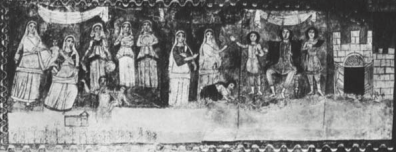
fig. 46 Fresco with childhood of Moses from Dura Europos synagogue. Damascus, National Museum
Another classical figure with a widely understood significance is the image of the Thracian musician Orpheus charming the animals (fig. 22; nos. 161, 162), which appears in the main panel above the Torah niche in the Dura synagogue (fig. 47). Although Orpheus was worshiped as the god of a pagan mystery cult that promised salvation and life after death, the'Dura congregation did not fear idolatry. They must have interpreted the figure, who is wearing a Phrygian cap (normally used as a royal crown in the Dura paintings), as the Messianic king David, who was a musician and compiler of the Psalms. David has assumed the image of Orpheus not only in Dura but also in the floor mosaic of the Gaza synagogue of 508-509, where the name David is written above in Hebrew (fig. 48). An image of Christ-Orpheus of the House of David is known from the Roman catacombs, such as the fourth-century catacomb of Domitilla. Another representation of a Christian Orpheus charming the animals appears in a fifth-century floor mosaic from a funerary chapel in Jerusalem, now in the Istanbul Archaeological Museum (Grabar [1], 1966, fig. 119). In a world of religious syncretism, images and their meanings were sometimes conflated, each religion giving a specific meaning to images used in common.
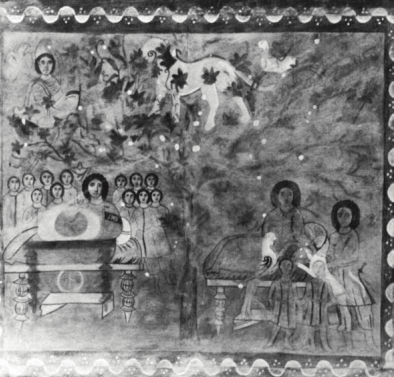
Fig. 47. Fresco with Jacob blessing Ephraim and Manasseh and David as Orpheus from Dura Europos synagogue. Damascus, National Museum
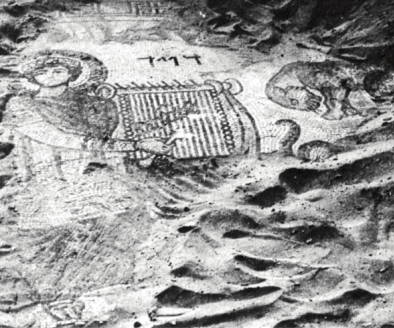
Fig. 48. Floor mosaic with David/Orpheus. Gaza, synagogue
In another example, the figure of Helios, the pagan sun god, driving a quadriga, appears in floor mosaics of the synagogues of Hamat Tiberias (no. 342), Na'aran, Beth Alpha (fig. 45), and others. He is depicted as Christ driving his chariot in the center of the vaulted ceiling in the early Christian cemetery now in the grotto of St. Peter's in the Vatican (no. 467). For the Jews, the depiction of Helios in the center of the zodiac wheel in their synagogue floor mosaics may have symbolized eternity or the continuous cycle of the agricultural seasons.
A seasons sarcophagus from Rome (no. 346) depicts, besides the four genii of the seasons, a seven-branched menorah in a clipeus, where the image of the deceased is normally depicted. Under the wreath are Dionysiac putti pressing grapes, denoting personal salvation and life after death. This example, like many others, illustrates that specific symbols of Jewish identity appear on Jewish edifices and artifacts with a composition and ornamentation common to pagan and Christian art. The seven-branched menorah represents the candelabrum from the destroyed Temple of Jerusalem. One of the main cult objects, it became a symbol of the temple while it was still in existence and after its destruction symbolized aspirations for national redemption. The deceased, or his family, chose a ready-made sarcophagus with pagan subjects implying eternal life and personal salvation. However, instead of a personal portrait, a Jewish national symbol of redemption was inserted.
The menorah is only one of the symbols of identity. According to the Mishnaic rule, it was forbidden to portray an exact image of the temple menorah. Indeed, there are no extant replicas of the menorah, and, moreover, no two depicted menorot look alike. The same applies to other temple and sanctuary implements, such as the Ark of the Covenant, the sacrificial altar, the incense altar, the shewbread table, and others. At times a conventional temple facade is represented. This was later transformed into a Torah ark with curtains. Some or all of these implements may be found represented in synagogues: above the Torah niche, as at Dura (no. 341); in stone capitals, as at Caesarea; on the marble screen, as at Sardis or Ashkelon (no. 345); and in numerous floor mosaics, such as at Beth Shean (no. 343), Beth Alpha (fig. 45), and Hamat Tiberias (no. 342). Minor art objects also show sanctuary implements. Examples include clay and bronze oil lamps (no. 351), glass bottles (no. 354), gold glass (nos. 347, 348), coins, and other objects. The menorah is sometimes accompanied by a flat shovel used to collect the burnt wicks or live coal from the altar upon which incense was burned.
In addition to these sanctuary implements there are sometimes elements that belong to the Feast of Tabernacles. These are the shofar (ram's horn), the ethrog (citron), the lulav (palm branch), aravah (willow), and others. The Feast of Tabernacles was the main feast of the temple, and so the objects used for its ritual also came to symbolize the temple and national redemption. Another common national symbol is the lion of David's tribe, Judah (Gen. 49:9), represented in gold glass and the Dura synagogue, as well as in the Hamat Tiberias and Beth Alpha floor mosaics. These symbols were depicted not only on ritual and household goods and in public houses of assembly, as an expression of pride in identification with the Jewish nation, but also on sepulchral objects and in burial chambers.
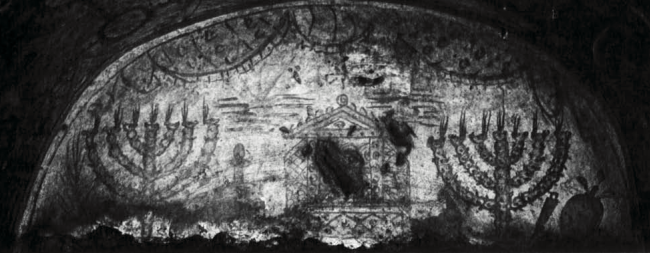
Fig. 49. Fresco with Torah ark and temple implements. Rome, Jewish catacomb of Villa Torlonia
Unlike the Christians or adherents of pagan mystery cults, the Jews believed that their personal salvation was contingent on redemption of the entire Jewish nation. When the Messiah of the House of David comes, states the Jewish daily prayer, he will gather the Jews from among the nations and raise the dead; he will rebuild the temple in Jerusalem and his reign will usher in eternal peace. This belief is reflected in the Jewish catacombs in Rome, as, for example, in the Villa Torlonia, where a part of the walls was covered with national symbols (fig. 49), including the menorah, lulav, ethrog, and shofar. Most of the tomb slabs, sarcophagi, ossuaries, and gold-glass fragments bear these symbols of identification. Only a few have symbols of personal salvation, such as birds of paradise (no. 344).
bibliography: Goodenough, 1953-1968, I-XIII; Urbach, 1959; Grabar (1), 1966; Gutmann, 1971; Roth, 1971.
Date added: 2026-07-14; views: 156;