
Synagogue wall painting with biblical representations
Dura Europos, Syria, 245-256 Tempera on plaster Damascus, National Museum. The synagogue (no. 358) was discovered in 1932, close to the western city walls. In an attempt to strengthen the walls during the Sassanian siege of 256, it had been partly filled with rubble. Consequently, only sections of the four painted walls survived. Almost the entire height of the western wall with a protruding Torah niche in the center is preserved. Of the north and south walls only a trapezoidal shape, and of the eastern wall only the lower part are extant. Some of the decorated ceiling tiles that fell on the rubble heap have dedicatory inscriptions in Aramaic dating from a.d. 244-245.
The wall paintings are tempera on dry plaster, arranged in framed panels. Remnants of under drawings survive. The main colors are different shades of brown, yellow, white, red, blue, green, and black. Shadings and highlights are linear, in either black or white.
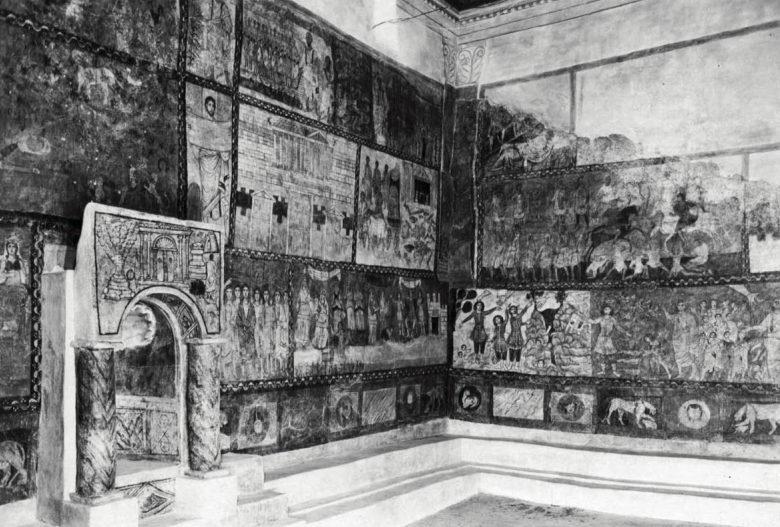
The protruding panel over the Torah niche depicts the temple facade flanked on the right by the Sacrifice of Isaac, symbolizing the covenant between God and his chosen people, and on the left by a treelike menorah, a lulav, and an ethrog.
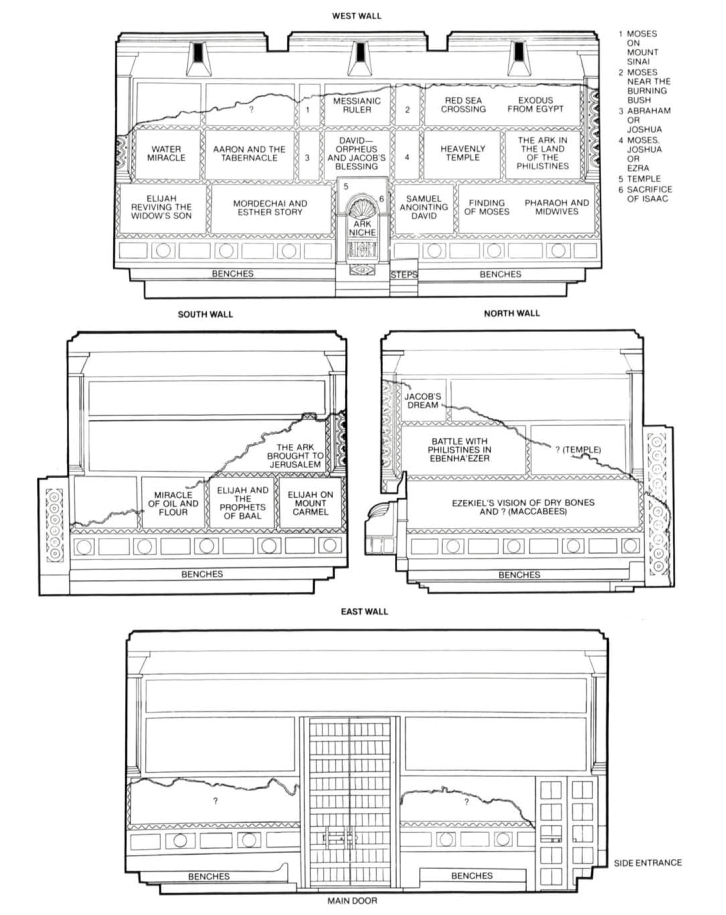
The area above this panel was overpainted several times during 245-265. The earliest stage had a large tree of life flanked by two tables. In the second stage the area was divided horizontally into two panels. An enthroned figure with two interpreters and other courtiers was painted in the top panel. In the lower panel Jacob was depicted blessing Ephraim and Manasseh on the right and his other sons on the left (fig. 47). In the middle between the two scenes, the lion of Judah was probably painted at the same time. In the third stage, an Orpheus-like David playing a harp, charming an eagle, a duck, and a lion was added between the panels to the left of the lion above Jacob blessing his sons.
Flanking this central area are four panels with single figures. The two at the top are surely Moses; the figures below are identified as either Moses, Joshua, or Ezra on the right, and Abraham or Joshua on the left, leaders of the Jewish nation reestablishing the covenant with God through the Torah.
Most of the painted panels in the synagogue depict biblical episodes of Jewish national and personal redemption. These scenes are mingled with midrashic elements, most of which are taken from the Aramaic Targumim.
The most obvious midrashic elements are based mainly on the Jonathan Targum. Those appear on the western wall: (fig. 43) in the Exodus from Egypt Moses is depicted larger than other figures and the Israelites, bearing twelve standards and crossing the sea in twelve paths; (fig. 46) in the story of the rescue of Moses, the two midwives are dressed exactly like Moses' mother, Yok- heved, and his sister, Miriam. Pharaoh's daughter takes Moses out of the water herself; in the central panel in front of the enthroned Messiah are two interpreters alluded to by the Jonathan Targum to Gen. 49: 10. On the south wall another example is found in the panel dealing with Elijah's contest with the prophets of Baal. Within Baal's altar stands Hiel Beth Haeli ready to kindle the fire, but God sends a serpent to kill him.
Other subjects represent eschatological scenes, such as the Heavenly Temple, which, according to the Midrash, will descend from heaven surrounded by seven walls, when the Messiah comes.
The subjects of the paintings (see diagram, page 373) are haphazardly arranged and do not follow the narrative sequence of the Bible. None of the many attempts to uncover a theological plan for the paintings has been successful. The Dura synagogue is provincial, and may have been inspired by another unknown painted synagogue, executed by better artists and with a clearer theological plan.
The style of the wall paintings is Eastern Hellenistic with much Parthian influence. One chief artist-draughtsman did most of the preliminary sketches and painted with the help of several apprentices.
bibliography: Rostovtzeff, 1938; Wischnitzer, 1948; Kraeling, 1956; Goodenough, 1964; IX-XI; Gutmann, 1973 (with the most important bibliography); Perkins, 1973; Schubert et al., 1974, pp. 35 ff.
Date added: 2026-07-14; views: 155;