
Oil lamp with David and Goliath. Incense burner
Alexandria (?), 4th century (?). Terracotta 3.8 x 9.5 x 13 cm.; H. with handle 5.7 cm. New Haven, Yale University Art Gallery, Gift of Rebecca Darlington Stoddard, 1913.653. The lamp, in excellent condition, is mold-cast in the shape of a trapezoid with rounded corners and a large round filling hole in the center. A row of seven wick holes ranges along the wider side, and on the opposite side is a short, protruding handle decorated with a palm branch. A thin line outlines the lamp, sloping upward and backward at an angle. The lamp is made of unglazed, reddish brown, lightweight clay not found in Egypt but known to have been imported to Alexandria. The shape with many wick holes is similar to that of some lamps from Egypt of the third century in the British Museum (Walters, 1914, p. 65, nos. 446, 447, pi. xv, and fig. 70) and especially to a rectangular mold with a scene from a hippodrome (Walters, 1914, p. 211, no. 1398, fig. 330).
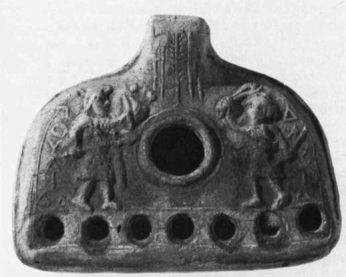
Flanking the central filling hole are the figures of Goliath on the left and David on the right. Goliath, wearing a tunic of chain mail and a sword, holds a spear in his right hand and protects himself with a shield in his left hand against two stones slung by David; a third stone hits him on the forehead. David whirls a fourth stone in the sling in his raised right hand and holds a spear in his left. The figures are identified by vertical Greek inscriptions; ΓΟVΛΙΑΔ for Goliath (the Г is reversed, and the AΔ is written from right to left), and ΔAVIΔ for David.
This lamp is rare in depicting a narrative biblical scene (1 Sam. 17:49). The David and Goliath theme probably signified for the owner the victory of the weak over the strong, stressing the power of faith. The subject was not very popular in Early Christian art. It was perhaps depicted on some sarcophagi (e.g., Wilpert, 1932, II, pp. 264- 265, pi. clxxxxiv, 1, 2). David is painted alone, with a sling, on the damaged ceiling of cubiculum 3 in the catacomb of Domitilla, Rome (Wilpert, 1903, pp. 356-357, pi. 55). In Egypt the scene appears in the sixth-century wall painting in chapel III at Bawit, but its composition is reversed and David's sling is not raised. The scene on our lamp must stem from another iconographic recension, possibly a Jewish one belonging to a life cycle of David.
This scene could well have suited the Jewish cause, since by the end of the third or beginning of the fourth century, while Christianity in Alexandria was an established religion, the Jewish faith was oppressed after several rebellions there. The seven wick holes may symbolize the destroyed seven-branched menorah of the temple, which is not represented on our lamp.
From the Stoddard collection. bibliography: Baur, 1928; Goodenough, 1953, II, pp. 105- 106; III, fig. 959.
Incense burner. Egypt, 5th century. Bronze. 28.3 cm., diam. 14 cm. New York, The Brooklyn Museum, Charles Edwin Wilbour Fund, 41.684. This incense burner was cast in three separate parts; a tripod base with claw feet, a baluster, and a bowl. The rim of the bowl has a register of openwork rings, each surmounted by a conventionalized bird, two of which are missing. On the exterior of the bowl, in punchwork, are three crude lines of inscription in illiterate Greek. The first line is preceded by an incised seven-branched menorah. The baluster and bowl remain connected by the original rivet, but the base has been rethreaded and attached to the baluster by a new screw (Herbert, 1972, p. 23). There is some pitting on the baluster.
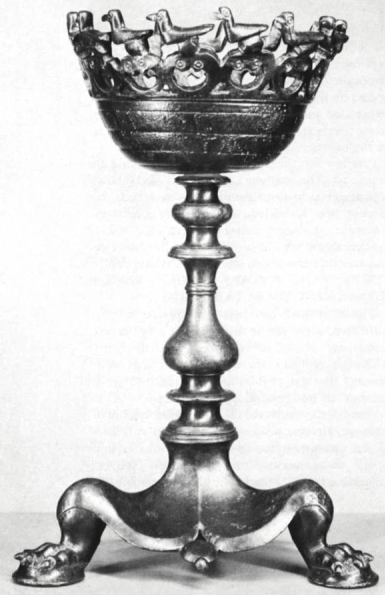
Parallels for the base and baluster abound in Coptic art. The openwork on the rim of the bowl was designed to ventilate the coals on which the incense was sprinkled, an especially necessary feature in a stationary censer (Herbert, 1972, p. 23).
Several attempts have been made to transcribe and translate the Greek inscription, which reads:

The first line has been interpreted as “in fulfillment of the vow of Auxanon" and by Herbert (1972) as “on behalf of a vow of Auxanon." Although scholars are not in agreement concerning the text that follows, Herbert suggests the key to understanding the inscription in its entirety is the menorah, the distinctive symbol of Judaism. Herbert proposes that the last two lines of the inscription are an attempt to render into Greek some verses from a Hebrew prayer: “B lessed art thou, О Lord (who gives graciously ?). “ According to Narkiss (verbally), an incense burner was used by the Jews at the end of the Sabbath for the benediction of habdalah—"separation" between holy and profane.
Herbert also suggests that the contrast between the elegance of the piece and the crudeness of the lettering may indicate that Auxanon came into possession of the censer, intending to dedicate it in his synagogue, after it had originally served some other purpose. The Greek text may not have been finished because the censer never reached a synagogue but was used for the habdalah ceremony at home.
Acquired through the Charles Edwin Wilbour Fund from Max Nahman, Cairo.
bibliography: Baltimore, 1947, no. 271; Herbert, 1972, no. 32.
Date added: 2026-07-14; views: 142;