
Early Christian Abbreviated Biblical Art
Abbreviated representations of biblical themes— reduced to the most essential figures, yet maintaining the recognizability of the scene—appeared in Western Christian art around 200 and about 240 in Eastern art. Together with narrative representations, in which the artist endeavors to pictorialize as many figures and actions as the text can supply, they constitute the earliest form of biblical imagery. Although objective evidence is still lacking, the frescoes in the Christian baptistery of Dura Europos (no. 360) and the coinage minted under Septimius Severus from Apamea Kibotos (no. 350) suggest that antecedents probably go back to the end of the second century. Considering Early Christian art and especially the problem of its beginnings, one must keep in mind the fortuitous character of its preservation—for instance, in Rome—and the systematic destruction of Christian images, particularly in the East.
A typical abbreviated representation is found on the short western wall above the baptismal font in the baptistery at Dura (fig. 50), which was presumably once fully decorated with frescoes. Appropriately for the theme of baptism, the representation shows Adam and Eve on either side of the tree of knowledge, framed by trees of paradise. Above it, a broader presentation of a sheep carrier with his flock introduces a bucolic theme, which, in this context, is to be understood as a symbolic reference to John 10:11. The Good Shepherd was depicted even more frequently without the flock, thus stressing the symbolic significance.
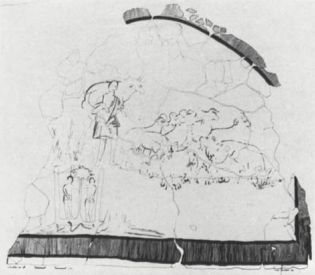
Fig. 50. Tracing of fresco from the baptistery of Dura Europos, with Good Shepherd and Adam and Eve. New Haven, Yale University, Art Gallery
The representation of the healing of the paralytic on the north wall of the Dura baptistery (no. 360) is an abbreviated double scene. Although Christ appears only once—approaching the bed of the lame man—a second phase is also presented, with the paralytic man carrying his bed away, thus showing the effect of Christ's miraculous healing. In portraying this miracle the artist presumably intended to recall not so much the specific event as the words of Christ connected with it: “My son, your sins are forgiven" (Mark 2 : 5), which had special significance in the baptismal context.
The lower register on the north wall of the baptistery depicts the five women in the sepulchral cave, a scene that was preceded on the east wall by the same five women (only the feet are still visible) walking toward the sepulcher. Not only do we have here a narrative representation extended over two walls, but the possibility that at the beginning of the third century a larger repertory of images existed in Syria than in the West.
The Cleveland statuettes (nos. 364-368) also attest to the early origin of Christian art in the East. They reflect a separate and original iconography whose existence could not even have been anticipated twenty years ago. The four Jonah statuettes establish the existence and tradition of a Jonah cycle in the East in the third quarter of the third century, and they demonstrate the dissolution of a unified cycle into separate abbreviated representations. Each statuette is a segment of the whole Jonah story. Moreover, the statuette of the Good Shepherd (no. 364) confirms the early transfer of the bucolic theme to Christ, an association implicit in John 10.
The frescoes at Dura, and probably the Cleveland statuettes, do not belong to sepulchral art. In contrast, third-century Christian art in the West is preserved only as funerary art, at least until the fourth century. A repertory of salvation scenes, abbreviated to the essential details toward about the third decade of the third century on wall and ceiling paintings in the Roman catacombs, was transferred to sarcophagi from about 250 onward. With the exception of the Jonah cycle, the abbreviated form predominated. A striking and characteristic trait of Western pagan and Christian art of the second half of the third century is the bucolic and maritime framework.
Christian art in the pre-Constantinian period is relatively well preserved in Rome, Velletri, and Cimitile. A sarcophagus in Sta. Maria Antiqua in Rome dating to about 260 (fig. 51), for example, combines the religiously neutral center—reading scene, orant, Good Shepherd—-with a Jonah representation on one side and a baptismal scene on the other. The imagery of the Jonah sarcophagus in Rome (no. 361) presents a biblical anthology: the Jonah trilogy dominates the front side, while around it depictions of the Raising of Lazarus, Moses, and an abbreviated Noah scene enlarge the repertory of images without presenting a unified program.
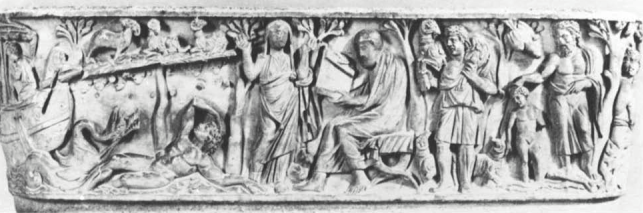
Fig. 51. Sarcophagus with Jonah scene, orant, reader, Good Shepherd, and baptismal scene. Rome, Sta. Maria Antiqua
The most convincing explanation proposed so far of the selection of themes on catacomb walls and sarcophagi imagery is that they are based upon prayers for salvation. In the appeal to God, examples of
his redeeming work are cited: Jonah in the belly of the whale, Daniel in the lions' den, Susanna among the Elders, the Miracle of Cana, and Christ healing the blind, the mute, the lame, and others. Although the earliest Latin version of these prayers dates only from the beginning of the fifth century, the formulae with their references to God's miracle-working activity must have been known as early as the third century; they ultimately go back to Jewish prayers. It appears indeed that we have here liturgical texts that presuppose with Christian congregations a knowledge of similar and older lists of paradigms as they occur, for instance, in the writings of Irenaeus [Adversus haereses 2.33.1) and Tertullian (De bapt. 9). Prayers spoken for the dying may have influenced the serial presentation of such themes in sepulchral art, though this still does not indicate the iconographic source of the corresponding abbreviated representations. The individualized portrait of the resting Jonah on the British Museum sarcophagus of about 300 (fig. 52) shows that the Christians wanted to incorporate into the biblical story wishes for the deceased as they were expressed in the prayers.
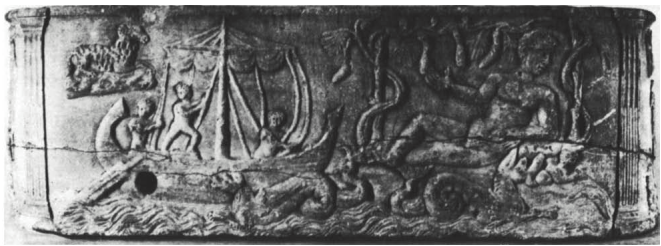
Fig. 52. Sarcophagus with Jonah scenes. London, The Trustees of the British Museum
The Velletri plaque (no. 371) demonstrates the fusion of neutral pagan themes—sheep carrier, orant, resting shepherd—with bibhcal subject matter: the Fall of Man, Noah, Daniel, and the Jonah cycle, pressed into the smallest space, juxtaposed over the only New Testament scene, the Multiplication of the Loaves (Matt. 15 : 37).
During the pre-Constantinian period most of the biblical representations are taken from the Old Testament, especially Genesis, Exodus, Daniel, and Jonah. In the West, besides the abbreviated scenes from the Old Testament, the repertory of New Testament themes was expanded. Some of them are unique and seem to reflect a pictorial recension that is otherwise lost. The polychrome fragments in Rome (nos. 372, 373), which date to about 300 to 310, are good examples. The representations of the Sermon on the Mount, the Feeding of the Five Thousand, and the adjoining scenes of miraculous healings display certain aspects of narrative compositions. In these we can observe how the separation of the individual scene from a narrative context leads to an abbreviated representation and how in most cases the abbreviation itself constitutes a second stage in the development. Both fragments portray Christ bearded, a type that was to supersede the youthful beardless Christ Logos only toward the end of the fourth century.
It was only after Constantine's victory at the Milvian Bridge in 312 that Christian iconography outgrew its experimental stage and became fixed and that the biblical repertory was greatly enriched. It is important to note that Christian and pagan art were produced in the same workshops. The historical reliefs of the Arch of Constantine (313-315; no. 58), to cite a striking example, come from the same workshops as the Christus-Petrus sarcophagi of one or two registers (fig. 53), as proved by a comparison of the heads of the soldiers on the Arch of Constantine to those on the Lateran sarcophagus 161 (no. 374; fig. 54). What can be observed in sculpture has a counterpart in book illumination of the Constantinian era, when the Vatican Vergil (no. 203) and the Quedlinburg Itala (no. 424) were illustrated in the same scriptoria. The Christian element in representational art lies only in the biblical or christological themes, not in the style of the representation.
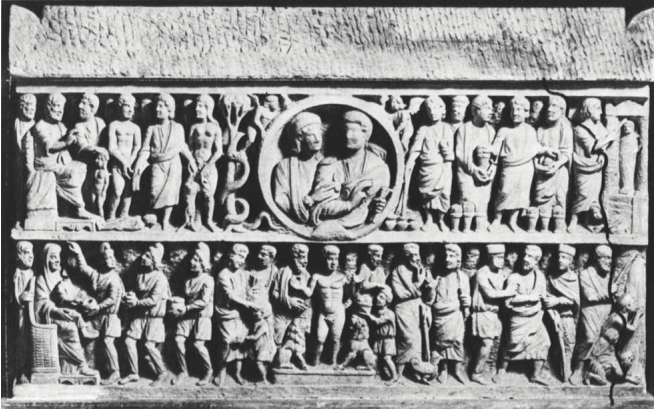
Fig. 53. Sarcophagus with Old and New Testament scenes. Vatican City, Museo Pio Cristiano
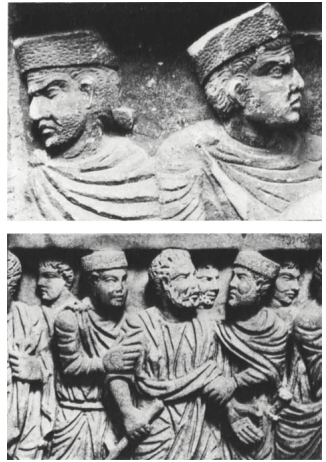
Fig. 54. (top) Detail of heads of soldiers on the Arch of Constantine Rome (bottom) Detail of soldiers on the Lateran sarcophagus 161 (no. 374). Vatican City, Museo Pio Cristiano
These datable Christian sarcophagi also demonstrate that local Roman traditions concerning the apostle Peter entered Christian imagery at the same time that the basilica of St. Peter's in the Vatican (no. 581) and the Basilica Apostolorum at the Via Appia (later S. Sebastiano) were erected. A trilogy consisting of Peter's Water Miracle, his capture by Roman soldiers, and Christ's prediction of Peter's denial (no. 374) is juxtaposed as a coherent group with a group of Christ's miracles. Recently, a well- balanced example of the same compositional type, close to the archetype, around 330, was found in Arles (fig. 55: on the lid, the Three Hebrews in the Fiery Furnace, at the left, and the Adoration of the Magi, at the right). The main frieze, which lines up abbreviated scenes one after another with heads filling the background space, has compositional analogies in the reliefs on the Arch of Constantine. Thus, the style and principle of composition— frontality, centralized composition, two registers— occur in both Christian sarcophagi and imperial reliefs, however different the themes. Likewise influenced by the Roman tradition is the newly found double register sarcophagus in Arles, dated about 330 (fig. 56), which on its lid depicts abbreviated scenes mostly from the Old Testament, and, on the main friezes: in the upper left register, the Creation of Adam and Eve; in the lower right, Peter as teacher of the soldiers and, immediately to the left, their baptism.
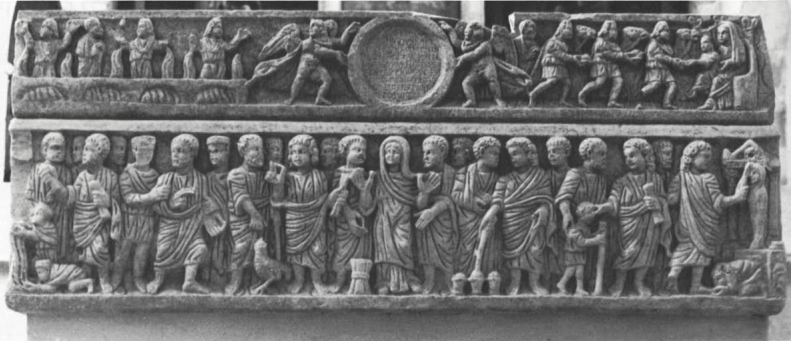
Fig. 55. Sarcophagus with Old and New Testament scenes. Arles, Musee Reattu
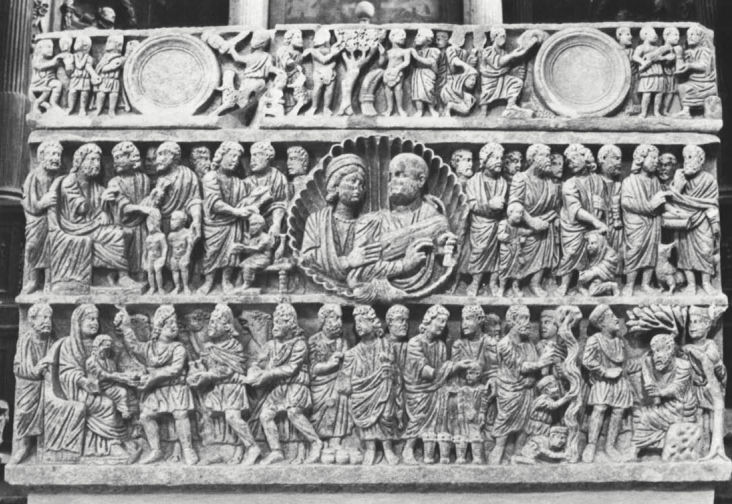
Fig. 56. Sarcophagus with Old and New Testament scenes. Arles, Musee Reattu
Both sarcophagi show the Adoration of the Magi, a favored theme, fashioned after a composition pertaining to the imperial cult. Such imperial traits as scepter, nimbus, and acceptance of homage by prostration were transferred to Christ in the fourth century. The epitaph of Severa in Rome, from 325-350 (fig. 57), shows this theme in an interesting version, as does the engraved ring stone at Oxford (no. 393).
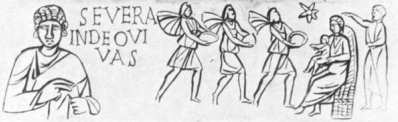
Fig. 57. Tracing of marble epitaph with Adoration of the Magi. Vatican City, Museo Pio Cristiano
The migration of iconographic schemes from one medium to another can be observed everywhere in the fourth century. The stereotyped iconographic depictions of the Raising of Lazarus, the healing of the lame and the blind, the Water Miracles performed by either Moses or Peter, Daniel in the lions' den, and the Sacrifice of Isaac appear on gold glasses (nos. 377, 382), on terracotta plates (no. 379), and on gems, as well as on catacomb frescoes (no. 381) and sarcophagi. Common models in fourth-century pattern books must be assumed as the source.
On a sarcophagus relief in the Vatican (no. 375) can be recognized—assuming intermediate stages— the reduction of a narrative presentation of the prophecy of Ezekiel 37 describing the resurrection of the dead, a theme also preserved in one of the synagogue frescoes at Dura Europos (no. 341). Christ as the fulfiller of prophecies is in the relief replacing the prophet, an image that reinterprets the Old Testament event. Two abbreviated Genesis scenes (figs. 53, 56), where Christ participates in the Creation of Man and apportions work to the first parents, are other examples of such replacement.
Klauser ([1], 1961, pp. 142—143) suggested that abbreviated representations originated in gems, and he pointed to a passage by Clement of Alexandria, an early Church father, to support this conclusion. Two considerations, however, contradict this theory: Christian gems postdate the earliest Christian works of art in other media, and, according to some scholars, gems do not show original designs but usually copy models of monumental art. At this time no solution to the problem of the origin of the abbreviated scenes in Early Christian art can be reached.
Recent discoveries have shown that it is unwise to construct elaborate theories based on accidentally preserved artistic monuments. The catacomb of the Via Latina in Rome (nos. 219, 419, 423), which was discovered in 1955 and dates between 320 and 380, offers a pictorial repertory that completely deviates from known catacomb paintings. In addition to mythological scenes, there are about sixty Old Testament representations in contrast to only seven New Testament ones. Moreover, the depictions have a distinctly narrative character that contrasts with the abbreviated nature of most “orthodox" catacomb art. Their majority most likely derives from three different biblical picture recensions that existed in Rome in the first half of the fourth century.
In the East, the Dura synagogue (no. 341) shows that a Jewish Septuagint illustration must have existed before 240 and suggests that abbreviated representations of Old Testament themes were taken from the narrative Septuagint illustration. As for the Dura baptistery, where abbreviated and narrative scenes occur side by side, the narrative themes were probably derived from Tatian's Diatessaron, familiar in the Syrian sphere, or from the Gospels of Matthew and John, predominant in the non-Syrian area. The chronological priority of Old Testament illustrations cannot be doubted. Furthermore, there are many indications that the choice of themes from the New Testament was at first limited to the Gospels, and, finally, that in the East narrative compositions were the earliest form of representation.
The development in the West seems to have differed. Here, Christian art of the pre-Constantinian period—preserved only in the sepulchral realm— depicts Old Testament scenes like the Jonah and Susanna cycle in the narrative mode, while abbreviated compositions appear simultaneously. In the East abbreviated representations probably constitute a second stage of development; in the West abbreviated scenes, possibly through the quoting of miraculous salvation, predominated. The polychrome fragments in Rome (nos. 372, 373), however, with their narrative elements, point to an as yet unidentified source of imagery.
Another problem concerns the adoption of ancient pictorial forms and compositions into Christian art. The representation of the resting nude Jonah was derived and transformed from the picture of Dionysos lying under the vine (fig. 58) or from Endymion sleeping. The Creation of Man (fig. 53, upper left) was fashioned after the Prometheus representation. Samson's struggle with the lion was adapted from a typical image of Heracles' struggle with the lion (nos. 139, 140), the ascension of Elijah was patterned on a typical representation of Sol as seen on the short side of the Arch of Constantine (no. 58), and the representation of Adam and Eve with the snake may go back to the Hesperides scene. The representation of the Sacrifice of Isaac (no. 380) would have been impossible without the model of ancient execution scenes, and the conversion of the Calydonian meal in the Meleager myth into a Christian funeral meal through substitution of bread and fish for the boar's shank shows the adoption and renewal of older forms.
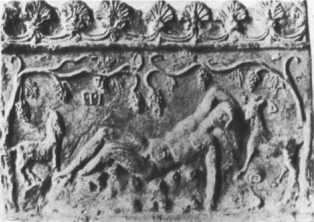
Fig. 58. Campanian terracotta with Dionysos under the vine. Paris, Musee du Louvre
The types ultimately go back to narrative contexts and thus enhance the likelihood that these were the source of the abbreviated composition. Adaptation and integration within a given context, however, do not exclude the possibility that some iconographic scenes are original in conception, as one has probably to assume for the Passion cycle of around 350.
How firmly fixed iconographic types became during the fourth century, especially in the abbreviated scenes, is evident wherever old themes appear in new compositional contexts and other art forms: for instance, the short scenes on the two-register columnar sarcophagi that were adopted from frieze sarcophagi, or on ivory tablets, such as the Murano diptych, where on either side of Christ enthroned appear miracle scenes abbreviated to two persons (fig. 59). Also, the pictorial repertory of the nave mosaics above the clerestory windows in S. Apollinare Nuovo at Ravenna is partly derived from the tradition of abbreviated scenes: for example, the Raising of Lazarus, the healing of the blind, the Samaritan woman at the well.
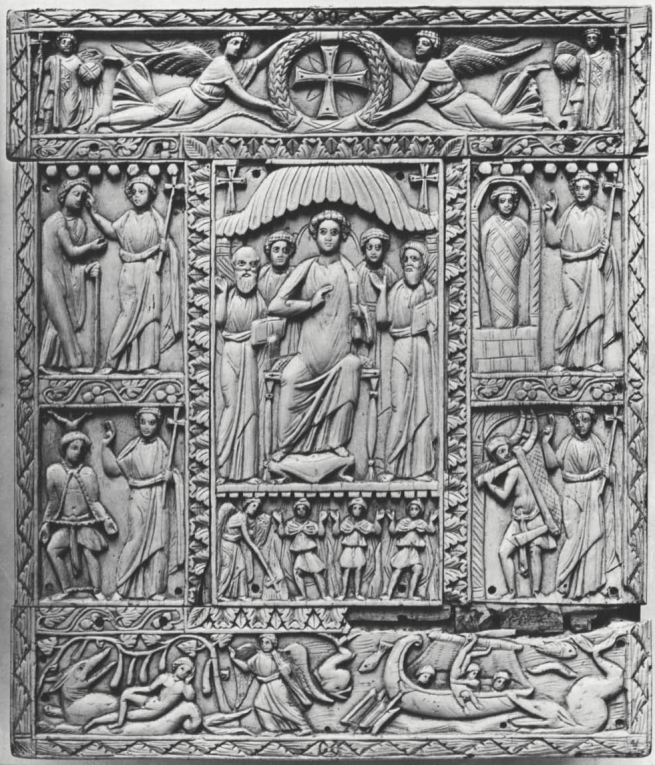
Fig. 59. Leaf from the Murano diptych, with Christ enthroned and miracle scenes. Ravenna, Museo Nazionale
Finally, to understand the meaning of any abbreviated composition, its function has to be taken into account. The same scene may suggest different shades of meaning, depending on whether it appears in a catacomb painting, on an ivory pyxis, a Uturgical vessel, or on gems or ornaments. Although the abbreviated representation is always rooted in a biblical episode, its symbolic allusions transcend that text. It is intended, at least by the person who gave the commission, as a reference to the function of the object or to the patron's life.
bibliography: Wilpert, 1903; Gerke, 1940; Morey, 1959; Klauser (1), 1961; Klauser, 1965-1966; Bovini and Brandenburg, 1967, I; Fremersdorf, 1967; Weitzmann (2), 1971; Brandenburg, 1975;Nestori, 1975; Sotomayor, 1975; Volbach, 1976.
Date added: 2026-07-14; views: 158;