
Portrait busts, Good Shepherd, and Jonah figures
Eastern Mediterranean (probably Asia Minor), end 3rd quarter 3rd century Marble. Cleveland, The Cleveland Museum of Art, John L. Severance Fund. The two busts (one of three pairs in Cleveland [Wixom, 1967, figs. 1-6]) and the five symbolic sculptures are each carved from a single block of the same white, fine-grained, well-crystallized, semitranslucent marble. Natural accretions or patinas, varying from yellow to brown, are distributed in a fairly orderly pattern over each piece according to their positioning in burial. The sculptures are otherwise well preserved, with the chief losses restricted to chipped extremities: small portions of the tail of the ketos are missing in both representations as is Jonah's left hand in Jonah cast up.
The flesh and draperies have been polished. The hair and beards are fairly rough. The drill has been used in the details of the beards, the corners of the mouths, furred edges of drapery in the busts, and in the gourd vine. Chisel strokes are evident on the reverses and underneath the bases, as well as in the beards and hair. Many strengthening or connecting struts remain in the symbolic figures, especially the Jonah praying.
The overall shapes of the six Cleveland busts are similar. Each bears an index plate without any trace of a name. The nearly circular bases have molded fronts; the reverses are roughly cut with a claw chisel. Each bust is hollowed out on either side of a central stem support at the back.
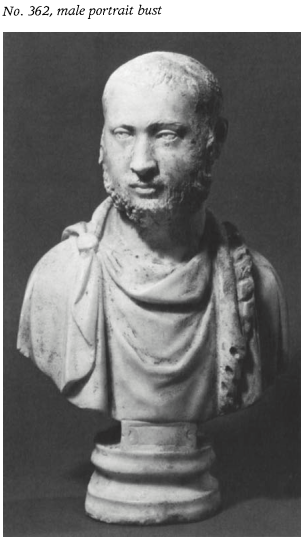
The man (no. 362) is possibly in his middle thirties, with short-cropped hair, a pronounced widow's peak, a high domed skull, a low brow, a slightly aquiline nose, heavy-lidded eyes, a thin mustache, and a beard with full sideburns. His head is turned slightly to his right. He wears a tunic and a fringed paludamentum fastened over his right shoulder with a disc fibula.
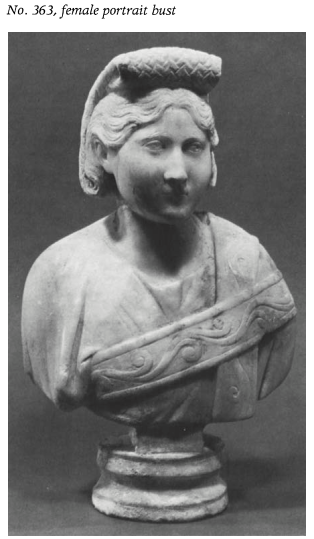
The features of the woman (no. 363)—pointed chin, full cheeks, heavy-lidded but small and close-set eyes, and a flattened, aquiline nose— make her age more difficult to determine. Her hair, parted in the center, is drawn back at the sides over the ears in loose waves, then is dipped down to the nape of the neck, where it is braided, pulled up over the top of the head, and folded under at the front in a variation of the Scheitelzopf (see nos. 14, 20; and Wessel, 1946-1947, pp. 66-70, pis. ii, hi). The head is turned slightly to her left. The woman wears a tunic overdraped with a togalike garment with a wide rinceau- decorated border, stolelike or trabealike in character.
The details of male fashion—such as the short- cropped hair, full sideburns, and light mustache —together with an impressionistic style, suggest that the Cleveland male busts may be regarded as extensions of the type and style of the portraits of the emperor Gallienus (cf. no. 2). Since close parallels are found in central and southern Asia Minor (Wixom, 1967, figs. 10-16), the Cleveland busts may have been carved there. The probable date has been assumed to be in the third quarter of the third century.
The Scheitelzopf of the Cleveland female busts is also imperially derived; closest analogies may be seen in the hairstyle of Ulpia Severina and Magnia Urbica, which may also be compared to Asia Minor portraits (e.g., Wixom, 1967, fig. 21). This fact—plus stylistic parallels in examples found in the southern part of that area with regard to the treatment of the eyes, brows, lips, and modeling of the flesh—allows a localization and date comparable to that of the male busts. If considered alone, the date for the female busts could be given as about 270-280.
Cleveland's freestanding, paired busts, together with several other pairs, suggest that busts in pairs must have been quite common, an assumption further supported by the number of paired busts in relief on Christian sarcophagi in the western Mediterranean dating from the fourth and fifth centuries.
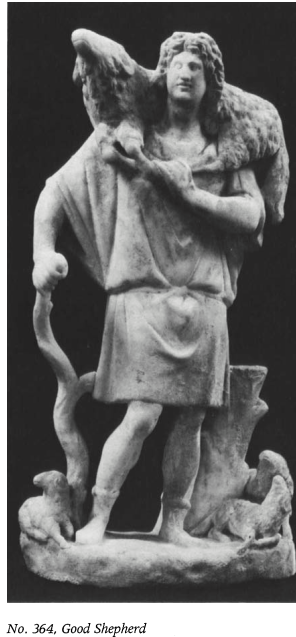
The Good Shepherd (no. 364) is represented as a youth wearing a short, low-waisted, and belted tunic. He stands in contrapposto, with his weight borne by his left leg. His right hand holds the upper end of his heavy walking stick, the other end of which rests on the irregularly modeled ground found in this and three of the Cleveland Jonah sculptures. With his left hand the Good Shepherd holds the four legs of a ram that rests over his shoulders. Three smaller rams rest or stand on the ground. A heavy tree stump strengthens the left leg. The back is summarily cut and unpolished; a shoulder bag hangs against the middle of the back, but neither the bag nor any means of supporting it can be seen at the front. Parallels for many of these features may be seen in criophoros carvings (no. 464) and in marble Good Shepherd statuettes dating from the second to third century in both the eastern and western Mediterranean areas (Wixom, 1967, figs. 22, 52, 53). The head, features, and heavenward gaze may derive, as suggested by Kitzinger, from earlier depictions of Alexander (in Wixom, 1967, p. 88, figs. 41, 42). These elements are also paralleled in Early Christian third-century statuettes and sarcophagi reliefs.
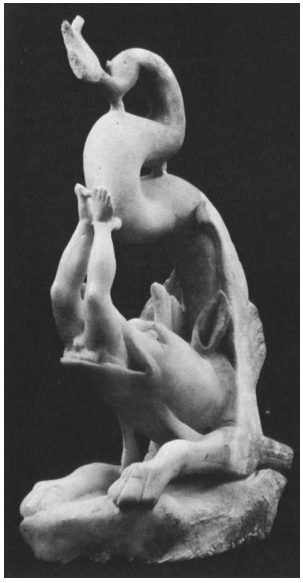
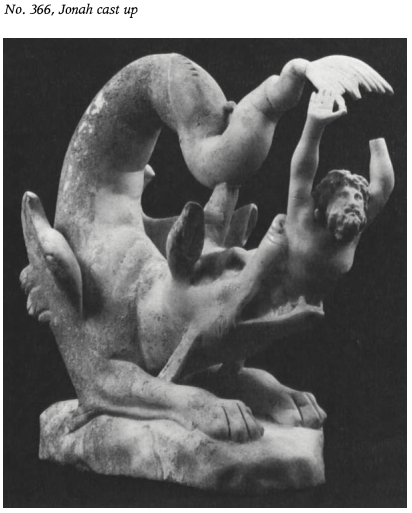
The sculptures of Jonah swallowed (no. 365) and Jonah cast up (no. 366) depict the same type of ketos—with boarlike head, bold, writhing, and winged body, and powerful, leonine paws. Only the legs of Jonah are seen in the first; in the second, Jonah bursts head first out of the monster's mouth, with his arms flung upward. In both cases, Jonah is nude. In his second appearance, he is shown with disheveled hair and full beard. The rear parts of both of these groups are highly finished, suggesting that they may have been meant to be seen in the round. The physiognomic characteristics of the ketos derive from Hellenistic works and may be seen continued in EarlynChristian and Byzantine reliefs up to the sixth century (Wixom, 1967, figs. 39, 40).
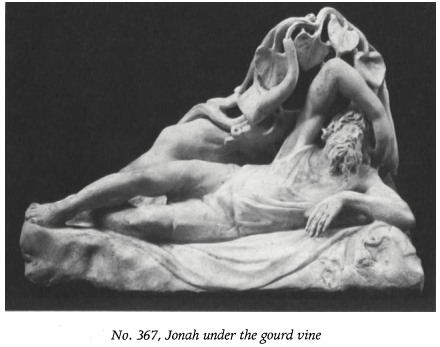
Jonah under the gourd vine (no. 367) is only roughly carved on the back. Clad in a short tunic he reclines languidly on a drapery-covered rocky shelf, beneath an intricate, almost writhing vine. Jonah's physiognomy, beard, and hair resemble those of the Jonah cast up. This sculpture also may be shown to follow such Hellenistic types as river god personifications (Wixom, 1967, figs. 36-38).
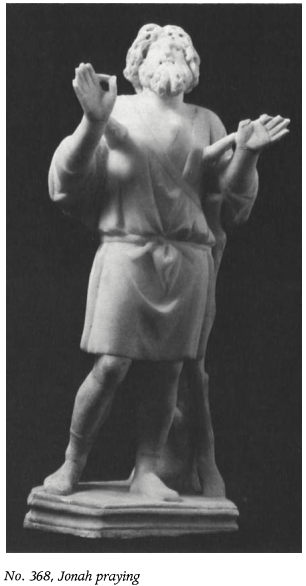
The fifth sculpture, a figure standing with hands upraised and head thrown back, may be identified as Jonah praying (no. 368), from the head type and by comparison with a similar figure in a sardonyx intaglio in Boston (Bonner, 1950, no. 347, ill.). The back is cut like that of the Good Shepherd, with a bag hanging from a diagonal shoulder strap, which here continues from front to back. The figure is carved in one piece with the angularshaped base, which has a molded profile in the front and on the sides. A tree stump behind Jonah's left leg gives the sculpture stability. Kitzinger has compared this imagery with earlier Hellenistic representations of migrant Cynic philosophers, whose short tunics, satchels, and disheveled, bearded physiognomies alluded to a moral superiority (in Wixom, 1967, p. 88e).
Each of the symbolic figures is notable for the skillful, easy rendering of active or arrested movement, in keeping with each subject. The technique in the details of the physiognomies, hair, beards, and drapery has a sure shorthand mastery, authority, and freshness. The sculptor has made a creative selection of some of the most expressive elements from the Hellenistic tradition. These figures demonstrate that this tradition continued uninterrupted in Asia Minor into Roman and Early Christian times.
A general dating of these strongly Hellenized, yet individualized, symbolic figures within the second half of the third century depends on stylistic comparisons, proposed chiefly by Kitzinger, with a series of pre-Constantinian sculptures, the sculptures of Orpheus from the third century, and the series of criophoros bone carvings and marble Good Shepherds dating from the second to third century (in Wixom, 1967, figs. 47-54).
The intended function of the symbolic figures is not known. Their relationship to the busts may be more than a shared material and experience in burial. Three of several hypotheses have proposed a relationship to a funerary, baptismal, or private fountain context.
By its association with the Jonah narrative, the Cleveland Good Shepherd reaffirms a probable Christian significance for many of the previously known marble Early Christian Good Shepherds, which no longer give any evidence of their original contexts.
The discovery of paired busts together with symbolic figures is invaluable. They represent two sculptural modes for two types of subjects, both grounded in established and honored traditions, yet possibly the output of a single workshop. While they lack the impact of many, more imposing Roman imperial portraits, the Cleveland busts embody a personal and intimate impression of the subject, suggesting a sense of introspection. The symbolic figures are notable for their sculptural animation and expressiveness, a rare feature within the body of preserved late Roman and Early Christian sculptures. Compared to the dullness of the several Roman replicas of the Hellenistic river gods, Jonah under the gourd vine offers a feeling of both bodily and spiritual repose. The intensity of the sculptor's vision is especially evident in the sea monster episodes. The Good Shepherd and Jonah praying have an unusual ineffable nobility and monumentality.
The entire group of eleven sculptures, three pairs of male and female bust portraits and five symbolic figures with Early Christian subjects, was acquired in New York in September 1965. An unconfirmed report tells us that they came from the same underground find, a single huge pithos. The shared features—the common material, the similar incrustations and patinas, and a shared general dating made independently for each piece on stylistic grounds—support the theory of a common origin. Stylistic comparisons corroborate suggestions that the sculptures originated from Asia Minor, possibly in ancient Phrygia or to the south. However, the unknown find-site may have been outside this area, a possibility in keeping with ancient commerce and the mobility of workshops and their products.
bibliography: Wixom, 1967, pp. 65-88k, cover ill., figs. 1-9, 11-13, 17-19, 23-32, 34, 38, 43, 57; du Bourguet, 1971, pp. 116, 118, ills. pp. 105, 106, 107, 109, 110; Weitzmann (1), 1972, III, pp. 10-11; Gough, 1973, pp. 39, 206, pis. 36, 37.
Date added: 2026-07-14; views: 170;