
Sculpture group with Jonah scenes
Asia Minor, 1st quarter 4th century Marble. 49.5 x 58.4 x 31.8 cm. New York, The Metropolitan Museum of Art, Gift of John Todd Edgar, 1877, 77.7. Upper part of sculpture with sail is almost completely destroyed, so that present proportions are misleading. Heads and shoulders of three sailors amidship and of Jonah cast out are broken away. The reverse, roughly treated, shows a pillar, now partly broken, which supported the sail. The three- dimensional group and pedestal were carved in one piece.
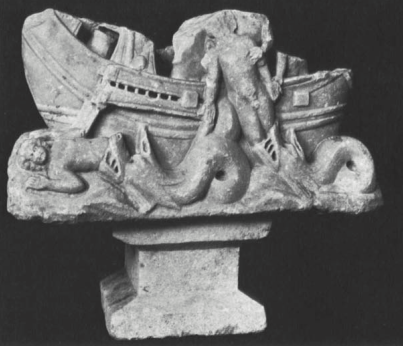
The ship is sailing to the right. Three naked sailors throw Jonah overboard, where he is swallowed by the ketos. To the left, Jonah is cast up by the monster and lies on the ground, his arms raised in the gesture of an orant. Jonah's frontal position is unusual in this scene (Grabar, 1963, p. 46). His face is young and beardless, and his hair frames the head in thick curls. Also rare is Jonah's being swallowed feet first. The iconography has a parallel on a magical amulet (Bonner, 1950, pp. 227-228, fig. 346, pi. xix) and may be influenced by rabbinical tradition telling that the reluctant sailors first dipped Jonah into the water as far as his waist. Another parallel is to be found on a wall mosaic in Tomb M under St. Peter's, dating about 300 (Perler, 1953, pi. ivb).
The figures are stiff, the eyes large and staring, the treatment of hands and hair schematic. A drill is used to mark the corners of eye and mouth. The sea monster is repeated without much variation. In style and iconography, the group differs from the Cleveland marbles (nos. 364-367) and also from the Western Jonah sarcophagi in Rome (no. 361) and Copenhagen (Gerke, 1940, pi. n, fig. 1), suggesting a later date.
The rough treatment of the back indicates that the group was not meant to be seen from the rear. This feature, the pillar support in the back, the shape of the pedestal, and the small size connect the piece with a group of freestanding sculptures from the third and fourth centuries, which treat such mythological subjects as Bellerophon, Orpheus, and Leda and the swan (Mendel, 1914, III, no. 820, and others). They may have been placed in niches in private homes; for the Jonah group, von Schoenebeck (1936) suggests sepulchral use. Among these sculptures, the Jonah group is the only one with nonallegorical, biblical subject matter. Found in Tarsus, Cilicia, in 1876, and acquired by the Metropolitan Museum a year later.
bibliography: Lowrie, 1901, pp. 51-57; Strzygowski, 1903, p. 198; von Schoenebeck, 1936, pp. 332-333; Lowrie, 1947, pp. 8, 84; Grabar, 1963i, p. 46; Wixom, 1967, pp. 88c-88d.
Date added: 2026-07-14; views: 148;