
Plaque with biblical scenes
Place of origin uncertain, about 300-310 Marble. 86.5 x 197 x 2.5 cm. Velletri, Museo Civico, 171. A vertical break runs through the plaque left of the orant, a shorter one at the right of her head. The plaque is cut at the edges and bottom, the original measurements thus having been slightly larger. The entire surface of the relief is rubbed. The back is polished. Traces of polychromy remain, as, for example, on the legs of left shepherd.
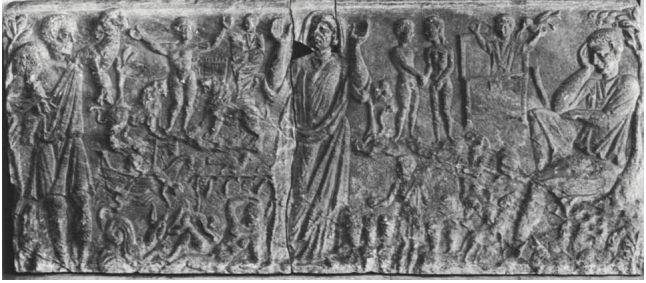
The composition is articulated by three tall figures occupying the height of the relief: at the left, before a tree, a standing shepherd, carrying a sheep on his shoulders; at the right, under a tree, a herdsman with a pensive gesture, resting in the midst of his flock; in the center, an orant with a palla framing the face, who has the individual features of an elderly woman. The spaces between these figures are filled with abbreviated biblical scenes arranged in two registers, suggested by ledges serving as groundlines. In the upper left: Daniel, a nude shaped after a classical model, stands between the lions, with the gesture of an orant. Right of him sits a smaller-scaled, bearded philosopher, reading from an open scroll, a scri- nium filled with rotuli at his side. In the lower left is the Jonah trilogy, condensed because of limited space to the ketos casting Jonah up to the shore, and Jonah resting under the gourd vine in larger scale. In the right section two iconographic unica appear: the Fall of Man—Adam, embracing Eve with his .left hand, joins right hands with her in the dextrarum junctio, the official marriage gesture (Reekmans, 1958, p. 65, "L'union dans le peche”).
The serpent is depicted under, not on, a low “tree." At the right Noah prays in the ark and the dove returns, offering a plant (Kaiser-Minn, 1977, pp. 661 f.). Unique and enigmatic is the scene below: a man wearing boots and tunica exomis stands among seven baskets with food, holding a loaf in each hand. The setting and the baskets recall the Multiplication of the Loaves and Fishes (Matt. 15:34), but the costume of the man is against the rule for the depiction of Christ. Such irregularities confirm the observation that in this period the iconography of biblical scenes was not yet fixed (cf. nos. 372, 373). As the Multiplication of Loaves and Fishes, the scene would be the only one from the New Testament on the plaque. The pictorial program seems not to be based upon a coherent theological concept, except that the theme of salvation is set against that of man's guilt, epitomized in the Fall.
The relief is rather flat. Some parts seem unfinished. Typical for the time is the combination of biblical and idyllic bucolic subjects (no. 361), but no parallel exists to the specific loose arrangement of the scenes and the unusual iconography of some of them.
Found in Velletri, near Rome. First mentioned by Borgia'(1780, pp. 99, 108).
bibliography: Gerke, 1940, p. 339, VII/3, esp. pp. 73-81; Klauser, 1965-1966, pp. 24-25, 53; Giordani, 1972; Dassmann, 1973, pp. 26, 34, 395, 401, 417; Engemann (2), 1973, pp. 19 n. 42, 75, 86; Sotomayor, 1975, pp. 10, 58, 64.
Date added: 2026-07-14; views: 157;